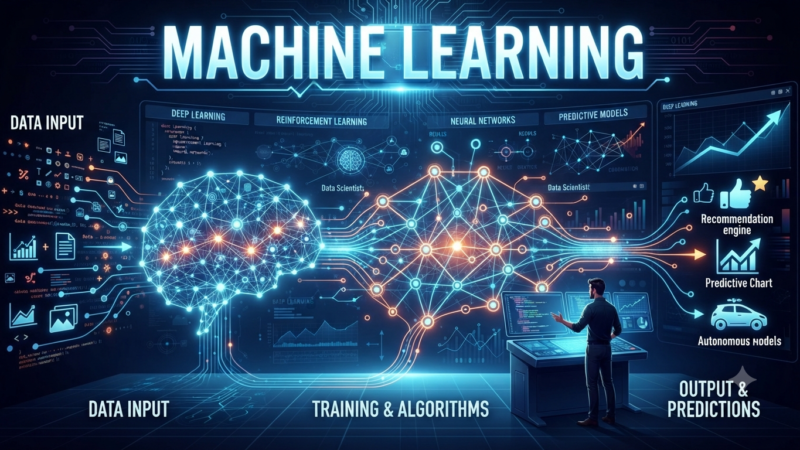
Machine learning has become a key area in modern science and technology. It plays a vital role in many fields, from medicine and finance to transportation and entertainment services. In this article, we’ll explore what machine learning is, the different types of machine learning, how it works, and introduce the main algorithms and application examples.
General overview of machine learning
Machine learning is a field of artificial intelligence that enables computers to learn from data and make predictions or decisions without explicitly programming rules. Machines learn from data, identify patterns, and draw conclusions that they then apply to specific problems.
The Importance and Relevance of Machine Learning in the Modern World
Today, it’s used practically everywhere: from movie recommendations on streaming services to disease diagnosis in medicine. It helps automate routine processes, improve forecasting accuracy, and speed up decision-making. Machine learning is becoming increasingly relevant because data volumes are growing exponentially, and traditional analysis methods can no longer handle them.
Definition of machine learning
Imagine you want to teach a machine to perform a task that was previously done manually. Traditionally, programmers wrote strict instructions, describing every action the program should perform. But what if instead you could simply show the machine examples of how to perform the task, and it would figure out how to proceed? This is exactly what machine learning does.
Machine learning is a technique that enables a computer or program to extract information from data and use it to make decisions without explicitly programming all possible scenarios. Simply put, it’s a process by which a system learns from accumulated experience (i.e., data) and improves its ability to perform specific tasks over time.
For example, imagine you want to create a program that classifies images of animals. Instead of assigning each image a precise rule determining whether it’s a cat or a dog, you feed the system thousands of photos of cats and dogs, labeled with appropriate attributes. The system studies these photos, identifies common features, and creates a model that can correctly classify new images.
This approach differs from traditional programming in that there is no hard-coded set of instructions. Instead, the system itself identifies patterns and draws conclusions based on the data provided to it. The more data it receives, the more accurate its predictions and decisions become.
Machine learning thus enables computers to adapt to changing conditions and improve their performance over time based on experience gained from data.
How does it relate to artificial intelligence?
Machine learning is a subset of artificial intelligence (AI). AI aims to create systems capable of performing tasks that require human intelligence, such as understanding natural language, recognizing patterns, and making decisions. Machine learning provides the tools to realize these capabilities.
Types of machine learning
There are three main types of machine learning: supervised learning, unsupervised learning, and reinforcement learning.
Supervised Learning
This is a type of machine learning where the model is trained on labeled data, meaning the data contains labels indicating the correct answer. An example is image classification, where a machine learns to distinguish between cats and dogs in photographs.
Unsupervised Learning
This type of machine learning involves working with unlabeled data. The model searches for hidden structures and patterns in the data. An example is clustering customers based on their on-site behavior.
Reinforcement Learning
Here, the model learns by interacting with the environment. It is rewarded for correct actions and penalized for incorrect ones. An example would be teaching a robot to walk or drive a car.
How it works
The machine learning process consists of several stages:
| Data preparation | Collecting, cleaning, and transforming data for further use |
| Model training | Applying the selected algorithms to find patterns in the data |
| Model evaluation and testing | Testing the model’s performance on new data |
Basic machine learning algorithms
Let’s look at some popular machine learning algorithms:
Linear regression
The linear regression algorithm is used to predict numerical values based on a linear relationship between variables. An example is predicting real estate prices based on the square footage of a home.
Decision trees
The decision tree algorithm constructs a decision tree that partitions the feature space into regions corresponding to classes. An example is determining the probability of a borrower’s default based on their credit history.
Neural networks
Neural networks mimic the functioning of the human brain, which consists of neurons. They are capable of processing complex nonlinear data and discovering hidden patterns. Examples include speech or image recognition.
Machine learning tools and libraries
- TensorFlow is an open-source numerical computing library created by Google. It is particularly popular for developing and training deep neural networks. TensorFlow supports a variety of architectures, including graphics processing units (GPUs), and has a rich ecosystem of tools and add-ons.
- Scikit-learn: This Python machine learning library focuses on classic machine learning algorithms such as regression, classification, clustering, and dimensionality reduction. It’s easy to use and ideal for beginners and for quickly prototyping models.
- PyTorch: This is another popular deep learning library developed by Facebook. It’s known for its flexibility and ease of use, especially for research and experimentation. PyTorch makes it easy to build and train neural networks and also supports GPU acceleration.
- Keras is a high-level API for creating and training neural networks that runs on top of TensorFlow, Theano, and Microsoft Cognitive Toolkit (CNTK). Keras is known for its simple and intuitive syntax, making it an excellent choice for quickly developing and testing models.
- H2O.ai is a machine learning and data analytics platform designed for working with large volumes of data. It offers a wide range of tools, including support for distributed computing, making it suitable for large corporate projects and scientific research.
Examples of machine learning applications
Machine learning is applied in a wide variety of areas:
- Medicine: diagnosis of diseases, analysis of medical images, prediction of treatment outcomes.
- Financial technologies: credit risk assessment, fraud detection, investment management.
- Transport: control of self-driving cars, optimization of delivery routes.
Machine learning is a powerful tool that is changing the world around us. It opens new horizons in process automation, improving forecast accuracy, and decision-making. By studying and applying machine learning, you can make a significant contribution to the development of modern technologies and improve people’s lives.
Final thoughts on the future of machine learning
Machine learning continues to evolve, and its potential is enormous. In the future, we can expect even greater adoption of machine learning in everyday life, improved accuracy and processing speed, and the emergence of new and exciting applications.
Motivation for studying and applying machine learning in practice
Studying machine learning opens doors to a multitude of career opportunities and enables the creation of innovative products and services. It’s a fascinating and dynamic field that awaits its researchers and innovators.