SQL Interview Questions and Tasks
Today, SQL is one of the most popular languages, actively used in many professions. Analysts in various fields, data engineers, testers, DevOps engineers, and others all face SQL-related interview questions. It’s important not only to understand the theoretical aspects of SQL but also to be able to apply them in practice. But what exactly should candidates expect at different stages of the hiring process?
In this article, we’ll cover typical interview questions, sample SQL tasks, and the specifics of the test, technical, and final interviews.
What stages does a candidate go through?
The hiring process can vary greatly depending on the position and company, but it typically consists of several stages, each aimed at assessing a candidate’s various skills: from a thorough understanding of theoretical foundations to in-depth knowledge and the ability to apply them in practice. Let’s look at the most popular ones.
1. Telephone or online interview (Screening)
Often, the first stage of an interview is a brief phone or online conversation with a recruiter or HR representative. The main goal of this stage is to determine whether your experience and skills match the job requirements.
SQL Questions at this stage:
SQL is typically only briefly touched upon at this stage. You may be asked about your experience working with databases, the types of queries you’ve used, and how often you’ve used SQL in your work. Examples of questions:
- What volume of data do you typically work with?
- Which DBMS do you prefer and why?
- How familiar are you with indexes and their uses?
Sometimes, even at this stage, you may be asked more practical questions, but usually with simple answers that an HR specialist can verify. For example:
- We’re given two tables: the first has only 5 rows, the second has 10. We’re joining them using a LEFT JOIN. What are the minimum and maximum number of rows that can appear in the resulting table?
Answer:
The table can contain from 5 to 50 rows.
2. Technical interview
This stage is typically conducted with the technical lead or another specialist, who dives deeper into your technical background. This is where the main assessment of your SQL knowledge begins and can include both theoretical questions and query writing challenges.
SQL Questions at this stage:
- Explain the difference between INNER JOIN, LEFT JOIN, and FULL OUTER JOIN.
Example answer:
- INNER JOIN : Returns only those records that have matching values in both tables involved in the join. If a record is missing from either table, it will not be included in the result.
- LEFT JOIN : Returns all records from the left table (the one specified first in the query), even if there are no matching records in the right table. If there is no matching record in the right table, NULL values will be returned instead.
- FULL OUTER JOIN : Returns all records from both tables, regardless of whether there are matching records in the other table. If there are no matching records, NULL values are returned for the missing data.
- How does GROUP BY work, and what aggregation functions can be used with it?
Example answer:
GROUP BY : This operator groups rows with identical values in the specified columns into one or more rows. This allows you to apply aggregate functions such as COUNT, SUM, AVG, MAX, MIN, and others to each group of data.
- What is an index in a database, and how does it affect query performance?
Example answer:
- An index is a data structure in a database used to quickly search and access data in a table. Indexes are created on one or more table columns and help speed up queries by reducing the number of rows that need to be scanned.
- Positive impact on performance: Indexes significantly speed up search (SELECT), sort (ORDER BY), and join (JOIN) operations because they allow the database to quickly find the rows it needs.
- Negative impact on performance: However, indexes can slow down INSERT, UPDATE, and DELETE operations because every time an indexed field changes, the index itself must be updated.
- How does COALESCE work, and where can it be used?
Example answer:
- COALESCE takes one or more arguments and returns the first one that is not NULL. If all arguments are NULL, NULL is returned.
- Handling NULL values: COALESCE is often used to supply a default value if a field contains NULL.
- Simplifying complex expressions: COALESCE can be used in complex environments to simplify the handling of multiple possible NULL values in a single expression.
SQL Tasks at this stage:
Depending on the position level, tasks at this stage may involve writing SQL queries of varying levels. You may be asked to solve a problem in real time and explain your logic and approach to the solution. Let’s look at some examples of interview tasks:
Easy task (taken from a real test at Alfa-Bank):
You are given the following table structure:
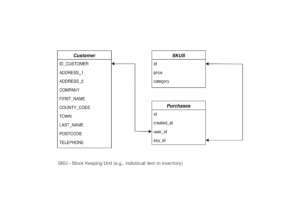
It is necessary to display the number of people who purchased a product with ID = 5 after October 10, 2021 (inclusive).
Answer:
SELECT COUNT(DISTINCT user_id)

FROM purchases

WHERE sku_id = 5

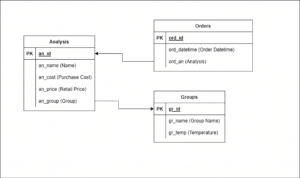
AND created_at >= '2021-10-10'- Average task: You are given the following table structure:
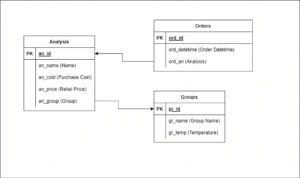
Select the product ID with the highest number of orders, broken down by year.
Answer:
WITH sales AS

(

SELECT TO_CHAR(ord_datetime, 'YYYY') as year, a.an_id, COUNT(DISTINCT o.ord_id) as cnt

FROM Orders o

JOIN Analysis a

ON o.ord_an = a.an_id

GROUP BY TO_CHAR(ord_datetime, 'YYYY'), a.an_id

),

ranks AS

(

SELECT *, RANK() OVER(PARTITION BY year ORDER BY cnt DESC) as rnk

FROM sales

)

SELECT year, an_id, cnt

FROM ranks

WHERE rnk = 1

ORDER BY year, an_id
Complex task (taken from a real test at Alfa-Bank):
You are given the following table structure:
It is necessary to calculate the average cost of the 5th purchase, broken down by city.
Answer:
WITH rn AS (

SELECT *, ROW_NUMBER() OVER(PARTITION BY c.town, c.id_customer ORDER BY p.created_at, p.id) AS rn

FROM purchases p

JOIN skus s

ON p.sku_id = s.id

JOIN customer c

ON p.user_id = c.id_customer

),

filtered_rn AS (

SELECT *

FROM rn

WHERE rn = 5

)

SELECT town, AVG(price) AS avg_price_5th_purchase

FROM filtered_rn

GROUP BY town

ORDER BY avg_price_5th_purchase DESC
3. Test task
This isn’t a mandatory selection step, but after completing the technical interview (and sometimes after the phone interview), candidates may be asked to complete a test task. Typically, this task is more comprehensive than the tasks in the technical interview and may involve data analysis, conclusions, and creating reports based on SQL queries.
SQL Tasks at this stage:
The test assignment often includes more complex tasks requiring multi-level query writing, code optimization, and data analysis. Example assignment:
You are working with tables that represent a standard e-commerce database structure:
- orders (order information):
- order_id: unique order identifier.
- customer_id: customer ID
- order_date: order date
- status: order status
- order_items (information about products in orders):
- order_item_id: unique identifier of the item in the order
- order_id: order ID
- product_id: product identifier
- quantity: quantity of goods
- price: the price per unit of goods
Exercise:
- Write a query that returns all orders containing more than 5 units of the same product type.
- Write a query that returns the total number of products sold and the total revenue for each product for the last month.
- Write a query that returns the percentage of canceled orders compared to the total number of orders over the last three months.
- Write a query to detect potential data problems (e.g. orders without products or products without orders).
4. Final interview
During the final interview stage, candidates typically meet with managers or senior management. While these meetings may not address technical issues, they may discuss previous test results and general problem-solving approaches.
SQL Questions at this stage:
This can include higher-level discussions about how SQL is used within the company, how to optimize database operations, and how you can improve your company’s analytics processes. For example:
- How would you organize the ETL process for our project?
- How do you deal with SQL query performance issues in large databases?
- How do you ensure data integrity when working with transactions?
SQL Tasks at this stage:
Most often, the tasks at this stage will be similar to those you solved during the technical interview.
Conclusion
Now you know exactly which SQL questions and tasks to prepare for your interview. Remember, it’s important not only to understand the theory but also to be able to apply your knowledge in practice, demonstrating an understanding of business objectives and an ability to optimize data processing. You can practice solving SQL problems on our platform – we have SQL and Python tasks of varying levels, including examples from real interviews at top companies!
Explore More IT Terms
#
A
- A Guide to SQL Query Formatting for Beginners
- A/B testing
- Abstract Data Type (ADT)
- AES Encryption Algorithm: How It Works and Where It's Used
- Agile
- Algorithm
- Algorithm Analysis
- Algorithm Complexity
- Algorithm complexity: deep parsing O(log n)
- Algorithm vs. Program
- Algorithms and Data Structures in C#
- An overview of the C # programming language
- An overview of the Python programming language
- Anaconda Python
- Android
- Android App Bundle
- Android SDK
- Angular
- Ansible
- Apache
- Apache Airflow
- Apache Kafka
- Apache Tomcat
- App Store
- AppCode
- Applications of microcontrollers: From simple circuits in electronics to complex systems
- Applications of the derivative
- Arduino: How to Program It: Basics for Beginners
- Array-based stack
- ArrayList
- ASCII
- ASP.NET
- Assembly Language Lessons
B
C
D
- Data Analytics: applications of data analysis in companies
- Data Engineer - Who is it, what does a data engineer do, and an overview of the profession
- Data modeling: what it is, types, and process steps.
- Data preprocessing: a complete guide for beginners and professionals.
- Data structure
- Data Structures and Algorithms (DSA)
- Data types vs. Data structures
- Database Tests with Answers
- Deep Learning
- Defining Aliases
- Defining Arrays
- Deque
- Developing a Website from Scratch
- Differential Equations
- Differentiation of functions
- Digital data: understand the importance of this asset for businesses.
- Double integrals
- Doubly linked lists
- DSA Tutorial
E
F
G
H
- Handling errors and exceptions
- Heads or Tails? How Probability Theory Is Used in IT
- History of the development of computer science
- Homogeneous equations
- Homogeneous vs. non-homogeneous structures
- How to effectively organize your workflow
- How to Learn Java: Tips for Beginner Developers
- How to Learn PHP: A Beginner's Guide
- How to Use S3 Storage in Kubernetes with CSI
- HTML
- HTML and CSS: Definition, Application, and Operating Principles
- HTML and CSS. Layout from Scratch: What to Learn, Where to Learn, and How Long Will It Take?
- HTML Frame Structure
- HTML Link Formatting
I
- if..else construction
- Infinite sequences and series
- Information properties
- Inheritance in Java: A Complete Guide to Principles and Implementation
- Inserting an Image
- Integration of functions
- Interactive Python Tutorial – Learn Programming from Scratch
- Interpreter
- Interview Problem: Finding a Deleted Element in O(N)
- Interview Scare: The FizzBuzz Challenge
- Introduction to C++
- Introduction to Machine Learning
- Introduction to Networking | Network Fundamentals Part 1
- Introduction to Number Systems (Binary, Octal, Hexadecimal) | Math for CS Foundations #1
- IT Specialist Resume (CV)
J
K
L
M
- Machine Learning
- Machine Learning Basic Tool: NumPy
- Machine Learning Basic Tool: Pandas
- Machine Learning Mathematics
- Mathematics for programmers: what is really needed?
- MD5 encryption algorithm: What is it and why is it needed?
- Microcontroller and Microprocessor - what's the difference?
- ML Engineer: Who They Are, What They Do, How Much They Earn, and How to Become a Neural Network Specialist
- Monte Carlo Simulation: How It Works and What It's For
O
P
- PHP lessons
- Private DNS server and its configuration
- Program code
- Programmer's Dictionary
- Programming
- Programming with pseudocode
- Python Code Formatting Guide: PEP8
- Python for data analysis: how to do it and main libraries
- Python Lessons
- Python Superstar: 5 Ways to Use the * Operator
- Python vs. Julia: Should You Replace Python with Julia?
R
S
- SFML Graphics Library Tutorials
- Sorting Algorithms in Programming: Types, Descriptions, and Comparisons
- SQL commands: see what they are, what the main ones are + examples
- SQL Interview Questions and Tasks
- SQL Lessons
- SQL Stored Procedures
- SQL Syntactic Sugar: The COALESCE Function
- Stack
- Start in analytics: Python or R
- Static vs. dynamic data structures
- Statistical analysis: importance for decision making.
- String formatting in Python
- Structure of computer science
- Swift Lessons
- switch/match construct
- Syntax
T
- Terms in programming
- Text and paragraph formatting tags
- The concept of information and its transmission
- The Future of Python: Key Trends and Insights from Global Researc
- The Infrastructure of Code: A Complete Guide to Repositories for Languages, Frameworks, and Compilers
- The pip package manager in Python
- The role of informatization in the development of society
- Transfers
- Tutorials / Articles
- TypeScript: What It Is and Why Developers Need It
W
- What are databases, and why do they need DBMS and SQL?
- What do Linux distributions consist of?
- What is .NET and what is it used for?
- What is a data structure?
- What is a GPU in a computer, in simple terms?
- What is a quantum computer: 100,500 problems in one second
- What Is an Algorithm?
- What is Arduino: How it Works and the Platform's Capabilities
- What is Big Data? Introduction, Types, Characteristics, and Examples
- What is FizzBuzz Challenge?
- What is Golang and what is it used for?
- What is Haskell and what is it used for?
- What is Kotlin and what is it used for?
- What is Linux? The History of Linux
- What is machine learning, and how does it work?
- What is Power BI: everything about the data analytics software
- What is recursion, recursive and iterative process in programming?
- What is the C++ programming language?
- What is the OSI Model: A Complete Explanation of the Seven Layers and Their Role in Networking
- What's the difference between x86 and ARM processors?
- Where to start learning the C programming language?
- Which Linux distribution should you choose? A Linux distribution overview