Mathematics for programmers: what is really needed?
Fear that IT is exclusively for techies discourages many from entering the profession. Mathematics in computer science intimidates many. But is it really necessary? We explore the mathematical knowledge essential for this profession.
Do programmers need mathematics?
Mathematics is a vast field of knowledge. If the question is, “Is there anything in mathematics that a programmer needs to know?” then yes, of course. But if the question is, “Is there anything in mathematics that a programmer doesn’t need to know?” then the answer is also, “Yes, there are plenty.”
The level of mathematical knowledge required directly depends on the field in which you want to work. For example, web developers or developers creating simple apps may find a basic level of mathematics sufficient. However, as they move into more complex and specialized fields, such as data science, machine learning, or computer graphics, the requirements for mathematical training increase.
In programming, it’s often not the mathematics itself that’s important, but rather logical and mathematical thinking, which is greatly developed by studying various branches of mathematics. The ability to think and reason, to arrive at solutions and discard incorrect approaches, to identify boundary and exceptional situations—these are the skills that help programmers achieve success in any development field. Abstract thinking is also an extremely useful complement to general logic. It helps one better perceive complex business models and processes, reproduce them in code, and, of course, better manipulate the abstractions on which all programming languages are built.
The main branches of mathematics that programmers need
School Mathematics – Basic Knowledge of Algebra and Geometry
Arithmetic and algebra are the foundation for many aspects of programming. Programmers use arithmetic operations to add, subtract, multiply, and divide numbers, as well as to solve equations and complex problems. Algebra helps them work with variables, functions, and equations, which is essential for writing code. Geometry and trigonometry help programmers understand and visualize space, angles, and distances. This is especially important for game development, which requires an understanding of how objects move and interact in space.
Mathematical analysis
Mathematical analysis is a branch of mathematics that studies the properties of numbers, functions, and related geometric objects. Mathematical analysis plays an important role in the creation of complex software products.
First, mathematical analysis gives programmers a deep understanding of how quantities change. Derivatives and integrals—the fundamental concepts of mathematical analysis—allow for analyzing and modeling data dynamics, which is especially important in algorithm development and program performance optimization.
Secondly, calculus is a fundamental tool in artificial intelligence and machine learning. Machine learning algorithms based on optimization methods and gradient descent use calculus to find optimal solutions and train models from data.
Third, understanding limits and infinitesimals allows programmers to more deeply understand the structure of algorithms and their complexity. This is especially useful when working with large amounts of data, optimizing code, and solving complex computational problems.
Mathematical analysis is important in the development of graphical applications and computer graphics. Knowledge of differentiation and integration allows programmers to create realistic visual effects, animations, and 3D models. Mathematical analysis also influences the development of encryption and cryptographic algorithms. Methods for analyzing functions and their behavior under infinitely variable variables are becoming important tools in ensuring data security and creating secure software systems.
Discrete mathematics
Discrete mathematics is a branch of mathematics that studies discrete objects, such as sets, graphs, binary relations, and functions. It differs from continuous mathematics in that it studies objects that can be represented as a finite number of elements.
- Discrete mathematics for programmers provides a theoretical foundation for working with various data structures. Sets, graphs, and trees are widely used in the design of databases, search algorithms, and data structures.
- Combinatorial theory, an important part of discrete mathematics, is essential for algorithm optimization. Understanding combinatorial structures and enumeration methods allows us to create optimal algorithms for a variety of problems, from finding paths in graphs to resource allocation.
- The theory of formal languages and automata is used in compilers and programming language development. Understanding formal languages allows programmers to create efficient and reliable compilers, and automata are used in the development of algorithms for string and text processing.
Discrete mathematics is important in cryptography. Number theory and combinatorics are used to develop cryptographic algorithms and encryption systems. The concept of discrete mathematics helps protect data and ensure privacy. Discrete mathematics is an important part of the theory of algorithms. Algorithms for sorting, searching, graph traversal, and many other problems are based on the principles of discrete mathematics.
Linear algebra and geometry
Linear algebra is a branch of mathematics that studies vectors, matrices, linear transformations, and other objects and concepts related to linear equations.
Linear algebra is the foundation for working with multidimensional spaces and matrices. Programmers developing graphics, computer vision, or working with machine learning regularly encounter linear operations, such as matrix multiplication, solving systems of linear equations, and calculating eigenvalues. These operations underlie algorithms for image processing, data filtering, and creating mathematical models.
Machine learning is indispensable without linear algebra. Many algorithms based on linear regression or optimization methods use matrix operations to train models from data. Singular value decomposition and principal component analysis help analyze and extract information from high-dimensional data.
Geometry is essential for developing visual applications and computer graphics. Spatial concepts such as vectors, points, and angles are essential for creating 3D models, animations, and visual effects. Geometric transformations such as translation, rotation, and scaling are used to create realistic visual scenes.
Linear algebra and geometry are used in the development of algorithms and data structures. Vectors and matrices are needed in image processing algorithms, virtual reality, and data analysis. Graphics algorithms, such as Bresenham’s line-drawing algorithm, are based on geometric principles.
Linear algebra and geometry are essential for game development, from creating 3D worlds to controlling the movement of objects in space. Mathematical concepts give programmers the tools they need to develop visually stunning and technically complex game projects.
Mathematical logic
Mathematical logic is a branch of logic that studies methods for proving and justifying mathematical statements. Mathematical logic is needed everywhere—from creating basic conditions in if-else statements to complex database operations. It’s more than just a tool for programmers. It’s the foundation upon which the structure of the entire software world is built.
Initially, mathematical logic manifests itself in the use of conditions that determine the course of program execution. Comparison operators and logical expressions form the basis for decision-making in code. For example, when developing conditions in the if-else statement, the program refers to logical operators such as AND, OR, and NOT. This allows for the creation of flexible and multifunctional algorithms. When working with databases, the SQL query language is an excellent example of how mathematical logic is integrated into the daily work of a programmer. SQL operates on data sets using union, intersection, difference, and filter operators. These are closely related to the concepts of mathematical logic. This allows for efficient extraction of relevant information from databases and the creation of queries that optimally match the logic of business problems.
In the context of algorithms and data structures, mathematical logic plays a critical role. Programmers use logical constructs to create algorithms with branching logic capable of effectively solving various problems. Mathematical logic enables the formalization and abstraction of solutions. Data security is another area where mathematical logic plays a key role. The creation of authentication systems, data encryption, and access control is based on rigorous mathematical principles. The application of logical consistency in processes contributes to the creation of resilient security systems.
Probability theory, mathematical statistics
Probability theory is a branch of mathematics that studies random events and their probabilities.
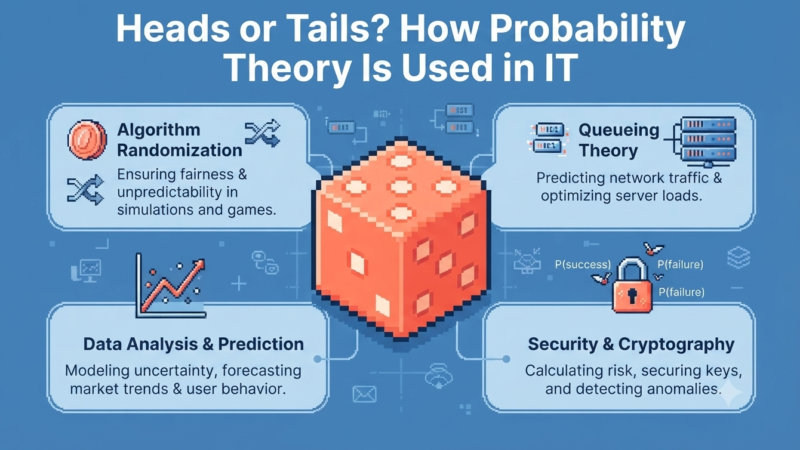
Mathematical statistics is the science of processing and analyzing data using mathematical methods. These areas of mathematics are widely applied in various aspects of programming, providing confidence in decision-making and improving the quality of development.
Where are disciplines needed?
Data processing
Working with large volumes of data requires an understanding of probability distributions, statistical analysis methods, and the correct use of probabilistic models. Programmers involved in data processing or developing machine learning algorithms use probabilistic methods to model and predict various scenarios.
Data-driven decision making
Statistical analysis helps programmers identify patterns, draw conclusions, and make decisions based on objective data. This is critical in data-driven software development, where it is necessary to consider a variety of factors and predict system behavior.
Software testing
Programmers use statistical methods to evaluate program reliability, conduct A/B testing, evaluate performance, and identify potential issues in program code. This allows them to create more stable and efficient programs.
Statistics in machine learning
Programmers who develop machine learning algorithms often use statistical methods to train models from data, analyze their performance, and make decisions based on statistical inference.
Creating reliable security systems
Cybersecurity programmers use statistical methods to analyze network traffic, identify anomalies, and detect potential threats.
If you’ve decided to try your hand at programming, don’t worry about your lack of mathematical training. A high school level of mathematics will likely be sufficient—you can brush up on your knowledge in a few evenings. However, if you decide to delve into more complex areas of programming, such as data science or cryptography, you’ll need to understand more advanced areas of mathematics.
Explore More IT Terms
#
A
- A Guide to SQL Query Formatting
- A/B testing
- Abstract Data Type (ADT)
- AES Encryption Algorithm: How It Works and Where It's Used
- Agile
- Algorithm
- Algorithm Analysis
- Algorithm Complexity
- Algorithm complexity: deep parsing O(log n)
- Algorithm vs. Program
- Algorithms and Data Structures in C#
- An overview of the C # programming language
- An overview of the Python programming language
- Anaconda Python
- Android
- Android App Bundle
- Android SDK
- Angular
- Ansible
- Apache
- Apache Airflow
- Apache Kafka
- Apache Tomcat
- App Store
- AppCode
- Applications of microcontrollers: From simple circuits in electronics to complex systems
- Applications of the derivative
- Arduino: How to Program It: Basics for Beginners
- Array-based stack
- ArrayList
- ASCII
- ASP.NET
- Assembly Language Lessons
B
C
D
- Data Analytics: applications of data analysis in companies
- Data Engineer - Who is it, what does a data engineer do, and an overview of the profession
- Data modeling: what it is, types, and process steps.
- Data preprocessing: a complete guide for beginners and professionals.
- Data structure
- Data Structures and Algorithms (DSA)
- Data types vs. Data structures
- Database Tests with Answers
- Deep Learning
- Defining Aliases
- Defining Arrays
- Deque
- Developing a Website from Scratch
- Differential Equations
- Differentiation of functions
- Digital data: understand the importance of this asset for businesses.
- Double integrals
- Doubly linked lists
- DSA Tutorial
E
F
G
H
- Handling errors and exceptions
- Heads or Tails? How Probability Theory Is Used in IT
- History of the development of computer science
- Homogeneous equations
- Homogeneous vs. non-homogeneous structures
- How to effectively organize your workflow
- How to Learn Java: Tips for Beginner Developers
- How to Learn PHP: A Beginner's Guide
- How to Use S3 Storage in Kubernetes with CSI
- HTML
- HTML and CSS: Definition, Application, and Operating Principles
- HTML and CSS. Layout from Scratch: What to Learn, Where to Learn, and How Long Will It Take?
- HTML Frame Structure
- HTML Link Formatting
I
- if..else construction
- Infinite sequences and series
- Information properties
- Inheritance in Java: A Complete Guide to Principles and Implementation
- Inserting an Image
- Integration of functions
- Interactive Python Tutorial – Learn Programming from Scratch
- Interpreter
- Interview Problem: Finding a Deleted Element in O(N)
- Interview Scare: The FizzBuzz Challenge
- Introduction to C++
- Introduction to Machine Learning
- Introduction to Networking | Network Fundamentals Part 1
- Introduction to Number Systems (Binary, Octal, Hexadecimal) | Math for CS Foundations #1
- IT Specialist Resume (CV)
J
K
L
M
- Machine Learning
- Machine Learning Basic Tool: NumPy
- Machine Learning Basic Tool: Pandas
- Machine Learning Mathematics
- Mathematics for programmers: what is really needed?
- MD5 encryption algorithm: What is it and why is it needed?
- Microcontroller and Microprocessor - what's the difference?
- ML Engineer: Who They Are, What They Do, How Much They Earn, and How to Become a Neural Network Specialist
- Monte Carlo Simulation: How It Works and What It's For
O
P
- PHP lessons
- Private DNS server and its configuration
- Program code
- Programmer's Dictionary
- Programming
- Programming with pseudocode
- Python Code Formatting Guide: PEP8
- Python for data analysis: how to do it and main libraries
- Python Lessons
- Python Superstar: 5 Ways to Use the * Operator
- Python vs. Julia: Should You Replace Python with Julia?
R
S
- SFML Graphics Library Tutorials
- Sorting Algorithms in Programming: Types, Descriptions, and Comparisons
- SQL commands: see what they are, what the main ones are + examples
- SQL Interview Questions and Tasks
- SQL Lessons
- SQL Stored Procedures
- SQL Syntactic Sugar: The COALESCE Function
- Stack
- Start in analytics: Python or R
- Static vs. dynamic data structures
- Statistical analysis: importance for decision making.
- String formatting in Python
- Structure of computer science
- Swift Lessons
- switch/match construct
- Syntax
T
- Terms in programming
- Text and paragraph formatting tags
- The concept of information and its transmission
- The Future of Python: Key Trends and Insights from Global Researc
- The Infrastructure of Code: A Complete Guide to Repositories for Languages, Frameworks, and Compilers
- The pip package manager in Python
- The role of informatization in the development of society
- Transfers
- Tutorials / Articles
- TypeScript: What It Is and Why Developers Need It
W
- What are databases, and why do they need DBMS and SQL?
- What do Linux distributions consist of?
- What is .NET and what is it used for?
- What is a data structure?
- What is a GPU in a computer, in simple terms?
- What is a quantum computer: 100,500 problems in one second
- What Is an Algorithm?
- What is Arduino: How it Works and the Platform's Capabilities
- What is Big Data? Introduction, Types, Characteristics, and Examples
- What is FizzBuzz Challenge?
- What is Golang and what is it used for?
- What is Haskell and what is it used for?
- What is Kotlin and what is it used for?
- What is Linux? The History of Linux
- What is machine learning, and how does it work?
- What is Power BI: everything about the data analytics software
- What is recursion, recursive and iterative process in programming?
- What is the C++ programming language?
- What is the OSI Model: A Complete Explanation of the Seven Layers and Their Role in Networking
- What's the difference between x86 and ARM processors?
- Where to start learning the C programming language?
- Which Linux distribution should you choose? A Linux distribution overview