Structure of computer science
- The Master Framework: Theoretical vs. Applied Computer Science
- Pillar 1: Theoretical Computer Science (The Foundations)
- Pillar 2: Computer Systems and Architecture (The Hardware-Software Interface)
- Pillar 3: Software Engineering (The Craft of Building)
- Pillar 4: Artificial Intelligence & Intelligent Systems (Simulation of Cognition)
- Pillar 5: Networking and Cybersecurity (Connectivity and Protection)
- Pillar 6: Interdisciplinary & Emerging Fields
- Comprehensive Structural Map of Computer Science
- How the Structure of CS Translates to Education and Industry
- The Evolution of the CS Structure: What Lies Ahead?
To the uninitiated, computer science looks like a monolith of code. It is often visualized as a dark room where a programmer types green characters on a black screen, building apps, websites, or games. However, computer science is not merely about writing code. Programming is simply the tool—much like a telescope is to astronomy or a scalpel is to surgery.
At its core, computer science (CS) is the systematic study of computation, information, and automation. It is an incredibly vast, highly structured discipline that bridges abstract mathematical theories with real-world, physical systems.
Understanding the structure of computer science is vital for students, educators, software engineers, and tech leaders. It provides a roadmap for navigating the field, selecting a specialization, or understanding how complex modern systems—from cloud infrastructure to generative AI—operate.
This comprehensive guide dissects the structural architecture of computer science, mapping out its main pillars, subfields, academic pathways, and industry applications.
The Master Framework: Theoretical vs. Applied Computer Science
To understand how computer science is structured, we must first divide it into two primary domains:
- Theoretical Computer Science (TCS): The mathematical and logical foundation of computation. It answers the fundamental questions: What can be computed? How efficiently can it be computed? How do we represent and verify information?
- Applied Computer Science: The engineering and practical implementation of these theories. It answers the question: How do we build robust, secure, and scalable systems to solve human problems?
This division is similar to physics. Theoretical physics develops the mathematical models of the universe, while applied physics and engineering use those models to build bridges, rockets, and microchips.
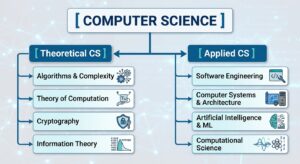
Below, we explore the core pillars that make up these two domains.
Pillar 1: Theoretical Computer Science (The Foundations)
Theoretical computer science provides the mathematical bedrock. Without these theories, modern software would be slow, insecure, and incapable of handling complex data.
1. Algorithms and Data Structures
An algorithm is a step-by-step procedure for solving a problem. A data structure is a specialized format for organizing, processing, and storing data.
- Key Focus: How do we organize data (e.g., arrays, linked lists, trees, graphs) so we can run algorithms on it as fast as possible with the least amount of memory?
- Real-World Impact: Search engines like Google use sophisticated graph algorithms (like PageRank) to index the web. Navigation apps use Dijkstra’s algorithm or A* search to find the fastest route.
2. Theory of Computation
This subfield explores the capabilities and limitations of computers. It is divided into:
- Automata Theory: The study of abstract mathematical machines (like finite automata or Turing machines) and the languages they can recognize.
- Computability Theory: What can actually be solved by a computer? (e.g., the famous Halting Problem, which proves some problems are mathematically impossible to solve with a program).
- Computational Complexity Theory: Classifying problems based on how difficult they are to solve in terms of time (steps) and space (memory). This is where the famous P vs. NP question resides—one of the Millennium Prize Problems in mathematics.
3. Cryptography and Coding Theory
Historically a branch of mathematics, cryptography is now central to CS.
- Cryptography: The study of hiding information and securing communications against adversaries. It relies heavily on number theory.
- Coding Theory: The study of how to transmit data accurately over noisy communication channels (error-correcting codes) and compress data (information theory).
4. Programming Language Theory (PLT)
PLT deals with the design, implementation, analysis, characterization, and classification of programming languages. It studies how we translate human-readable code into machine-executable instructions using compilers and interpreters.
Pillar 2: Computer Systems and Architecture (The Hardware-Software Interface)
While theoretical CS deals with abstract concepts, computer systems research focuses on the physical machines that execute these concepts. This pillar bridges the gap between hardware engineering and software development.
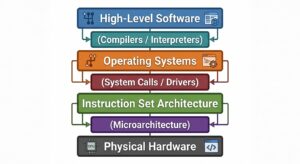
1. Computer Organization and Architecture
This field is concerned with designing the physical components of computers and how they interact.
- Microarchitecture: Designing Central Processing Units (CPUs), Graphics Processing Units (GPUs), register files, and cache hierarchies (L1, L2, L3).
- Instruction Set Architecture (ISA): The interface between hardware and software (e.g., x86, ARM, RISC-V). It defines the machine language instructions that a processor can execute.
2. Operating Systems (OS)
An operating system is the master program that manages computer hardware and provides common services for software applications.
- Core Concepts: Kernel design, process scheduling, memory management (virtual memory), file systems, and input/output (I/O) device communication.
- Examples of Study: Linux kernel architecture, Windows NT subsystem, virtualization, and hypervisors.
3. Distributed Systems & Cloud Computing
Modern systems rarely run on a single machine. Distributed systems study how multiple independent computers coordinate and communicate over networks to appear as a single coherent system.
- Core Challenges: Consensus algorithms (e.g., Paxos, Raft), data replication, fault tolerance, and absolute scalability.
- Examples: Amazon Web Services (AWS), Google Cloud Platform, decentralized blockchain networks, and microservice architectures.
4. Database Systems
How do we store, retrieve, and manage massive volumes of data efficiently, reliably, and concurrently?
- Subfields: Relational Databases (SQL), NoSQL databases (document, key-value, graph), query optimization, and transaction processing (ensuring ACID properties).
Pillar 3: Software Engineering (The Craft of Building)
Software engineering is the application of systematic, disciplined, and quantifiable approaches to the development, operation, and maintenance of software.
1. Software Development Lifecycle (SDLC)
Software engineering studies methodologies for managing software projects from conception to retirement. This includes Agile, Scrum, DevOps, and Continuous Integration/Continuous Deployment (CI/CD) pipelines.
2. Software Architecture and Design Patterns
How do we structure a software system so that it is maintainable, testable, and extensible? Developers use architectural patterns (like MVC, Microservices, and Event-Driven Architecture) and design patterns (like Singleton, Factory, and Observer) to build clean, maintainable codebases.
3. Verification, Testing, and Quality Assurance
This area deals with verifying that software behaves as intended. It ranges from manual and automated testing (unit, integration, and end-to-end tests) to formal mathematical verification, where code is proven correct like a math theorem.
Pillar 4: Artificial Intelligence & Intelligent Systems (Simulation of Cognition)
Artificial Intelligence (AI) has transitioned from an experimental branch of computer science to one of its most dominant, transformative pillars. It is dedicated to creating systems capable of performing tasks that typically require human intelligence.
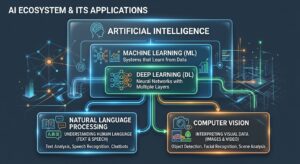
1. Machine Learning (ML) and Deep Learning (DL)
Instead of writing explicit rules to solve a problem, machine learning trains algorithms on massive datasets to recognize patterns and make predictions.
- Supervised Learning: Classification and regression using labeled data.
- Unsupervised Learning: Clustering and dimensionality reduction.
- Reinforcement Learning: Training agents via systems of rewards and punishments.
- Deep Learning: Using multi-layered artificial neural networks (inspired by human brains) to process complex data formats like images and text.
2. Natural Language Processing (NLP)
The study of how computers understand, interpret, and generate human language.
- Applications: Machine translation, sentiment analysis, chatbots, and Large Language Models (LLMs) like GPT-4.
3. Computer Vision
Giving computers the ability to “see” and interpret visual information from the world, such as digital images and videos.
- Applications: Facial recognition, object detection, medical image analysis, and autonomous vehicles.
4. Robotics
The intersection of computer science, electrical engineering, and mechanical engineering. Computer scientists write the control loops, path-planning algorithms, and environmental perception software that allow physical robots to navigate and interact with their environments.
Pillar 5: Networking and Cybersecurity (Connectivity and Protection)
As computers became interconnected, the need to transport data reliably and protect it from malicious actors became critical.
1. Computer Networks
This field studies how digital devices share resources and data.
- Key Concepts: The OSI Model, the TCP/IP protocol suite, routing algorithms, wireless communication, and software-defined networking (SDN).
2. Cybersecurity
The practice of protecting computers, servers, mobile devices, electronic systems, networks, and data from malicious attacks.
- Subfields: Network security, application security, cloud security, penetration testing (ethical hacking), and threat intelligence.
Pillar 6: Interdisciplinary & Emerging Fields
Computer science does not exist in a vacuum; it constantly intersects with other scientific and artistic disciplines.
1. Human-Computer Interaction (HCI)
HCI merges computer science with cognitive psychology and design. It studies how humans interact with technology and works to design user interfaces (UI) and user experiences (UX) that are intuitive and accessible.
2. Computational Science
Using computer simulation, modeling, and data analysis to solve complex scientific challenges in other fields.
- Bioinformatics: Analyzing biological data, such as genomic sequences.
- Computational Chemistry & Physics: Simulating molecular behaviors or cosmological phenomena.
3. Quantum Computing
An emerging frontier that combines quantum mechanics with computer science. Quantum computers use qubits (which can exist in multiple states simultaneously via superposition) rather than classical binary bits (0 or 1). This allows them to solve specific computational problems—like factoring massive numbers or simulating molecular bonds—exponentially faster than classical computers.
Comprehensive Structural Map of Computer Science
The following table summarizes the structural organization of computer science, highlighting key subfields, core targets, and the tools or concepts defining each area.
| Core Pillar | Subfield / Discipline | Primary Scientific Target | Essential Technologies & Concepts |
|---|---|---|---|
| Theoretical CS | Algorithms & Data Structures | Computational efficiency and memory optimization | Big O Notation, Sorting, Graphs, Hash Tables |
| Theory of Computation | Mathematical boundaries of what can be calculated | Turing Machines, P vs NP, Finite State Automata | |
| Programming Language Theory | Formal translation of human intent to machine code | Compilers, Type Theory, Static Analysis, Abstract Syntax Trees | |
| Systems & Architecture | Computer Architecture | Engineering physical compute nodes and microchips | CPUs, GPUs, RISC-V, Cache Coherency, Pipelining |
| Operating Systems | Low-level hardware resource orchestration | Kernels, POSIX, Processes, Threads, Memory Scheduling | |
| Distributed Systems | Coordinating multiple independent machines | Raft Consensus, gRPC, Microservices, CAP Theorem | |
| Software Engineering | Software Design | Scalable, clean, and maintainable code bases | OOP, Functional Programming, CI/CD, Design Patterns |
| Verification & Testing | Verification of program correctness | Unit Testing, Formal Verification, Static Code Analysis | |
| Intelligence & Data | Machine & Deep Learning | Statistical pattern recognition and modeling | Neural Networks, PyTorch, Linear Algebra, Backpropagation |
| NLP & Vision | Interaction with unstructured human media (text/images) | Transformers, CNNs, Image Segmentation, Tokenization | |
| Networks & Security | Computer Networks | Secure, reliable global communication protocols | IP Routing, TCP/IP Stack, DNS, DNSSEC, BGP |
| Cybersecurity | Protection of computational infrastructure and data | Cryptographic keys, Zero Trust, Firewalls, Threat Modeling | |
| Interdisciplinary | HCI | Optimizing human-machine collaboration | UI/UX Design, Heuristic Evaluation, Accessibility |
| Quantum Computing | Computing utilizing quantum mechanics | Qubits, Superposition, Entanglement, Shor’s Algorithm |
How the Structure of CS Translates to Education and Industry
Understanding the theoretical structure of computer science is valuable, but how does this structure map to academic curricula and industry roles?
1. The Academic Structure (Computer Science Curriculum)
If you study computer science at a university level, the curriculum is structured to guide you from foundational abstractions to highly specialized applied fields.
- Year 1: Foundations. Focuses on basic programming syntax, foundational mathematics (calculus and discrete mathematics), and introductory computational thinking.
- Year 2: Core Infrastructure. Students dive deep into algorithms, data structures, computer organization, assembly language, and basic software engineering principles.
- Year 3: Low-Level and High-Level Systems. Core courses include operating systems, compiler design, database management systems, and introductory networking.
- Year 4: Specialization & Capstone. Students choose electives based on their career goals: machine learning theory, cybersecurity protocols, computer graphics, or advanced software engineering.
2. The Industry Structure (Career Paths)
In the corporate world, the theoretical structural pillars of CS are translated into specialized professional roles:
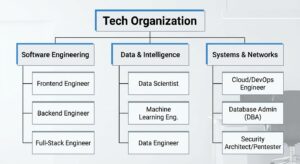
- The Application Layer (Software Engineering): Software engineers use tools built on applied computer science to create user-facing products. This includes Frontend Engineers (HCI focus), Backend Engineers (Systems and DB focus), and Mobile Developers.
- The Infrastructure Layer (Systems and Networks): Systems engineers, DevOps engineers, and Site Reliability Engineers (SREs) ensure that hardware virtualization, cloud infrastructure, and distributed servers run continuously and efficiently.
- The Intelligence & Data Layer (Data Science & ML): Machine learning engineers and data scientists analyze massive datasets, build models, and integrate predictive intelligence into software products.
- The Protection Layer (Cybersecurity): Security analysts, penetration testers, and security engineers implement advanced cryptography, run network security Audits, and defend against active cyber threats.
The Evolution of the CS Structure: What Lies Ahead?
The structure of computer science is not static. It has radically evolved since the mid-20th century, when computers were massive machines operated by punch cards, and it continues to pivot today.
We are currently witnessing a structural convergence. Areas that were once isolated are merging:
- Hardware and Software Co-design: With the physical limits of microchips reaching their physical boundary (the slowdown of Moore’s Law), software developers can no longer rely on hardware simply getting faster every year. The structure of software is now being optimized in tandem with specialized hardware (like TPUs and ASICs designed specifically for AI workloads).
- Neuromorphic Computing: Computational systems are being structured to mimic the neural networks of the biological brain on a hardware level, blending neuroscience, computer architecture, and cognitive science.
- Distributed Trust and Decentralized Web Systems: The emergence of decentralized cryptographic ledgers (blockchains) is restructuring how we view database systems, security, and networked consensus.
Regardless of how complex or advanced technology becomes, its core structure remains anchored to its foundational roots. Every modern breakthrough—from the sophisticated code running generative AI tools to the distributed microservices powering global streaming platforms—is built on the timeless principles of algorithms, computer systems, and mathematical logic. By understanding this structure, we demystify the technology of today and prepare ourselves to design the innovations of tomorrow.
Explore More IT Terms
#
- Using an integrating factor
- Equations in total differentials
- Bernoulli's equation
- Linear differential equations of the first order
- 10 Mixed C++ Challenges to Test Your Skills
- 11 Tricky Non-Technical Questions to Ask in a Recruiting Interview
- 50 Terms Every Programmer Should Know
- 52 Java Thread Interview Questions
- 7 Levels of Using the Zip Function in Python
- 7 Python Code Bugs You Need to Fix
- 70+ Free Resources for Learning Programming
A
- A Comprehensive Guide to HTML and CSS
- A Comprehensive Guide to MODX CMS
- A computer science question tests your ability to work with IP addresses and network masks
- A Guide to SQL Query Formatting for Beginners
- A/B testing
- Abstract Data Type (ADT)
- AES Encryption Algorithm: How It Works and Where It's Used
- Agile
- Algorithm
- Algorithm Analysis
- Algorithm Complexity-Key Points
- Algorithm complexity: deep parsing O(log n)
- Algorithm vs. Program
- Algorithms and Data Structures in C#
- An overview of the C # programming language
- An overview of the Python programming language
- Anaconda Python
- Analysis of graphs and adjacency matrices question
- Android
- Android App Bundle
- Android SDK
- Angular
- Ansible
- Apache
- Apache Airflow
- Apache Kafka
- Apache Tomcat
- App Store
- AppCode
- Applications of microcontrollers: From simple circuits in electronics to complex systems
- Applications of the derivative
- Arduino: How to Program It: Basics for Beginners
- Array-based stack
- ArrayList
- ASCII
- ASP.NET
- Assembly Language Lessons
B
C
- C++ Lessons
- Cache
- Calculating Memory Capacity
- Character sets and encodings
- Characteristics of a good Algorithm
- Circular singly linked list
- Coding Tests with Answers
- Combinational Circuits Solved Questions
- Compiler
- Complexity of algorithms-Tutorial
- Computer Science Fundamentals Test with Answers (47 questions)
- Computer science tests with answers (More than 100 Questions)
- Constants
- Creating a Table in HTML
- Creating Forms in HTML
- Creating Lists
- Cybernetics and informatics
- Cycles
D
- Data Analytics: applications of data analysis in companies
- Data Engineer - Who is it, what does a data engineer do, and an overview of the profession
- Data modeling: what it is, types, and process steps.
- Data preprocessing: a complete guide for beginners and professionals.
- Data structure
- Data Structures and Algorithms (DSA)
- Data types vs. Data structures
- Database Tests with Answers
- Deep Learning
- Defining Aliases
- Defining Arrays
- Deque
- Detailed articles and tutorials on PHP
- Developing a Website from Scratch
- Differential Equations
- Differentiation of functions
- Digital data: understand the importance of this asset for businesses.
- Double integrals
- Doubly linked lists
- DSA Tutorial
E
F
G
H
- Handling errors and exceptions
- Heads or Tails? How Probability Theory Is Used in IT
- History of the development of computer science
- Homogeneous equations
- Homogeneous vs. non-homogeneous structures
- How to convert numbers between binary, octal, and hexadecimal number systems
- How to effectively organize your workflow
- How to Learn Java: Tips for Beginner Developers
- How to Learn PHP: A Beginner's Guide
- How to Use S3 Storage in Kubernetes with CSI
- HTML
- HTML and CSS: Definition, Application, and Operating Principles
- HTML and CSS. Layout from Scratch: What to Learn, Where to Learn, and How Long Will It Take?
- HTML Frame Structure
- HTML Link Formatting
- HTML Quizzes with Answers
I
- if..else construction
- Infinite sequences and series
- Information properties
- Inheritance in Java: A Complete Guide to Principles and Implementation
- Inserting an Image
- Integration of functions
- Interactive Python Tutorial – Learn Programming from Scratch
- Interpreter
- Interview Problem: Finding a Deleted Element in O(N)
- Interview Scare: The FizzBuzz Challenge
- Introduction to C++
- Introduction to Machine Learning
- Introduction to Machine Learning with Python
- Introduction to Networking | Network Fundamentals Part 1
- Introduction to Number Systems (Binary, Octal, Hexadecimal) | Math for CS Foundations #1
- IT Specialist Resume (CV)
J
K
L
M
- Machine Learning
- Machine Learning Basic Tool: NumPy
- Machine Learning Basic Tool: Pandas
- Machine Learning Basics
- Machine Learning Mathematics
- Machine Learning with Python
- Mathematics for programmers: what is really needed?
- MD5 encryption algorithm: What is it and why is it needed?
- Microcontroller and Microprocessor - what's the difference?
- ML Engineer: Who They Are, What They Do, How Much They Earn, and How to Become a Neural Network Specialist
- Monte Carlo Simulation: How It Works and What It's For
O
P
- PHP lessons
- Private DNS server and its configuration
- Program code
- Programmer's Dictionary
- Programming
- Programming with pseudocode
- Python Code Formatting Guide: PEP8
- Python for data analysis: how to do it and main libraries
- Python Lessons
- Python Superstar: 5 Ways to Use the * Operator
- Python vs. Julia: Should You Replace Python with Julia?
Q
R
S
- Setting up model parameters
- SFML Graphics Library Tutorials
- Sorting Algorithms in Programming: Types, Descriptions, and Comparisons
- SQL commands: see what they are, what the main ones are + examples
- SQL Interview Questions and Tasks
- SQL Lessons
- SQL Stored Procedures
- SQL Syntactic Sugar: The COALESCE Function
- Stack
- Start in analytics: Python or R
- Static vs. dynamic data structures
- Statistical analysis: importance for decision making.
- String formatting in Python
- Structure of computer science
- Supervised learning
- Swift Lessons
- switch/match construct
- Syntax
T
- Terms in programming
- Text and paragraph formatting tags
- The Complete Guide to Bootstrap
- The Complete Guide to JavaScript
- The concept of information and its transmission
- The Future of Python: Key Trends and Insights from Global Researc
- The Infrastructure of Code: A Complete Guide to Repositories for Languages, Frameworks, and Compilers
- The pip package manager in Python
- The role of informatization in the development of society
- Transfers
- Tricky Java Questions Often Asked in Interviews
- Tutorials / Articles
- TypeScript: What It Is and Why Developers Need It
W
- What are databases, and why do they need DBMS and SQL?
- What do Linux distributions consist of?
- What is .NET and what is it used for?
- What is a data structure?
- What is a GPU in a computer, in simple terms?
- What is a quantum computer: 100,500 problems in one second
- What Is an Algorithm?
- What is Arduino: How it Works and the Platform's Capabilities
- What is Big Data? Introduction, Types, Characteristics, and Examples
- What is FizzBuzz Challenge?
- What is Golang and what is it used for?
- What is Haskell and what is it used for?
- What is Kotlin and what is it used for?
- What is Linux? The History of Linux
- What is machine learning, and how does it work?
- What is Power BI: everything about the data analytics software
- What is recursion, recursive and iterative process in programming?
- What is the C++ programming language?
- What is the OSI Model: A Complete Explanation of the Seven Layers and Their Role in Networking
- What's the difference between x86 and ARM processors?
- Where to start learning the C programming language?
- Which Linux distribution should you choose? A Linux distribution overview