50 Terms Every Programmer Should Know
We’ve compiled a list of 50 terms for aspiring programmers and explained what each one means to ease their entry into the profession.
Are you a beginner programmer, but your colleagues speak a language you don’t understand during breaks at the water cooler? Or maybe you’re just getting interested in programming, but find reading guides and documentation incredibly difficult?
Fear not, we’ve compiled a list of 50 terms for beginner programmers and explained what each one means to make it easier for you to get started with programming.
Terms for Beginner Programmers
Here is a list of 50 terms and explanations that every aspiring programmer should be familiar with.
1. Variable
This is an identifier used to store values in computer memory. The programmer can assign and change the values of variables.
2. Function
This is a block of code that performs a specific operation. Functions can be called and used in different parts of a program.
3. Conditional Statement
This is a construct used by programmers to perform different operations depending on conditions. An example would be the “if-else” statement.
4. Loop
This is a construct that allows a program to execute a specific block of code repeatedly. Loops can be controlled or infinite, depending on the task.
5. Array
This is a data structure that allows you to store multiple elements of the same type. Array elements can be accessed by index.
6. Class
This is a template or description for creating objects. A class defines the properties and methods that can be used by objects of that class.
7. Object
It is an instance of a class that has its own property values and can call methods defined in the class.
8. Interface
This is a contract that defines the set of methods a class must implement. Interfaces allow for standardized interactions.
9. Recursion
This is the process of a function calling itself. Recursion can be useful for solving problems that can be broken down into simpler subproblems.
10. Stack
It’s a last-in-first-out (LIFO) data structure. Elements are added and removed from only one end of the stack.
11. Queue
It’s a first-in, first-out (FIFO) data structure. Elements are added to the end of the queue and retrieved from the beginning.
12. Recursive Algorithm
This is an algorithm that uses recursion to solve a problem. For example, tree traversal algorithms often use recursive calls.
13. SQL (Structured Query Language)
It is a programming language used to manage and manipulate relational databases.
14. API (Application Programming Interface)
It is an interface provided by software to interact with other programs or components.
15. GIT
It is a distributed version control system used to track changes in a code base and manage collaborative development.
16. IDE (Integrated Development Environment)
It is software that makes it easier to develop, debug, and test programs.
17. Debugging
This is the process of investigating and correcting errors in software code. Debugging may involve the use of specialized tools to find and fix errors.
18. Algorithm
Algorithms are a sequence of steps performed to solve a problem or perform a specific operation. Algorithms are used to solve various programming problems.
19. Exception
An object that represents an error or unusual situation that occurs during program execution. Exceptions allow a program to handle errors and make it more robust.
20. Database
It’s an organized data repository where information is stored and managed. Databases are used to efficiently store and retrieve information.
21. Index
It is a data structure that organizes values in a database to speed up searching and retrieving data.
22. Asynchronous Programming
This is an approach to writing programs where tasks are executed in parallel and independently. Asynchronous programming allows for the creation of responsive and efficient applications.
23. Thread
This is a separate execution path within a program. Threads allow multiple tasks to be executed in parallel and improve overall application performance.
24. Distributed Systems
These are systems in which computer resources and tasks are distributed across multiple computers or network nodes. Distributed systems allow for increased scalability and fault tolerance of applications.
25. REST (Representational State Transfer)
It is an architectural style for developing web services that uses standard HTTP protocols to exchange data between a client and a server.
26. MVC (Model-View-Controller)
This is a software architecture pattern that divides an application into three main components: model, view, and controller. MVC improves code structure and simplifies application development.
27. Hashing
Hashing is the process of converting fixed-length data into a fixed-size hash value. Hashing is used to uniquely identify data and for fast retrieval.
28. Bitwise Operations
These are operations performed on individual bits of numbers. Bitwise operations are useful for manipulating flags and bit fields.
29. Docker
Docker is a platform that allows you to package and run applications in isolated containers. It simplifies application deployment and scaling.
30. Refactoring
It is the process of changing the structure and organization of code to make it more understandable, maintainable, and efficient, without changing its functionality.
31. Memory Management
This is the process of managing the allocation and deallocation of memory during program execution. Memory management is important for efficient resource use and preventing memory leaks.
32. Deserialization
Deserialization is the process of converting serialized data back to its original format. Deserialization is used to reconstruct objects from data stored or transmitted over the network.
33. Regular Expressions
These are sequences of characters that define a pattern for searching and matching text. Regular expressions are widely used to process and analyze string data.
34. Sorting
This is the process of arranging elements in a given order. There are many sorting algorithms, such as bubble sort, insertion sort, and quicksort.
35. Design Pattern
This is a repeatable solution to a common problem in software development. Design patterns help create flexible, extensible, and readable code.
36. NoSQL
This is an approach to storing and processing data that doesn’t rely on traditional relational databases. NoSQL databases offer a flexible data schema and scalability for working with large volumes of information.
37. OOP (Object-Oriented Programming)
It’s a programming methodology in which programs are structured around objects that represent real-world or abstract entities. OOP allows for the creation of modular, reusable, and extensible code.
38. JSON (JavaScript Object Notation)
JSON is a data exchange format based on JavaScript syntax. JSON is often used to transfer data between client-side and server-side applications.
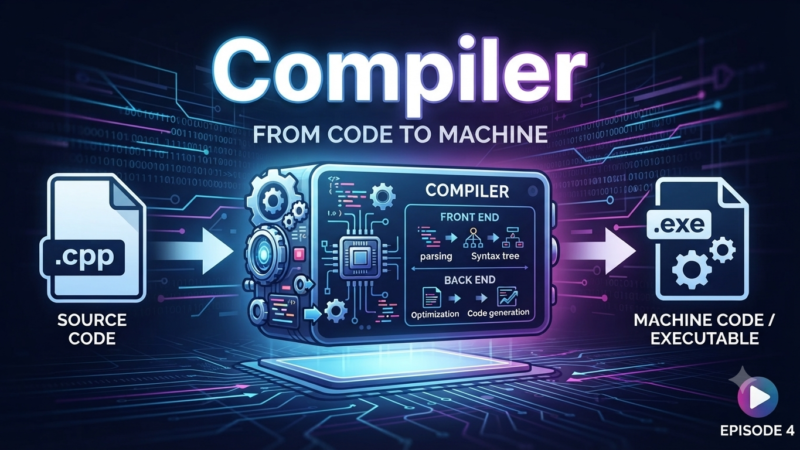
39. Compilation
This is the process of converting a program’s source code into machine code that can be executed by a computer. Compilation is usually performed before the program is run.
40. Virtualization
This is a technology that allows multiple operating systems or applications to run on a single computer or server. Virtualization improves resource efficiency and simplifies system management.
41. Cryptography
This is a field of science that deals with information security through encryption and decryption. Cryptography is used, for example, to ensure network security or data protection.
42. Emulation
Emulation is the process of creating software or hardware that simulates the behavior of another device or program. Emulation allows programs or games to run on different platforms.
43. CDN (Content Delivery Network)
A CDN is a network of servers located around the world to speed up content delivery to users. A CDN reduces latency and improves performance when working with websites or applications.
44. Deadlock
This is a situation where two or more program threads block each other and cannot continue execution. Deadlocks can lead to program freezing and incorrect operation.
45. Unit Test
This is the process of testing individual modules or functions in a program to ensure their correct operation. Unit tests are an important part of the software development process.
46. Big O notation
It’s a way to evaluate the performance of algorithms in terms of execution time and resource usage. Big O notation helps programmers analyze and compare the efficiency of algorithms.
47. Multithreading
This is a program’s ability to execute multiple threads in parallel. Multithreading improves performance by allowing parallel tasks to be executed.
48. SIMD (Single Instruction, Multiple Data)
SIMD is a parallel data processing technique that allows a single instruction to be executed on multiple data elements simultaneously. SIMD is used to accelerate computations such as image and audio processing.
49. ORM (Object-Relational Mapping)
It is a programming technique that provides automatic mapping and interaction between object-oriented code and a relational database.
50. Encapsulation
This is a principle of object-oriented programming that groups data and methods that operate on that data within a class. Encapsulation ensures controlled access and data hiding.
Conclusion
In this article, we tried to select the most basic terms, without touching on complex ones.
If we’ve forgotten a concept that even a beginner should know, or if we’ve explained something incorrectly from this list, please let us know in the comments.
We hope that after reading this article, the world of programming has become a little clearer for you.
Explore More IT Terms
#
- Using an integrating factor
- Equations in total differentials
- Bernoulli's equation
- Linear differential equations of the first order
- 10 Mixed C++ Challenges to Test Your Skills
- 11 Tricky Non-Technical Questions to Ask in a Recruiting Interview
- 50 Terms Every Programmer Should Know
- 52 Java Thread Interview Questions
- 7 Levels of Using the Zip Function in Python
- 7 Python Code Bugs You Need to Fix
- 70+ Free Resources for Learning Programming
A
- A Comprehensive Guide to HTML and CSS
- A Comprehensive Guide to MODX CMS
- A computer science question tests your ability to work with IP addresses and network masks
- A Guide to SQL Query Formatting for Beginners
- A/B testing
- Abstract Data Type (ADT)
- AES Encryption Algorithm: How It Works and Where It's Used
- Agile
- Algorithm
- Algorithm Analysis
- Algorithm Complexity-Key Points
- Algorithm complexity: deep parsing O(log n)
- Algorithm vs. Program
- Algorithms and Data Structures in C#
- An overview of the C # programming language
- An overview of the Python programming language
- Anaconda Python
- Analysis of graphs and adjacency matrices question
- Android
- Android App Bundle
- Android SDK
- Angular
- Ansible
- Apache
- Apache Airflow
- Apache Kafka
- Apache Tomcat
- App Store
- AppCode
- Applications of microcontrollers: From simple circuits in electronics to complex systems
- Applications of the derivative
- Arduino: How to Program It: Basics for Beginners
- Array-based stack
- ArrayList
- ASCII
- ASP.NET
- Assembly Language Lessons
B
C
- C++ Lessons
- Cache
- Calculating Memory Capacity
- Character sets and encodings
- Characteristics of a good Algorithm
- Circular singly linked list
- Coding Tests with Answers
- Combinational Circuits Solved Questions
- Compiler
- Complexity of algorithms-Tutorial
- Computer Science Fundamentals Test with Answers (47 questions)
- Computer science tests with answers (More than 100 Questions)
- Constants
- Creating a Table in HTML
- Creating Forms in HTML
- Creating Lists
- Cybernetics and informatics
- Cycles
D
- Data Analytics: applications of data analysis in companies
- Data Engineer - Who is it, what does a data engineer do, and an overview of the profession
- Data modeling: what it is, types, and process steps.
- Data preprocessing: a complete guide for beginners and professionals.
- Data structure
- Data Structures and Algorithms (DSA)
- Data types vs. Data structures
- Database Tests with Answers
- Deep Learning
- Defining Aliases
- Defining Arrays
- Deque
- Detailed articles and tutorials on PHP
- Developing a Website from Scratch
- Differential Equations
- Differentiation of functions
- Digital data: understand the importance of this asset for businesses.
- Double integrals
- Doubly linked lists
- DSA Tutorial
E
F
G
H
- Handling errors and exceptions
- Heads or Tails? How Probability Theory Is Used in IT
- History of the development of computer science
- Homogeneous equations
- Homogeneous vs. non-homogeneous structures
- How to effectively organize your workflow
- How to Learn Java: Tips for Beginner Developers
- How to Learn PHP: A Beginner's Guide
- How to Use S3 Storage in Kubernetes with CSI
- HTML
- HTML and CSS: Definition, Application, and Operating Principles
- HTML and CSS. Layout from Scratch: What to Learn, Where to Learn, and How Long Will It Take?
- HTML Frame Structure
- HTML Link Formatting
- HTML Quizzes with Answers
I
- if..else construction
- Infinite sequences and series
- Information properties
- Inheritance in Java: A Complete Guide to Principles and Implementation
- Inserting an Image
- Integration of functions
- Interactive Python Tutorial – Learn Programming from Scratch
- Interpreter
- Interview Problem: Finding a Deleted Element in O(N)
- Interview Scare: The FizzBuzz Challenge
- Introduction to C++
- Introduction to Machine Learning
- Introduction to Networking | Network Fundamentals Part 1
- Introduction to Number Systems (Binary, Octal, Hexadecimal) | Math for CS Foundations #1
- IT Specialist Resume (CV)
J
K
L
M
- Machine Learning
- Machine Learning Basic Tool: NumPy
- Machine Learning Basic Tool: Pandas
- Machine Learning Mathematics
- Mathematics for programmers: what is really needed?
- MD5 encryption algorithm: What is it and why is it needed?
- Microcontroller and Microprocessor - what's the difference?
- ML Engineer: Who They Are, What They Do, How Much They Earn, and How to Become a Neural Network Specialist
- Monte Carlo Simulation: How It Works and What It's For
O
P
- PHP lessons
- Private DNS server and its configuration
- Program code
- Programmer's Dictionary
- Programming
- Programming with pseudocode
- Python Code Formatting Guide: PEP8
- Python for data analysis: how to do it and main libraries
- Python Lessons
- Python Superstar: 5 Ways to Use the * Operator
- Python vs. Julia: Should You Replace Python with Julia?
R
S
- SFML Graphics Library Tutorials
- Sorting Algorithms in Programming: Types, Descriptions, and Comparisons
- SQL commands: see what they are, what the main ones are + examples
- SQL Interview Questions and Tasks
- SQL Lessons
- SQL Stored Procedures
- SQL Syntactic Sugar: The COALESCE Function
- Stack
- Start in analytics: Python or R
- Static vs. dynamic data structures
- Statistical analysis: importance for decision making.
- String formatting in Python
- Structure of computer science
- Swift Lessons
- switch/match construct
- Syntax
T
- Terms in programming
- Text and paragraph formatting tags
- The Complete Guide to Bootstrap
- The Complete Guide to JavaScript
- The concept of information and its transmission
- The Future of Python: Key Trends and Insights from Global Researc
- The Infrastructure of Code: A Complete Guide to Repositories for Languages, Frameworks, and Compilers
- The pip package manager in Python
- The role of informatization in the development of society
- Transfers
- Tricky Java Questions Often Asked in Interviews
- Tutorials / Articles
- TypeScript: What It Is and Why Developers Need It
W
- What are databases, and why do they need DBMS and SQL?
- What do Linux distributions consist of?
- What is .NET and what is it used for?
- What is a data structure?
- What is a GPU in a computer, in simple terms?
- What is a quantum computer: 100,500 problems in one second
- What Is an Algorithm?
- What is Arduino: How it Works and the Platform's Capabilities
- What is Big Data? Introduction, Types, Characteristics, and Examples
- What is FizzBuzz Challenge?
- What is Golang and what is it used for?
- What is Haskell and what is it used for?
- What is Kotlin and what is it used for?
- What is Linux? The History of Linux
- What is machine learning, and how does it work?
- What is Power BI: everything about the data analytics software
- What is recursion, recursive and iterative process in programming?
- What is the C++ programming language?
- What is the OSI Model: A Complete Explanation of the Seven Layers and Their Role in Networking
- What's the difference between x86 and ARM processors?
- Where to start learning the C programming language?
- Which Linux distribution should you choose? A Linux distribution overview