
Apache
Apache (Apache HTTP Server) is an open-source, cross-platform software for hosting and supporting a web server.

What is Apache used for?
The software allows you to:
- open dynamic PHP pages;
- distribute the load coming to the server;
- ensure server fault tolerance;
- Practice running PHP scripts and setting up a server.
How Apache Came to Be
Apache is an abbreviation for “A patchy server.” The name comes from the program’s origins. In the first half of the 1990s, the NCSA HTTPd web server was popular. When its developer left the project, development of the software slowed significantly. NCSA HTTPd had many bugs. Other developers began fixing them and applying their own patches. A patch is a piece of code, information, or software module that addresses developer errors. Another name for it is a patch.
What is a web server?
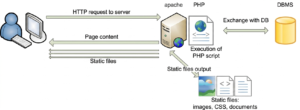
The server program acts as an intermediary between the server computer and the user’s browser. Upon receiving a request from the client, it finds the required page in the website’s directory and sends it back. The browser parses the received file and converts it into the web page displayed to the user. The workflow is as follows:
- The server runs on a port (usually 80, 8080, or 8000, but sometimes others) that is open to third-party client programs, including the user’s browser.
- When a request is received on one of the ports, the program compares it with internal instructions and rules and decides whether to execute it or not.
- If the web server rules prohibit the request, the user will see an error code (404) or a denial of access to data.
- After the server program has executed the request (successfully or with an error), it goes into standby mode.
Data exchange between a web server and a browser is carried out using the HTTP (HyperText Transfer Protocol). Later, it became possible to transfer all types of files. Today, an improved version, HTTPS, is used, encrypting traffic between the client and the server.
How Apache Works
Apache works on a modular principle. The core is installed first, and then the necessary modules are enabled based on the needs of the task.
Core
The Apache web server core includes core functionality—configuration file processing, the HTTP protocol, and a module loading system. It is written entirely in ASF, using the C programming language. The Apache core can operate without modules, but its functionality will be limited.
System of modules
Modules are separate software units. They connect to the web server core and expand its functionality. Modules are used to solve highly specialized problems, such as programming language support, bug fixes, security enhancements, authentication, and so on. Currently, there are over 500 modules available for the Apache web server. They can be included with the software during installation or loaded later via a configuration file.
Configuration system
This is a set of text commands for changing kernel parameters or adding new modules. Thanks to them, Apache can operate at several levels:
- The entire server. This level implements the web server’s overall operation and processes all incoming requests. These commands are specified in the httpd.conf file;
- A virtual host. A computer can host multiple websites managed by a single web server. Each website is assigned a separate virtual host. When a user requests a request, the system determines which host to send it to, where to retrieve the data, how to process it, and so on. These commands are specified in the extra/httpd-vhosts.conf configuration files.
- Catalog. The configuration file at this level (.htaccess) controls user access to data in the catalog. For example, it prevents illegal downloading of product lists or financial reports from an online store website.
The Apache server evaluates these rules for every request, so new directives are executed immediately after changes are made. Configurations can be edited in text configuration files or using the command line.
Advantages of Apache
Flexibility. Multiple configuration files that control web server operation at various levels, as well as modules, allow you to customize Apache to meet specific needs.
Cross-platform. Apache runs on computers running Microsoft Windows, MacOS, Linux, specialized network BSDs, and Novell NetWare. The web server’s functionality and administration remain the same across different operating systems; only the installation process and file directory locations differ.
Accessibility. Apache is open-source software. This means anyone can study, modify, and use the web server to solve their own problems.
Functionality. The core’s capabilities can be extended using Apache modules. Some are included with the installation package, while others can be downloaded separately.
documentation, modular kits, scenarios, and practical use cases have been released by the official developer and third-party experts. For virtually any problem a user might encounter while using the software, there’s a ready-made solution available online.
Scalability. Apache can power everything from a lightweight single-page landing page to a large-scale online store or information portal. If the load on a physical server increases, you can install a second Apache server on a different computer, connect the same website to it, and distribute the traffic between the two web servers.
Programming language support. Apache is written in C++, but numerous modules add support for various programming languages and development systems. These include Python, PHP, Ruby (apache-ruby), Tcl, Perl, and ASP (apache-asp). Apache supports FastCGI and CGI mechanisms, allowing it to run programs in almost all programming languages, including C, C++, sh, Lua, and JavaScript.
Apache Disadvantages
Performance. Because the system accesses configuration files for every request, processing time increases. This becomes noticeable under heavy server load—the Apache-based site processes each connection in turn, and at such times, it begins to noticeably slow down. However, this drawback can be partially mitigated by disabling unused modules.
Vulnerability. The core system has undergone numerous security checks, unlike third-party modules. Furthermore, the more functional blocks connected, the more complex the configuration and the higher the risk of a critical error.
Configuration file syntax. When working with them, users constantly deal with a large number of variables. This makes management and configuration difficult for beginners. To mitigate this, a special free tool, Apache GUI, can be used.
How to work on Apache
One of the simplest and most common ways to set up a web server with Apache is to use the MAMP software package. It includes Apache itself, a database manager, a PHP engine, and other components. It works as follows:
- The user downloads the MAMP package version for their OS from the official website and installs the web server on the computer.
- After installation, he launches the program and enters the Start command.
- The system will inform the user that the server is running, display its address, and the directory where the files are located (all of this can be left as default or configured manually).
- On the http://localhost/MAMP page, the user can view all information about the web server, including keys and database administration tools.
MAMP makes it easy to set up a local web server, but it won’t be visible from the internet unless you have a dedicated public IP address from your ISP. Setting up a website visible from the outside world is more complex and time-consuming.
Explore More IT Terms
#
- Using an integrating factor
- Equations in total differentials
- Bernoulli's equation
- Linear differential equations of the first order
- 10 Mixed C++ Challenges to Test Your Skills
- 11 Tricky Non-Technical Questions to Ask in a Recruiting Interview
- 50 Terms Every Programmer Should Know
- 52 Java Thread Interview Questions
- 7 Levels of Using the Zip Function in Python
- 7 Python Code Bugs You Need to Fix
- 70+ Free Resources for Learning Programming
A
- A Comprehensive Guide to HTML and CSS
- A Comprehensive Guide to MODX CMS
- A computer science question tests your ability to work with IP addresses and network masks
- A Guide to SQL Query Formatting for Beginners
- A/B testing
- Abstract Data Type (ADT)
- AES Encryption Algorithm: How It Works and Where It's Used
- Agile
- Algorithm
- Algorithm Analysis
- Algorithm Complexity-Key Points
- Algorithm complexity: deep parsing O(log n)
- Algorithm vs. Program
- Algorithms and Data Structures in C#
- An overview of the C # programming language
- An overview of the Python programming language
- Anaconda Python
- Analysis of graphs and adjacency matrices question
- Android
- Android App Bundle
- Android SDK
- Angular
- Ansible
- Apache
- Apache Airflow
- Apache Kafka
- Apache Tomcat
- App Store
- AppCode
- Applications of microcontrollers: From simple circuits in electronics to complex systems
- Applications of the derivative
- Arduino: How to Program It: Basics for Beginners
- Array-based stack
- ArrayList
- ASCII
- ASP.NET
- Assembly Language Lessons
B
C
- C++ Lessons
- Cache
- Calculating Memory Capacity
- Character sets and encodings
- Characteristics of a good Algorithm
- Circular singly linked list
- Coding Tests with Answers
- Combinational Circuits Solved Questions
- Compiler
- Complexity of algorithms-Tutorial
- Computer Science Fundamentals Test with Answers (47 questions)
- Computer science tests with answers (More than 100 Questions)
- Constants
- Creating a Table in HTML
- Creating Forms in HTML
- Creating Lists
- Cybernetics and informatics
- Cycles
D
- Data Analytics: applications of data analysis in companies
- Data Engineer - Who is it, what does a data engineer do, and an overview of the profession
- Data modeling: what it is, types, and process steps.
- Data preprocessing: a complete guide for beginners and professionals.
- Data structure
- Data Structures and Algorithms (DSA)
- Data types vs. Data structures
- Database Tests with Answers
- Deep Learning
- Defining Aliases
- Defining Arrays
- Deque
- Detailed articles and tutorials on PHP
- Developing a Website from Scratch
- Differential Equations
- Differentiation of functions
- Digital data: understand the importance of this asset for businesses.
- Double integrals
- Doubly linked lists
- DSA Tutorial
E
F
G
H
- Handling errors and exceptions
- Heads or Tails? How Probability Theory Is Used in IT
- History of the development of computer science
- Homogeneous equations
- Homogeneous vs. non-homogeneous structures
- How to effectively organize your workflow
- How to Learn Java: Tips for Beginner Developers
- How to Learn PHP: A Beginner's Guide
- How to Use S3 Storage in Kubernetes with CSI
- HTML
- HTML and CSS: Definition, Application, and Operating Principles
- HTML and CSS. Layout from Scratch: What to Learn, Where to Learn, and How Long Will It Take?
- HTML Frame Structure
- HTML Link Formatting
- HTML Quizzes with Answers
I
- if..else construction
- Infinite sequences and series
- Information properties
- Inheritance in Java: A Complete Guide to Principles and Implementation
- Inserting an Image
- Integration of functions
- Interactive Python Tutorial – Learn Programming from Scratch
- Interpreter
- Interview Problem: Finding a Deleted Element in O(N)
- Interview Scare: The FizzBuzz Challenge
- Introduction to C++
- Introduction to Machine Learning
- Introduction to Networking | Network Fundamentals Part 1
- Introduction to Number Systems (Binary, Octal, Hexadecimal) | Math for CS Foundations #1
- IT Specialist Resume (CV)
J
K
L
M
- Machine Learning
- Machine Learning Basic Tool: NumPy
- Machine Learning Basic Tool: Pandas
- Machine Learning Mathematics
- Mathematics for programmers: what is really needed?
- MD5 encryption algorithm: What is it and why is it needed?
- Microcontroller and Microprocessor - what's the difference?
- ML Engineer: Who They Are, What They Do, How Much They Earn, and How to Become a Neural Network Specialist
- Monte Carlo Simulation: How It Works and What It's For
O
P
- PHP lessons
- Private DNS server and its configuration
- Program code
- Programmer's Dictionary
- Programming
- Programming with pseudocode
- Python Code Formatting Guide: PEP8
- Python for data analysis: how to do it and main libraries
- Python Lessons
- Python Superstar: 5 Ways to Use the * Operator
- Python vs. Julia: Should You Replace Python with Julia?
R
S
- SFML Graphics Library Tutorials
- Sorting Algorithms in Programming: Types, Descriptions, and Comparisons
- SQL commands: see what they are, what the main ones are + examples
- SQL Interview Questions and Tasks
- SQL Lessons
- SQL Stored Procedures
- SQL Syntactic Sugar: The COALESCE Function
- Stack
- Start in analytics: Python or R
- Static vs. dynamic data structures
- Statistical analysis: importance for decision making.
- String formatting in Python
- Structure of computer science
- Swift Lessons
- switch/match construct
- Syntax
T
- Terms in programming
- Text and paragraph formatting tags
- The Complete Guide to Bootstrap
- The Complete Guide to JavaScript
- The concept of information and its transmission
- The Future of Python: Key Trends and Insights from Global Researc
- The Infrastructure of Code: A Complete Guide to Repositories for Languages, Frameworks, and Compilers
- The pip package manager in Python
- The role of informatization in the development of society
- Transfers
- Tricky Java Questions Often Asked in Interviews
- Tutorials / Articles
- TypeScript: What It Is and Why Developers Need It
W
- What are databases, and why do they need DBMS and SQL?
- What do Linux distributions consist of?
- What is .NET and what is it used for?
- What is a data structure?
- What is a GPU in a computer, in simple terms?
- What is a quantum computer: 100,500 problems in one second
- What Is an Algorithm?
- What is Arduino: How it Works and the Platform's Capabilities
- What is Big Data? Introduction, Types, Characteristics, and Examples
- What is FizzBuzz Challenge?
- What is Golang and what is it used for?
- What is Haskell and what is it used for?
- What is Kotlin and what is it used for?
- What is Linux? The History of Linux
- What is machine learning, and how does it work?
- What is Power BI: everything about the data analytics software
- What is recursion, recursive and iterative process in programming?
- What is the C++ programming language?
- What is the OSI Model: A Complete Explanation of the Seven Layers and Their Role in Networking
- What's the difference between x86 and ARM processors?
- Where to start learning the C programming language?
- Which Linux distribution should you choose? A Linux distribution overview