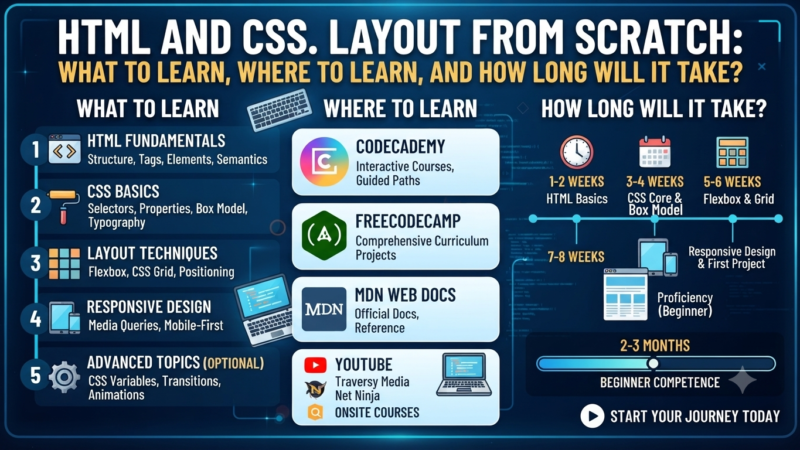
HTML and CSS: Definition, Application, and Operating Principles
Introduction
HTML and CSS are two key tools in web development, essential for creating modern websites. HTML is responsible for the structure of a web page, while CSS is responsible for its layout and style. Together, they form the foundation of front-end development and are essential learning for anyone interested in working in web technologies.
How HTML and CSS Came to Be
Before we dive into the basics of HTML and CSS and figure out what HTML and CSS are, let’s talk about how they came to be.
- HTML (HyperText Markup Language) emerged in the early 1990s and became the foundation for creating web pages. British computer scientist Sir Timothy Berners-Lee, also known as the “Father of the Internet,” is credited with creating HTML. HTML’s basic tags and attributes allowed for the structure of a website to be defined.
- CSS (Cascading Style Sheets) was developed a little later to separate the design of an HTML website from its structure. The term was coined by Norwegian technologist Håkon Wium Lie, a colleague of Berners-Lee’s at CERN. CSS’s capabilities gradually expanded, from basic CSS styles to modern CSS functions.
What is HTML in simple terms?
HTML is the HyperText Markup Language (HTML), which is responsible for the structure of a web page. In other words, it’s the foundation without which a website couldn’t exist. HTML markup creates the website’s structure: headings, paragraphs, lists, links, images, and tables. HTML tags and attributes help the browser understand how to display the content.
An HTML document consists of various elements, each of which performs its own function:
- Headings (
<h1>–<h6>) are used to indicate headings of different levels:<h1>the most important,<h6>the least significant. - Paragraphs (
<p>) are used to format blocks of text. - Lists (
<ul>,<ol>,<li>) are used to create bulleted and numbered lists. - Links (
<a href="URL">) allow you to navigate to other pages or resources. - Images (
<img src="URL" alt="Description">) insert graphics into the page. - Tables (
<table>,<tr>,<td>) are used to present data in tabular form.
Learn the basics of layout for free
Take a free HTML course on our website!
How does a browser process HTML?
When you open a web page, the browser downloads the HTML code, parses it, and builds the DOM (Document Object Model)—the document structure that forms the page’s display. However, HTML alone doesn’t determine the final appearance of a website—that’s the responsibility of CSS.
What is CSS in simple terms?
CSS is a style language for designing web pages created using HTML. It controls visual presentation: colors, fonts, spacing, element placement, and even animation. When a browser loads an HTML page, it first reads its structure and then applies CSS styles to give elements the desired appearance. For example, with CSS you can define:
- Text and background color.
- Indents between elements.
- Block and image sizes.
- Fonts and their parameters.
- Animations and effects on hover.
Without CSS, web pages would look like regular documents—solid text without formatting.
Free CSS Course for Beginners
Start learning for free!
Where HTML and CSS are used
HTML and CSS are used in most web development projects. These technologies underpin everything on the internet, from simple blogs to complex web applications. Developers can use them to solve the following problems:
- Website creation. HTML is responsible for the page structure, while CSS is responsible for its design. Whether you’re building a personal blog, an online store, or a corporate website, HTML and CSS are essential. Even major platforms like YouTube and Wikipedia use these technologies.
- Working with email newsletters. Many newsletters are designed using HTML and CSS. Email services like Gmail and Outlook use special markup to display emails beautifully.
- Creating web interfaces and control panels. Most online services, such as online banking, CRM systems, or website admin panels, are developed using HTML and CSS.
- Mobile App Development. Hybrid mobile apps (built with React Native or Apache Cordova) use HTML and CSS to create an interface that adapts to different devices.
- Working with a content management system (CMS). Platforms like WordPress, Joomla, and Drupal use HTML and CSS to create and customize website templates. Understanding these technologies allows for flexible design management.
How to learn HTML and CSS?
Learning HTML and CSS is the first step in mastering web development. These languages don’t require in-depth programming knowledge, so you can start learning them on your own. Here are some effective ways to quickly master the basics and learn how to create websites.
Study the theory
It’s worth starting with learning the basic concepts, key tags, and attributes. There are numerous websites online with quizzes and videos explaining HTML and CSS theory. It’s best to focus on the most recent publications, as HTML is constantly evolving and improving.
Connect to practice
The best way to remember the material is to immediately apply it. Start by creating a simple HTML document. Online sandboxes like CodePen, JSFiddle, or CodeSandbox allow you to experiment with code without installing any additional software. Later, tackle real-world tasks like coding web pages or developing a website layout in Figma.
Sign up for a free course
365education offers free courses, “HTML Basics” and “CSS Basics .” These lessons will help you master the fundamentals of these technologies and take your first steps in front-end development.
Practical tips for working with HTML and CSS
Mastering HTML and CSS isn’t just about tags and styles. It’s about writing clean and easy-to-use code. Here are the basic principles of good layout that help you create high-quality web pages.
1. Use semantic markup
HTML isn’t just a way to place text and images on a page. It helps search engines and browsers understand the role of elements. Instead of <div>using semantic tags for everything:
<header>— for the website header,<nav>— for the navigation menu,<article>— for articles,<section>— for sections,<footer>— for the page footer.
This approach improves SEO and makes the code clearer.
2. Separate markup and styles
Never write styles directly in HTML (e.g., style=”color: red;”). Instead, include a separate CSS file. This makes the code cleaner, easier to maintain, and allows you to change styles in all files at once.
3. Work with a grid system and responsiveness
Use CSS Grid or Flexbox to position elements on the page. These technologies allow you to create responsive layouts. Responsiveness is crucial. Use max-width instead of width, relative units (em, %, vw, vh) instead of pixels, and media queries:
This way, your website will look good on both computers and phones.
Avoid unnecessary animations and don’t use too many fonts or unoptimized images. Minify CSS and combine files to reduce the number of server requests.
4. Make your code readable
Clean code is important not only for other developers but also for your own future. Follow these rules:
- Indents (use 2 or 4 spaces, not tabs).
- Class names are descriptive, not
div1,div2. Bettermenu-item,footer-links. - Grouping properties: first positioning, then styling.
Check the code before publishing
Before you upload your site, test it:
- In different browsers (Chrome, Firefox, Safari).
- On mobile devices.
- Through validators ( W3C Validator for HTML, CSS Validator ).
CSS Basics in a Free Course
Your start in layout !
Conclusion
Although HTML and CSS aren’t programming languages in the traditional sense, they’re essential for creating a modern website. Learning them is the first step into the world of front-end development. By mastering the basic principles of markup and styling, you’ll be able to create responsive, user-friendly, and beautiful websites.
Explore More IT Terms
#
- Using an integrating factor
- Equations in total differentials
- Bernoulli's equation
- Linear differential equations of the first order
- 10 Mixed C++ Challenges to Test Your Skills
- 11 Tricky Non-Technical Questions to Ask in a Recruiting Interview
- 50 Terms Every Programmer Should Know
- 52 Java Thread Interview Questions
- 7 Levels of Using the Zip Function in Python
- 7 Python Code Bugs You Need to Fix
- 70+ Free Resources for Learning Programming
A
- A Comprehensive Guide to HTML and CSS
- A Comprehensive Guide to MODX CMS
- A computer science question tests your ability to work with IP addresses and network masks
- A Guide to SQL Query Formatting for Beginners
- A/B testing
- Abstract Data Type (ADT)
- AES Encryption Algorithm: How It Works and Where It's Used
- Agile
- Algorithm
- Algorithm Analysis
- Algorithm Complexity-Key Points
- Algorithm complexity: deep parsing O(log n)
- Algorithm vs. Program
- Algorithms and Data Structures in C#
- An overview of the C # programming language
- An overview of the Python programming language
- Anaconda Python
- Analysis of graphs and adjacency matrices question
- Android
- Android App Bundle
- Android SDK
- Angular
- Ansible
- Apache
- Apache Airflow
- Apache Kafka
- Apache Tomcat
- App Store
- AppCode
- Applications of microcontrollers: From simple circuits in electronics to complex systems
- Applications of the derivative
- Arduino: How to Program It: Basics for Beginners
- Array-based stack
- ArrayList
- ASCII
- ASP.NET
- Assembly Language Lessons
B
C
- C++ Lessons
- Cache
- Calculating Memory Capacity
- Character sets and encodings
- Characteristics of a good Algorithm
- Circular singly linked list
- Coding Tests with Answers
- Combinational Circuits Solved Questions
- Compiler
- Complexity of algorithms-Tutorial
- Computer Science Fundamentals Test with Answers (47 questions)
- Computer science tests with answers (More than 100 Questions)
- Constants
- Creating a Table in HTML
- Creating Forms in HTML
- Creating Lists
- Cybernetics and informatics
- Cycles
D
- Data Analytics: applications of data analysis in companies
- Data Engineer - Who is it, what does a data engineer do, and an overview of the profession
- Data modeling: what it is, types, and process steps.
- Data preprocessing: a complete guide for beginners and professionals.
- Data structure
- Data Structures and Algorithms (DSA)
- Data types vs. Data structures
- Database Tests with Answers
- Deep Learning
- Defining Aliases
- Defining Arrays
- Deque
- Detailed articles and tutorials on PHP
- Developing a Website from Scratch
- Differential Equations
- Differentiation of functions
- Digital data: understand the importance of this asset for businesses.
- Double integrals
- Doubly linked lists
- DSA Tutorial
E
F
G
H
- Handling errors and exceptions
- Heads or Tails? How Probability Theory Is Used in IT
- History of the development of computer science
- Homogeneous equations
- Homogeneous vs. non-homogeneous structures
- How to convert numbers between binary, octal, and hexadecimal number systems
- How to effectively organize your workflow
- How to Learn Java: Tips for Beginner Developers
- How to Learn PHP: A Beginner's Guide
- How to Use S3 Storage in Kubernetes with CSI
- HTML
- HTML and CSS: Definition, Application, and Operating Principles
- HTML and CSS. Layout from Scratch: What to Learn, Where to Learn, and How Long Will It Take?
- HTML Frame Structure
- HTML Link Formatting
- HTML Quizzes with Answers
I
- if..else construction
- Infinite sequences and series
- Information properties
- Inheritance in Java: A Complete Guide to Principles and Implementation
- Inserting an Image
- Integration of functions
- Interactive Python Tutorial – Learn Programming from Scratch
- Interpreter
- Interview Problem: Finding a Deleted Element in O(N)
- Interview Scare: The FizzBuzz Challenge
- Introduction to C++
- Introduction to Machine Learning
- Introduction to Machine Learning with Python
- Introduction to Networking | Network Fundamentals Part 1
- Introduction to Number Systems (Binary, Octal, Hexadecimal) | Math for CS Foundations #1
- IT Specialist Resume (CV)
J
K
L
M
- Machine Learning
- Machine Learning Basic Tool: NumPy
- Machine Learning Basic Tool: Pandas
- Machine Learning Basics
- Machine Learning Mathematics
- Machine Learning with Python
- Mathematics for programmers: what is really needed?
- MD5 encryption algorithm: What is it and why is it needed?
- Microcontroller and Microprocessor - what's the difference?
- ML Engineer: Who They Are, What They Do, How Much They Earn, and How to Become a Neural Network Specialist
- Monte Carlo Simulation: How It Works and What It's For
O
P
- PHP lessons
- Private DNS server and its configuration
- Program code
- Programmer's Dictionary
- Programming
- Programming with pseudocode
- Python Code Formatting Guide: PEP8
- Python for data analysis: how to do it and main libraries
- Python Lessons
- Python Superstar: 5 Ways to Use the * Operator
- Python vs. Julia: Should You Replace Python with Julia?
Q
R
S
- Setting up model parameters
- SFML Graphics Library Tutorials
- Sorting Algorithms in Programming: Types, Descriptions, and Comparisons
- SQL commands: see what they are, what the main ones are + examples
- SQL Interview Questions and Tasks
- SQL Lessons
- SQL Stored Procedures
- SQL Syntactic Sugar: The COALESCE Function
- Stack
- Start in analytics: Python or R
- Static vs. dynamic data structures
- Statistical analysis: importance for decision making.
- String formatting in Python
- Structure of computer science
- Supervised learning
- Swift Lessons
- switch/match construct
- Syntax
T
- Terms in programming
- Text and paragraph formatting tags
- The Complete Guide to Bootstrap
- The Complete Guide to JavaScript
- The concept of information and its transmission
- The Future of Python: Key Trends and Insights from Global Researc
- The Infrastructure of Code: A Complete Guide to Repositories for Languages, Frameworks, and Compilers
- The pip package manager in Python
- The role of informatization in the development of society
- Transfers
- Tricky Java Questions Often Asked in Interviews
- Tutorials / Articles
- TypeScript: What It Is and Why Developers Need It
W
- What are databases, and why do they need DBMS and SQL?
- What do Linux distributions consist of?
- What is .NET and what is it used for?
- What is a data structure?
- What is a GPU in a computer, in simple terms?
- What is a quantum computer: 100,500 problems in one second
- What Is an Algorithm?
- What is Arduino: How it Works and the Platform's Capabilities
- What is Big Data? Introduction, Types, Characteristics, and Examples
- What is FizzBuzz Challenge?
- What is Golang and what is it used for?
- What is Haskell and what is it used for?
- What is Kotlin and what is it used for?
- What is Linux? The History of Linux
- What is machine learning, and how does it work?
- What is Power BI: everything about the data analytics software
- What is recursion, recursive and iterative process in programming?
- What is the C++ programming language?
- What is the OSI Model: A Complete Explanation of the Seven Layers and Their Role in Networking
- What's the difference between x86 and ARM processors?
- Where to start learning the C programming language?
- Which Linux distribution should you choose? A Linux distribution overview