Linear vs. non-linear data structures
Linear Data Structures
1. Definition
A linear data structure is a data organization scheme where elements are stored sequentially in a single line, one after another. In a linear arrangement, every element (except the first and last) is connected directly to a unique predecessor and a unique successor. Because all items reside on a single logical level, the entire dataset can be traversed completely in a single pass.
2. Types of Linear Data Structures
A. Array
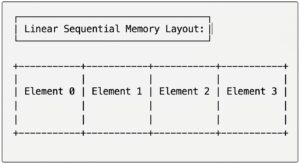
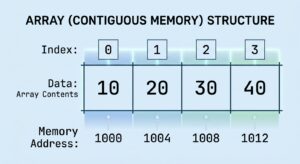
An array is a contiguous block of memory storing a fixed number of homogeneous elements (items of the same data type). Elements are indexed starting from 0, allowing direct access in constant O(1)time.
Implementation Code:
C++ Implementation:
#include <iostream>
using namespace std;

int main() {
    int arr[4] = {10, 20, 30, 40};

    // Accessing elements
    cout << "Element at index 2: " << arr[2] << endl;

    // Traversal
    for (int i = 0; i < 4; i++) {
        cout << arr[i] << " ";
    }
    return 0;
}
Python Implementation:
# In Python, dynamic arrays are implemented using lists
arr = [10, 20, 30, 40]

# Accessing elements
print("Element at index 2:", arr[2])

# Traversal
for val in arr:
    print(val, end=" ")
Java Implementation:
public class Main {
    public static void main(String[] args) {
        int[] arr = {10, 20, 30, 40};

        // Accessing elements
        System.out.println("Element at index 2: " + arr[2]);

        // Traversal
        for (int i = 0; i < arr.length; i++) {
            System.out.print(arr[i] + " ");
        }
    }
}
B. Linked List
A linked list consists of nodes where each node stores a data value and a pointer (reference) pointing to the next node in sequence. Unlike arrays, memory for a linked list is allocated dynamically across non-contiguous locations.

Implementation Code:
C++ Implementation:
#include <iostream>
using namespace std;

struct Node {
    int data;
    Node* next;
    Node(int val) : data(val), next(nullptr) {}
};

int main() {
    Node* head = new Node(10);
    head->next = new Node(20);

    Node* temp = head;
    while (temp != nullptr) {
        cout << temp->data << " -> ";
        temp = temp->next;
    }
    cout << "NULL" << endl;
    return 0;
}
Python Implementation:
class Node:
    def __init__(self, data):
        self.data = data
        self.next = None

head = Node(10)
head.next = Node(20)

curr = head
while curr:
    print(f"{curr.data} -> ", end="")
    curr = curr.next
print("None")
Java Implementation:
class Node {
    int data;
    Node next;
    Node(int data) {
        this.data = data;
        this.next = null;
    }
}

public class Main {
    public static void main(String[] args) {
        Node head = new Node(10);
        head.next = new Node(20);

        Node curr = head;
        while (curr != null) {
            System.out.print(curr.data + " -> ");
            curr = curr.next;
        }
        System.out.println("null");
    }
}
C. Stack
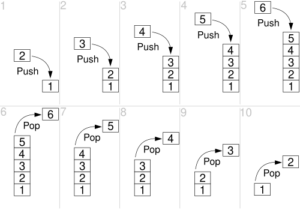
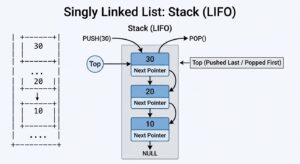
A stack is an abstract linear structure following the Last-In, First-Out (LIFO) principle. Insertion (push) and deletion (pop) operations occur strictly at a single end termed the top.
Implementation Code:
C++ Implementation:
#include <iostream>
#include <stack>
using namespace std;

int main() {
    stack<int> s;
    s.push(10);
    s.push(20);
    s.push(30);

    cout << "Top element: " << s.top() << endl; // Prints 30
    s.pop();
    cout << "Top after pop: " << s.top() << endl; // Prints 20
    return 0;
}
Python Implementation:
stack = []
stack.append(10) # Push
stack.append(20)
stack.append(30)

print("Top element:", stack[-1]) # Prints 30
stack.pop() # Pop
print("Top after pop:", stack[-1]) # Prints 20
Java Implementation:
import java.util.Stack;

public class Main {
    public static void main(String[] args) {
        Stack<Integer> stack = new Stack<>();
        stack.push(10);
        stack.push(20);
        stack.push(30);

        System.out.println("Top element: " + stack.peek()); // Prints 30
        stack.pop();
        System.out.println("Top after pop: " + stack.peek()); // Prints 20
    }
}
D. Queue
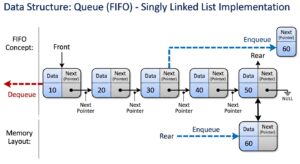
A queue follows the First-In, First-Out (FIFO) discipline. Elements enter at the rear end (enqueue) and exit from the front end (dequeue).
Implementation Code:
C++ Implementation:
#include <iostream>
#include <queue>
using namespace std;

int main() {
    queue<int> q;
    q.push(10); // Enqueue
    q.push(20);

    cout << "Front element: " << q.front() << endl; // Prints 10
    q.pop(); // Dequeue
    cout << "Front after pop: " << q.front() << endl; // Prints 20
    return 0;
}
Python Implementation:
from collections import deque

q = deque()
q.append(10) # Enqueue
q.append(20)

print("Front element:", q[0]) # Prints 10
q.popleft() # Dequeue
print("Front after pop:", q[0]) # Prints 20
Java Implementation:
import java.util.LinkedList;
import java.util.Queue;

public class Main {
    public static void main(String[] args) {
        Queue<Integer> q = new LinkedList<>();
        q.add(10); // Enqueue
        q.add(20);

        System.out.println("Front element: " + q.peek()); // Prints 10
        q.poll(); // Dequeue
        System.out.println("Front after pop: " + q.peek()); // Prints 20
    }
}
3. Advantages and Disadvantages of Linear Data Structures
Advantages
Simplicity: Conceptually simple and easy to implement due to sequential ordering.
Fast Direct Access: Fixed-size structures like arrays provide O(1) random index lookup.
Single-Pass Traversal: Complete traversal can be completed in a single linear pass.
Predictable Allocation: Contiguous memory layouts enhance spatial locality for hardware caches.
Disadvantages
Fixed Size Constraints: Static arrays require sizing upfront, causing potential buffer overflow or wasted capacity.
Costly Insertions & Deletions: Inserting or removing items from the middle of an array requires shifting elements O(N) time complexity).
Inefficient Multi-dimensional Modeling: Ineffective at storing hierarchical data (e.g., family trees, file system structures).
4. Real-World Applications
Arrays: Image pixel buffers, vector math engines, audio signal sampling arrays.
Linked Lists: Operating system process allocation tables, “undo” history buffers in text editors, music playlist trackers.
Stacks: Compiler expression evaluation (Shunting-Yard algorithm), call stack management in recursive functions, web browser back-forward history navigation.
Queues: CPU task schedulers, printer spools, customer service call routing systems, network packet queuing buffers.
Non-Linear Data Structures
1. Definition
A non-linear data structure is an organization scheme where elements are arranged hierarchically or across interconnected multi-level paths rather than in a continuous line. Elements may link to multiple neighboring nodes simultaneously. Because relationships branch, traversing all elements requires specialized multi-pass strategies such as Depth-First Search (DFS) or Breadth-First Search (BFS).

2. Types of Non-Linear Data Structures
A. Trees
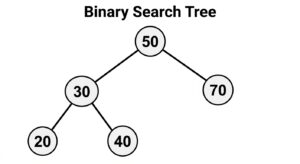
A tree is a hierarchical, acyclic structure consisting of a single root node connected to child nodes via edges.
A Binary Search Tree (BST) enforces the property that a node’s left child contains values less than the parent, while the right child contains values greater than the parent.
Implementation Code:
C++ Implementation:
#include <iostream>
using namespace std;

struct TreeNode {
    int val;
    TreeNode* left;
    TreeNode* right;
    TreeNode(int x) : val(x), left(nullptr), right(nullptr) {}
};

void inorder(TreeNode* root) {
    if (!root) return;
    inorder(root->left);
    cout << root->val << " ";
    inorder(root->right);
}

int main() {
    TreeNode* root = new TreeNode(50);
    root->left = new TreeNode(30);
    root->right = new TreeNode(70);

    cout << "In-order Traversal: ";
    inorder(root); // Outputs sorted order: 30 50 70
    return 0;
}
Python Implementation:
class TreeNode:
    def __init__(self, val):
        self.val = val
        self.left = None
        self.right = None

def inorder(root):
    if not root:
        return
    inorder(root.left)
    print(root.val, end=" ")
    inorder(root.right)

root = TreeNode(50)
root.left = TreeNode(30)
root.right = TreeNode(70)

print("In-order Traversal:", end=" ")
inorder(root) # Outputs sorted order: 30 50 70
Java Implementation:
class TreeNode {
    int val;
    TreeNode left, right;
    TreeNode(int val) {
        this.val = val;
        this.left = null;
        this.right = null;
    }
}

public class Main {
    static void inorder(TreeNode root) {
        if (root == null) return;
        inorder(root.left);
        System.out.print(root.val + " ");
        inorder(root.right);
    }

    public static void main(String[] args) {
        TreeNode root = new TreeNode(50);
        root.left = new TreeNode(30);
        root.right = new TreeNode(70);

        System.out.print("In-order Traversal: ");
        inorder(root); // Outputs: 30 50 70
    }
}
B. Graphs
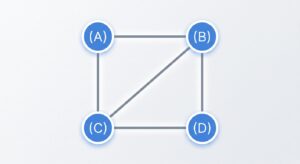
A graph consists of a finite set of vertices (nodes) connected by edges (links). Graphs can be directed/undirected and weighted/unweighted, making them suitable for modeling complex networks without rigid root/child rules.
Implementation Code:
C++ Implementation:
#include <iostream>
#include <vector>
#include <unordered_map>
using namespace std;

int main() {
    // Adjacency list representation of an undirected graph
    unordered_map<char, vector<char>> graph;
    graph['A'] = {'B', 'C'};
    graph['B'] = {'A', 'C', 'D'};

    cout << "Neighbors of Node B: ";
    for (char neighbor : graph['B']) {
        cout << neighbor << " ";
    }
    return 0;
}
Python Implementation:
# Adjacency list representation of an undirected graph
graph = {
    'A': ['B', 'C'],
    'B': ['A', 'C', 'D'],
    'C': ['A', 'B', 'D'],
    'D': ['B', 'C']
}

print("Neighbors of Node B:", graph['B'])
Java Implementation:
import java.util.*;

public class Main {
    public static void main(String[] args) {
        Map<Character, List<Character>> graph = new HashMap<>();
        graph.put('A', Arrays.asList('B', 'C'));
        graph.put('B', Arrays.asList('A', 'C', 'D'));

        System.out.println("Neighbors of Node B: " + graph.get('B'));
    }
}
3. Advantages and Disadvantages of Non-Linear Data Structures
Advantages
Efficient Lookups: Balanced search trees (e.g., AVL, Red-Black Trees) provide O(log N) dynamic search, insertion, and deletion operations.
Flexible Relationships: Graphs can model complex, cyclic, or many-to-many relationships.
Dynamic Memory Usage: Nodes are dynamically allocated as needed, reducing unallocated memory waste.
Disadvantages
Higher Overhead: Every node requires extra pointer fields to retain links to neighboring nodes.
Complex Implementation: Operations like tree rebalancing or graph traversal require sophisticated algorithm logic.
Cache Non-Locality: Dynamic pointer-chasing across separate heap addresses causes more CPU cache misses compared to contiguous arrays.
4. Real-World Applications
Trees: Operating system file directories, database indexes (B/B+ Trees), Abstract Syntax Trees (AST) in compilers, HTML DOM parsing engines.
Graphs: Mapping and GPS routing (Dijkstra’s Shortest Path), social networks (friend recommendation graphs), computer networking routing protocols, supply chain logistics engines.
Direct Comparison Table
| Feature / Metric | Linear Data Structures | Non-Linear Data Structures |
| Data Alignment | Single-level sequential arrangement. | Multi-level hierarchical or interconnected arrangement. |
| Traversal Mechanics | Single-pass processes all nodes in O(N). | Requires recursive or stack/queue algorithms (DFS/BFS). |
| Search Complexity | O(N)time (linear search on unsorted data). | O(log N) average search time in balanced trees. |
| Memory Allocation | Contiguous (Arrays) or pointer-linked (Linked Lists). | Dynamically linked across heap space. |
| Primary Examples | Arrays, Linked Lists, Stacks, Queues. | Binary Trees, Heaps, Graphs, Tries. |
Conclusion
Data structures form the foundational building blocks of modern computer systems. Choosing between linear and non-linear structures requires evaluating key architectural trade-offs:
Linear data structures excel when working with simple collections where sequential ordering, quick indexed access, or LIFO/FIFO processing is paramount.
Non-Linear data structures are necessary when representing complex real-world relationships, managing hierarchical systems, or optimizing search performance across massive datasets.
Matching your application’s data flow to the optimal data structure helps minimize time complexity, optimize memory usage, and keep system logic scalable.
Explore More IT Terms
#
- Using an integrating factor
- Equations in total differentials
- Bernoulli's equation
- Linear differential equations of the first order
- 10 Mixed C++ Challenges to Test Your Skills
- 11 Tricky Non-Technical Questions to Ask in a Recruiting Interview
- 50 Terms Every Programmer Should Know
- 52 Java Thread Interview Questions
- 7 Levels of Using the Zip Function in Python
- 7 Python Code Bugs You Need to Fix
- 70+ Free Resources for Learning Programming
A
- A Comprehensive Guide to HTML and CSS
- A Comprehensive Guide to MODX CMS
- A computer science question tests your ability to work with IP addresses and network masks
- A Guide to SQL Query Formatting for Beginners
- A/B testing
- Abstract Data Type (ADT)
- AES Encryption Algorithm: How It Works and Where It's Used
- Agile
- Algorithm
- Algorithm Analysis
- Algorithm Complexity-Key Points
- Algorithm complexity: deep parsing O(log n)
- Algorithm vs. Program
- Algorithms and Data Structures in C#
- An overview of the C # programming language
- An overview of the Python programming language
- Anaconda Python
- Analysis of graphs and adjacency matrices question
- Android
- Android App Bundle
- Android SDK
- Angular
- Ansible
- Apache
- Apache Airflow
- Apache Kafka
- Apache Tomcat
- App Store
- AppCode
- Applications of microcontrollers: From simple circuits in electronics to complex systems
- Applications of the derivative
- Arduino: How to Program It: Basics for Beginners
- Array-based stack
- ArrayList
- ASCII
- ASP.NET
- Assembly Language Lessons
B
C
- C++ Lessons
- Cache
- Calculating Memory Capacity
- Character sets and encodings
- Characteristics of a good Algorithm
- Circular singly linked list
- Coding Tests with Answers
- Combinational Circuits Solved Questions
- Compiler
- Complexity of algorithms-Tutorial
- Computer Science Fundamentals Test with Answers (47 questions)
- Computer science tests with answers (More than 100 Questions)
- Constants
- Creating a Table in HTML
- Creating Forms in HTML
- Creating Lists
- Cybernetics and informatics
- Cycles
D
- Data Analytics: applications of data analysis in companies
- Data Engineer - Who is it, what does a data engineer do, and an overview of the profession
- Data modeling: what it is, types, and process steps.
- Data preprocessing: a complete guide for beginners and professionals.
- Data structure
- Data Structures and Algorithms (DSA)
- Data types vs. Data structures
- Database Tests with Answers
- Deep Learning
- Defining Aliases
- Defining Arrays
- Deque
- Detailed articles and tutorials on PHP
- Developing a Website from Scratch
- Differential Equations
- Differentiation of functions
- Digital data: understand the importance of this asset for businesses.
- Double integrals
- Doubly linked lists
- DSA Tutorial
E
F
G
H
- Handling errors and exceptions
- Heads or Tails? How Probability Theory Is Used in IT
- History of the development of computer science
- Homogeneous equations
- Homogeneous vs. non-homogeneous structures
- How to convert numbers between binary, octal, and hexadecimal number systems
- How to effectively organize your workflow
- How to Learn Java: Tips for Beginner Developers
- How to Learn PHP: A Beginner's Guide
- How to Use S3 Storage in Kubernetes with CSI
- HTML
- HTML and CSS: Definition, Application, and Operating Principles
- HTML and CSS. Layout from Scratch: What to Learn, Where to Learn, and How Long Will It Take?
- HTML Frame Structure
- HTML Link Formatting
- HTML Quizzes with Answers
I
- if..else construction
- Infinite sequences and series
- Information properties
- Inheritance in Java: A Complete Guide to Principles and Implementation
- Inserting an Image
- Integration of functions
- Interactive Python Tutorial – Learn Programming from Scratch
- Interpreter
- Interview Problem: Finding a Deleted Element in O(N)
- Interview Scare: The FizzBuzz Challenge
- Introduction to C++
- Introduction to Machine Learning
- Introduction to Machine Learning with Python
- Introduction to Networking | Network Fundamentals Part 1
- Introduction to Number Systems (Binary, Octal, Hexadecimal) | Math for CS Foundations #1
- IT Specialist Resume (CV)
J
K
L
M
- Machine Learning
- Machine Learning Basic Tool: NumPy
- Machine Learning Basic Tool: Pandas
- Machine Learning Basics
- Machine Learning Mathematics
- Machine Learning with Python
- Mathematics for programmers: what is really needed?
- MD5 encryption algorithm: What is it and why is it needed?
- Microcontroller and Microprocessor - what's the difference?
- ML Engineer: Who They Are, What They Do, How Much They Earn, and How to Become a Neural Network Specialist
- Monte Carlo Simulation: How It Works and What It's For
O
P
- PHP lessons
- Private DNS server and its configuration
- Program code
- Programmer's Dictionary
- Programming
- Programming with pseudocode
- Python Code Formatting Guide: PEP8
- Python for data analysis: how to do it and main libraries
- Python Lessons
- Python Superstar: 5 Ways to Use the * Operator
- Python vs. Julia: Should You Replace Python with Julia?
Q
R
S
- Setting up model parameters
- SFML Graphics Library Tutorials
- Sorting Algorithms in Programming: Types, Descriptions, and Comparisons
- SQL commands: see what they are, what the main ones are + examples
- SQL Interview Questions and Tasks
- SQL Lessons
- SQL Stored Procedures
- SQL Syntactic Sugar: The COALESCE Function
- Stack
- Start in analytics: Python or R
- Static vs. dynamic data structures
- Statistical analysis: importance for decision making.
- String formatting in Python
- Structure of computer science
- Supervised learning
- Swift Lessons
- switch/match construct
- Syntax
T
- Terms in programming
- Text and paragraph formatting tags
- The Complete Guide to Bootstrap
- The Complete Guide to JavaScript
- The concept of information and its transmission
- The Future of Python: Key Trends and Insights from Global Researc
- The Infrastructure of Code: A Complete Guide to Repositories for Languages, Frameworks, and Compilers
- The pip package manager in Python
- The role of informatization in the development of society
- Transfers
- Tricky Java Questions Often Asked in Interviews
- Tutorials / Articles
- TypeScript: What It Is and Why Developers Need It
W
- What are databases, and why do they need DBMS and SQL?
- What do Linux distributions consist of?
- What is .NET and what is it used for?
- What is a data structure?
- What is a GPU in a computer, in simple terms?
- What is a quantum computer: 100,500 problems in one second
- What Is an Algorithm?
- What is Arduino: How it Works and the Platform's Capabilities
- What is Big Data? Introduction, Types, Characteristics, and Examples
- What is FizzBuzz Challenge?
- What is Golang and what is it used for?
- What is Haskell and what is it used for?
- What is Kotlin and what is it used for?
- What is Linux? The History of Linux
- What is machine learning, and how does it work?
- What is Power BI: everything about the data analytics software
- What is recursion, recursive and iterative process in programming?
- What is the C++ programming language?
- What is the OSI Model: A Complete Explanation of the Seven Layers and Their Role in Networking
- What's the difference between x86 and ARM processors?
- Where to start learning the C programming language?
- Which Linux distribution should you choose? A Linux distribution overview