
Employee work schedule: how to create it and not violate the Labor Code
What is an employee’s work schedule?
A work schedule is a document that describes an employee’s routine: when the workday begins and ends, how long a shift lasts, what days to work, and when to rest. Without a clear schedule, it’s impossible to organize a team’s work and comply with labor laws.
The specific work schedule is set out in the company’s internal regulations or directly in the employee’s contract. This is not just a formality: in a dispute, the court primarily looks at the stated terms.
For a company, a schedule serves several purposes. First, it helps distribute the workload evenly among employees and avoids situations where some work overtime while others are idle. Second, it allows for the flexible allocation of resources to match the workload. Call centers know their peak hours in advance and increase shifts during peak times. IT companies plan for additional support during the post-release period, when the volume of inquiries is predictably increased.
For employees, a transparent work schedule means predictability. According to VTsIOM, 31% of people value a convenient schedule when choosing a company. When an employee doesn’t know what shift they’ll be working next week, it creates stress and reduces loyalty to the employer.
In practice, establishing work schedules is the intersection of business, employee, and legal interests. Finding a balance between these and creating the right schedule is one of the key tasks of an HR manager. The “HR Manager” course provides a deeper understanding of how to organize work with employees. Classes teach how to build HR processes and work with a team in a real-world business setting.
Main Types of Work Schedules in the USA
The Fair Labor Standards Act (FLSA), overseen by the Department of Labor, establishes federal guidelines for work schedules and compensation. While the FLSA does not mandate a specific “official” schedule document, it defines the parameters for various work arrangements and overtime requirements.
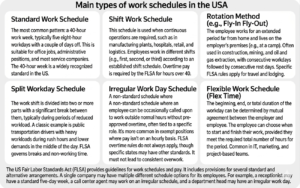
A single organization may utilize several different scheduling models based on operational needs and employee roles:
Standard Work Week: A receptionist or administrative assistant might work a traditional 9-to-5, five-day work week, totaling 40 hours.
Shift Work: A dispatcher or emergency responder might work a rotating shift schedule (such as 12-hour “on/off” rotations) to ensure 24/7 operational coverage.
Irregular or “Exempt” Hours: A department head or executive often works an irregular schedule that fluctuates based on project demands; these roles are typically “exempt” from standard overtime pay requirements under specific FLSA criteria.
Who in the company draws up the work schedule?
Who and how should draw up employee schedules depends on the size of the organization and how HR processes are organized within it.
The smaller the company, the shorter the chain: in small teams, the manager personally sets the schedule. In medium-sized businesses, this task is divided between department heads and HR. In corporations, specialized teams within the HR function exist for this purpose.
In practice, to draft a document in accordance with the law, a three-step process is used:
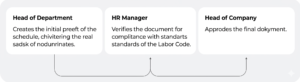
Regardless of who fills out the schedule, the employer is legally responsible for the schedule’s accuracy. If the document is found to contain any violations of the Labor Code, the organization, not the person who prepared the schedule, will be held liable.
What factors are taken into account when drawing up a schedule?
The choice of employee work schedule is influenced by several factors that must be considered before the first version of the document is correctly drafted.
- The specifics of the business and the company’s operating hours. The starting point is how the workflow is generally structured. A hospital, warehouse, or call center can’t close at 6:00 PM and go on weekends, so they need shifts. A marketing agency’s office fits perfectly into a standard five-day workweek.
- Seasonality and workload fluctuations. Many companies experience uneven workloads. Accounting tends to work more intensively during reporting periods, retail during holidays, and logistics before New Year’s sales. Some schedule changes are permanent, while others are seasonal: the company adjusts its schedule to current needs. It’s important to factor this into the work schedule in advance rather than rearranging it at the last minute.
- Legal restrictions. Some employees may be entitled to special conditions by law. For example, those working in hazardous conditions (levels 3 and 4) must work no more than 36 hours per week, and pregnant women are entitled to a reduced workday. Similar provisions apply to minors, disabled individuals, and parents of children under three.
- Employee preferences. Formally, employers aren’t obligated to coordinate schedules with each employee. But in practice, ignoring the team’s personal circumstances means high turnover and low engagement. This is especially true for flexible work arrangements, which require mutual agreement.
Rules for drawing up employee work schedules
Choosing staff work schedules is a legally binding process. Failure to comply with the procedure can result in fines, so it’s important to draft them correctly.
- Observe Labor Code regulations. All employees generally work a standard schedule of no more than 40 hours per week. For shift work, an employer may establish a flexible scheduling system; however, the FLSA requires that any hours worked over 40 within a single, designated 7-day workweek must be compensated at the overtime rate of 1.5 times the employee’s regular pay rate. Under federal law, averaging hours over two or more weeks to avoid overtime is prohibited. While there are no federal limits on the number of consecutive shifts an adult employee can work or mandatory weekly rest periods, employers must accurately track all hours and comply with any stricter state-level scheduling and rest break regulations.
- Under federal law, averaging hours over two or more weeks to avoid overtime is prohibited. While there are no federal limits on the number of consecutive shifts an adult employee can work, or on mandatory weekly rest periods, employers must accurately track all hours and comply with any stricter state-level scheduling and rest break regulations.
- Consider the production calendar. When drafting documents, it’s important to consider the official production calendar, which takes into account both holidays and rescheduled days off. Deviating from this data will lead to errors in calculating working hours and, consequently, to incorrect payroll.
- Document the schedule. The chosen schedule is set out in corporate documents or an employment contract, and if the company has a trade union, the shift schedule is also coordinated with it.
- Communicate the work schedule to staff. If employees work shifts, it’s important to notify them at least 30 days before the start of their shifts; for other schedules, at least two weeks in advance. Employees must confirm their knowledge of their work schedule by signing a form.
- Correctly formalize changes. When an employer changes the work schedule on its own initiative, the employee must receive at least two months’ written notice. The new terms are formalized in an additional agreement or order.
How to automate scheduling
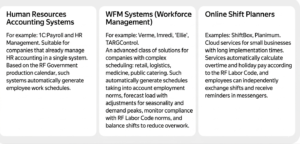
Small companies still use Excel to create schedules. But the more employees, the more varied the schedule, and the more complex the workload, the higher the risk of errors: overtime, overlapping shifts, and violations of labor regulations. This is where automation comes in handy, ensuring accurate documentation.
Today, there are many classes of instruments available on the global market:
Expert advice
Explore More IT Terms
#
- Using an integrating factor
- Equations in total differentials
- Bernoulli's equation
- Linear differential equations of the first order
- 10 Mixed C++ Challenges to Test Your Skills
- 11 Tricky Non-Technical Questions to Ask in a Recruiting Interview
- 50 Terms Every Programmer Should Know
- 52 Java Thread Interview Questions
- 7 Levels of Using the Zip Function in Python
- 7 Python Code Bugs You Need to Fix
- 70+ Free Resources for Learning Programming
A
- A Comprehensive Guide to HTML and CSS
- A Comprehensive Guide to MODX CMS
- A computer science question tests your ability to work with IP addresses and network masks
- A Guide to SQL Query Formatting for Beginners
- A/B testing
- Abstract Data Type (ADT)
- AES Encryption Algorithm: How It Works and Where It's Used
- Agile
- Algorithm
- Algorithm Analysis
- Algorithm Complexity-Key Points
- Algorithm complexity: deep parsing O(log n)
- Algorithm vs. Program
- Algorithms and Data Structures in C#
- An overview of the C # programming language
- An overview of the Python programming language
- Anaconda Python
- Analysis of graphs and adjacency matrices question
- Android
- Android App Bundle
- Android SDK
- Angular
- Ansible
- Apache
- Apache Airflow
- Apache Kafka
- Apache Tomcat
- App Store
- AppCode
- Applications of microcontrollers: From simple circuits in electronics to complex systems
- Applications of the derivative
- Arduino: How to Program It: Basics for Beginners
- Array-based stack
- ArrayList
- ASCII
- ASP.NET
- Assembly Language Lessons
B
C
- C++ Lessons
- Cache
- Calculating Memory Capacity
- Character sets and encodings
- Characteristics of a good Algorithm
- Circular singly linked list
- Coding Tests with Answers
- Combinational Circuits Solved Questions
- Compiler
- Complexity of algorithms-Tutorial
- Computer Science Fundamentals Test with Answers (47 questions)
- Computer science tests with answers (More than 100 Questions)
- Constants
- Creating a Table in HTML
- Creating Forms in HTML
- Creating Lists
- Cybernetics and informatics
- Cycles
D
- Data Analytics: applications of data analysis in companies
- Data Engineer - Who is it, what does a data engineer do, and an overview of the profession
- Data modeling: what it is, types, and process steps.
- Data preprocessing: a complete guide for beginners and professionals.
- Data structure
- Data Structures and Algorithms (DSA)
- Data types vs. Data structures
- Database Tests with Answers
- Deep Learning
- Defining Aliases
- Defining Arrays
- Deque
- Detailed articles and tutorials on PHP
- Developing a Website from Scratch
- Differential Equations
- Differentiation of functions
- Digital data: understand the importance of this asset for businesses.
- Double integrals
- Doubly linked lists
- DSA Tutorial
E
F
G
H
- Handling errors and exceptions
- Heads or Tails? How Probability Theory Is Used in IT
- History of the development of computer science
- Homogeneous equations
- Homogeneous vs. non-homogeneous structures
- How to effectively organize your workflow
- How to Learn Java: Tips for Beginner Developers
- How to Learn PHP: A Beginner's Guide
- How to Use S3 Storage in Kubernetes with CSI
- HTML
- HTML and CSS: Definition, Application, and Operating Principles
- HTML and CSS. Layout from Scratch: What to Learn, Where to Learn, and How Long Will It Take?
- HTML Frame Structure
- HTML Link Formatting
- HTML Quizzes with Answers
I
- if..else construction
- Infinite sequences and series
- Information properties
- Inheritance in Java: A Complete Guide to Principles and Implementation
- Inserting an Image
- Integration of functions
- Interactive Python Tutorial – Learn Programming from Scratch
- Interpreter
- Interview Problem: Finding a Deleted Element in O(N)
- Interview Scare: The FizzBuzz Challenge
- Introduction to C++
- Introduction to Machine Learning
- Introduction to Networking | Network Fundamentals Part 1
- Introduction to Number Systems (Binary, Octal, Hexadecimal) | Math for CS Foundations #1
- IT Specialist Resume (CV)
J
K
L
M
- Machine Learning
- Machine Learning Basic Tool: NumPy
- Machine Learning Basic Tool: Pandas
- Machine Learning Mathematics
- Mathematics for programmers: what is really needed?
- MD5 encryption algorithm: What is it and why is it needed?
- Microcontroller and Microprocessor - what's the difference?
- ML Engineer: Who They Are, What They Do, How Much They Earn, and How to Become a Neural Network Specialist
- Monte Carlo Simulation: How It Works and What It's For
O
P
- PHP lessons
- Private DNS server and its configuration
- Program code
- Programmer's Dictionary
- Programming
- Programming with pseudocode
- Python Code Formatting Guide: PEP8
- Python for data analysis: how to do it and main libraries
- Python Lessons
- Python Superstar: 5 Ways to Use the * Operator
- Python vs. Julia: Should You Replace Python with Julia?
R
S
- SFML Graphics Library Tutorials
- Sorting Algorithms in Programming: Types, Descriptions, and Comparisons
- SQL commands: see what they are, what the main ones are + examples
- SQL Interview Questions and Tasks
- SQL Lessons
- SQL Stored Procedures
- SQL Syntactic Sugar: The COALESCE Function
- Stack
- Start in analytics: Python or R
- Static vs. dynamic data structures
- Statistical analysis: importance for decision making.
- String formatting in Python
- Structure of computer science
- Swift Lessons
- switch/match construct
- Syntax
T
- Terms in programming
- Text and paragraph formatting tags
- The Complete Guide to Bootstrap
- The Complete Guide to JavaScript
- The concept of information and its transmission
- The Future of Python: Key Trends and Insights from Global Researc
- The Infrastructure of Code: A Complete Guide to Repositories for Languages, Frameworks, and Compilers
- The pip package manager in Python
- The role of informatization in the development of society
- Transfers
- Tricky Java Questions Often Asked in Interviews
- Tutorials / Articles
- TypeScript: What It Is and Why Developers Need It
W
- What are databases, and why do they need DBMS and SQL?
- What do Linux distributions consist of?
- What is .NET and what is it used for?
- What is a data structure?
- What is a GPU in a computer, in simple terms?
- What is a quantum computer: 100,500 problems in one second
- What Is an Algorithm?
- What is Arduino: How it Works and the Platform's Capabilities
- What is Big Data? Introduction, Types, Characteristics, and Examples
- What is FizzBuzz Challenge?
- What is Golang and what is it used for?
- What is Haskell and what is it used for?
- What is Kotlin and what is it used for?
- What is Linux? The History of Linux
- What is machine learning, and how does it work?
- What is Power BI: everything about the data analytics software
- What is recursion, recursive and iterative process in programming?
- What is the C++ programming language?
- What is the OSI Model: A Complete Explanation of the Seven Layers and Their Role in Networking
- What's the difference between x86 and ARM processors?
- Where to start learning the C programming language?
- Which Linux distribution should you choose? A Linux distribution overview