Static vs. dynamic data structures
In computer science, data structures are broadly categorized based on how they manage and allocate memory during execution. Selecting between a static or dynamic data structure impacts performance, memory overhead, and software design.
Static Data Structures
Definition
A static data structure is an organization of data in memory whose overall capacity and layout are fixed at compile-time or initialization. Memory allocation occurs in contiguous blocks—typically on the call stack—and cannot expand, shrink, or reallocate during runtime execution.
Types of Static Data Structures
Fixed-size Primitive Arrays: Single or multi-dimensional collections of identical data types with contiguous memory mapping.
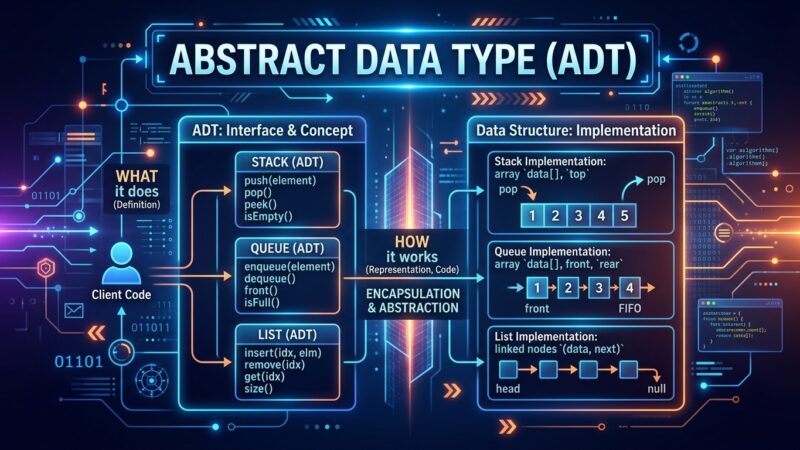
Static Stacks & Queues: Abstract Data Types (ADTs) capped at a fixed capacity using a static array underlying storage.
Structures / Records: Fixed aggregate types holding diverse variables allocated together (e.g.,
structin C/C++).
Detailed Breakdown & Behavior
Static data structures map elements in sequential memory addresses. Because the memory footprint is constant, the compiler calculates element location using a simple base-address offset calculation:
This constant-time calculation makes element access O(1). However, operations requiring structural changes (like inserting an element into the middle) require shifting remaining elements, resulting in an O(n) operation.
Advantages and Disadvantages
| Advantages | Disadvantages |
| Fast Access Times: Direct indexing allows instantaneous O(1) lookup. | Inflexible Capacity: Cannot expand if incoming data exceeds pre-allocated bounds. |
| Low Overhead: Zero memory spent on pointers or dynamic tracking metadata. | Memory Waste: Unused pre-allocated memory remains reserved and unavailable to other tasks. |
| Cache Locality: Contiguous memory layout maximizes CPU cache hit rates. | Re-compilation Required: Altering capacity demands source code changes. |
Implementation Examples
C++ (Static Fixed Array)
#include <iostream>
#include <array>

int main() {
    // Static stack-allocated array of fixed size 5
    int staticArray[5] = {10, 20, 30, 40, 50};

    // Direct index access - O(1)
    std::cout << "Element at index 2: " << staticArray[2] << std::endl;
    return 0;
}
Python (Simulated Fixed Bounds)
(Note: Native Python lists are dynamic arrays. Fixed-size behavior is enforced using standard fixed sequences or ctypes)
C++
// Python enforces fixed bounds via tuple or initialized fixed list pattern
fixed_array = [0] * 5  # Fixed pre-allocated slots
fixed_array[0] = 10
fixed_array[1] = 20

print(f"Element at index 1: {fixed_array[1]}")
Java (Primitive Array)
public class StaticExample {
    public static void main(String[] args) {
        // Fixed-size memory allocation
        int[] staticArray = new int[5];
        staticArray[0] = 10;
        staticArray[1] = 20;

        System.out.println("Array Length (Fixed): " + staticArray.length);
    }
}
Real-World Applications
Embedded Systems & Microcontrollers: Microcontrollers operating under low RAM limits use static allocation to eliminate runtime heap allocation failures and fragmentation.
Lookup Tables: Mathematical transformation tables (e.g., sine/cosine approximations, ASCII translation tables) where dataset sizes remain invariant.
Flight Control Systems: Safety-critical software mandates static arrays to guarantee deterministic execution timing without garbage collection pauses or heap allocations.
Dynamic Data Structures
Definition
A dynamic data structure is a flexible grouping of data that can grow or contract its memory allocation dynamically during runtime based on application demand. These structures rely on heap memory and pointers/references to request or free memory as items are added or removed.
Types of Dynamic Data Structures
Dynamic Arrays / Vectors: Resizable array-like structures that reallocate under the hood (e.g.,
std::vector, Pythonlist, JavaArrayList).Linked Lists: Nodes linked together via memory addresses (Singly, Doubly, or Circular).
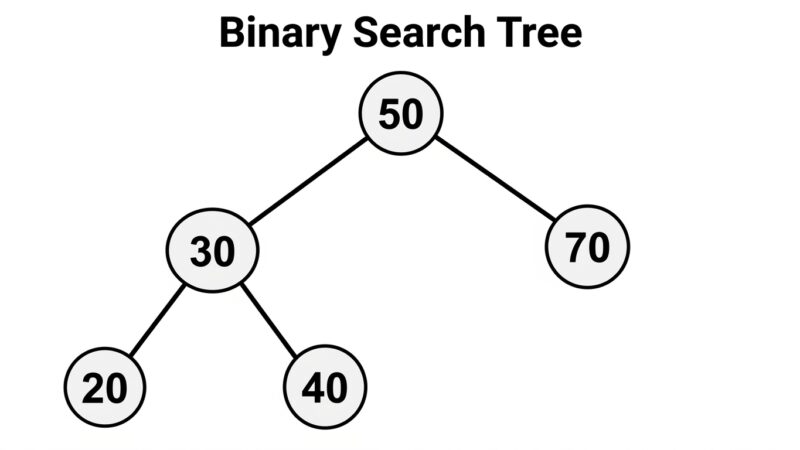
Trees & Graphs: Hierarchical or networked nodes linked by pointers (e.g., Binary Search Trees, Heaps, Adjacency Lists).
Hash Maps / Sets: Dynamically sized buckets with resizing thresholds to prevent hash collisions.
Detailed Breakdown & Behavior
Dynamic data structures do not require contiguous memory blocks (except dynamic arrays when reallocated). Instead, memory nodes are allocated on the system heap. Each element stores its payload alongside metadata—such as memory pointers referencing neighboring nodes.
Insertion or deletion in linked dynamic structures involves updating node pointers rather than shifting elements, reducing runtime complexity to O(1) once the insertion location is located. However, accessing arbitrary elements requires linear traversal, O(n), because non-contiguous memory invalidates direct address arithmetic.
Advantages and Disadvantages
| Advantages | Disadvantages |
| Runtime Adaptability: Expands or shrinks dynamically; no prior knowledge of size required. | Pointer Overhead: Pointer metadata consumes extra RAM per element. |
| Optimal Memory Usage: Allocates only what is actively used, avoiding over-reservation. | Slower Traversal: Non-contiguous layout degrades CPU cache performance. |
| Efficient Rearrangements: Fast pointer re-linking for insertions and removals. | Risk of Memory Leaks/Fragmentation: Requires dynamic garbage collection or manual deallocation. |
Implementation Examples
C++ (Dynamic Linked List Node)
#include <iostream>

struct Node {
    int data;
    Node* next;
    Node(int val) : data(val), next(nullptr) {}
};

int main() {
    // Dynamic Heap Allocation
    Node* head = new Node(10);
    head->next = new Node(20);

    std::cout << "First Node: " << head->data << ", Second Node: " << head->next->data << std::endl;

    // Cleanup manual allocations
    delete head->next;
    delete head;
    return 0;
}
Python (Dynamic Array / List)
# Python native lists are dynamic arrays that resize automatically
dynamic_list = []
dynamic_list.append(10)  # Dynamically expands
dynamic_list.append(20)
dynamic_list.append(30)

print(f"List contents: {dynamic_list}, Length: {len(dynamic_list)}")
Java (Dynamic Linked Collection)
import java.util.LinkedList;

public class DynamicExample {
    public static void main(String[] args) {
        LinkedList<Integer> dynamicList = new LinkedList<>();
        dynamicList.add(10); // Dynamic node creation
        dynamicList.add(20);
        dynamicList.addFirst(5);

        System.out.println("Head element: " + dynamicList.getFirst());
    }
}
Real-World Applications
Database Management Systems (DBMS): B-Trees and dynamic indexing structures dynamically grow to accommodate fluctuating data entries without system restarts.
Operating System Process Scheduling: Priority queues implemented via dynamic heaps manage process execution threads based on real-time task arrival.
Web Browsers: Navigation history (Forward/Back buttons) relies on dynamic stacks that adjust as user browsing sessions expand.
Architectural Comparison
| Metric | Static Data Structures | Dynamic Data Structures |
| Memory Allocation | Compile time / Stack frame | Runtime / Heap memory |
| Size Capacity | Fixed, predetermined boundary | Variable, expands and contracts |
| Element Access | Direct access: O(1) | Traversal access: O(n) (except Dynamic Arrays: O(1) |
| Insertion/Deletion | Costly: requires element shifting | Efficient: requires pointer updating |
| Memory Efficiency | High efficiency if full; wasteful if underutilized | High storage utilization; carries pointer overhead |
Conclusion
Static and dynamic data structures each offer distinct trade-offs between computational speed, memory flexibility, and hardware execution efficiency. Static structures yield predictable memory footprints, low pointer overhead, and high CPU cache efficiency, making them well-suited for systems with fixed constraints or deterministic runtime demands. Dynamic structures provide adaptability for handling unpredictable, fluctuating data streams at the cost of heap allocation management and link traversal overhead. Software architecture often combines both, using static layouts for low-level performance loops and dynamic models for high-level data aggregation.
Explore More IT Terms
#
- Using an integrating factor
- Equations in total differentials
- Bernoulli's equation
- Linear differential equations of the first order
- 10 Mixed C++ Challenges to Test Your Skills
- 11 Tricky Non-Technical Questions to Ask in a Recruiting Interview
- 50 Terms Every Programmer Should Know
- 52 Java Thread Interview Questions
- 7 Levels of Using the Zip Function in Python
- 7 Python Code Bugs You Need to Fix
- 70+ Free Resources for Learning Programming
A
- A Comprehensive Guide to HTML and CSS
- A Comprehensive Guide to MODX CMS
- A computer science question tests your ability to work with IP addresses and network masks
- A Guide to SQL Query Formatting for Beginners
- A/B testing
- Abstract Data Type (ADT)
- AES Encryption Algorithm: How It Works and Where It's Used
- Agile
- Algorithm
- Algorithm Analysis
- Algorithm Complexity-Key Points
- Algorithm complexity: deep parsing O(log n)
- Algorithm vs. Program
- Algorithms and Data Structures in C#
- An overview of the C # programming language
- An overview of the Python programming language
- Anaconda Python
- Analysis of graphs and adjacency matrices question
- Android
- Android App Bundle
- Android SDK
- Angular
- Ansible
- Apache
- Apache Airflow
- Apache Kafka
- Apache Tomcat
- App Store
- AppCode
- Applications of microcontrollers: From simple circuits in electronics to complex systems
- Applications of the derivative
- Arduino: How to Program It: Basics for Beginners
- Array-based stack
- ArrayList
- ASCII
- ASP.NET
- Assembly Language Lessons
B
C
- C++ Lessons
- Cache
- Calculating Memory Capacity
- Character sets and encodings
- Characteristics of a good Algorithm
- Circular singly linked list
- Coding Tests with Answers
- Combinational Circuits Solved Questions
- Compiler
- Complexity of algorithms-Tutorial
- Computer Science Fundamentals Test with Answers (47 questions)
- Computer science tests with answers (More than 100 Questions)
- Constants
- Creating a Table in HTML
- Creating Forms in HTML
- Creating Lists
- Cybernetics and informatics
- Cycles
D
- Data Analytics: applications of data analysis in companies
- Data Engineer - Who is it, what does a data engineer do, and an overview of the profession
- Data modeling: what it is, types, and process steps.
- Data preprocessing: a complete guide for beginners and professionals.
- Data structure
- Data Structures and Algorithms (DSA)
- Data types vs. Data structures
- Database Tests with Answers
- Deep Learning
- Defining Aliases
- Defining Arrays
- Deque
- Detailed articles and tutorials on PHP
- Developing a Website from Scratch
- Differential Equations
- Differentiation of functions
- Digital data: understand the importance of this asset for businesses.
- Double integrals
- Doubly linked lists
- DSA Tutorial
E
F
G
H
- Handling errors and exceptions
- Heads or Tails? How Probability Theory Is Used in IT
- History of the development of computer science
- Homogeneous equations
- Homogeneous vs. non-homogeneous structures
- How to convert numbers between binary, octal, and hexadecimal number systems
- How to effectively organize your workflow
- How to Learn Java: Tips for Beginner Developers
- How to Learn PHP: A Beginner's Guide
- How to Use S3 Storage in Kubernetes with CSI
- HTML
- HTML and CSS: Definition, Application, and Operating Principles
- HTML and CSS. Layout from Scratch: What to Learn, Where to Learn, and How Long Will It Take?
- HTML Frame Structure
- HTML Link Formatting
- HTML Quizzes with Answers
I
- if..else construction
- Infinite sequences and series
- Information properties
- Inheritance in Java: A Complete Guide to Principles and Implementation
- Inserting an Image
- Integration of functions
- Interactive Python Tutorial – Learn Programming from Scratch
- Interpreter
- Interview Problem: Finding a Deleted Element in O(N)
- Interview Scare: The FizzBuzz Challenge
- Introduction to C++
- Introduction to Machine Learning
- Introduction to Machine Learning with Python
- Introduction to Networking | Network Fundamentals Part 1
- Introduction to Number Systems (Binary, Octal, Hexadecimal) | Math for CS Foundations #1
- IT Specialist Resume (CV)
J
K
L
M
- Machine Learning
- Machine Learning Basic Tool: NumPy
- Machine Learning Basic Tool: Pandas
- Machine Learning Basics
- Machine Learning Mathematics
- Machine Learning with Python
- Mathematics for programmers: what is really needed?
- MD5 encryption algorithm: What is it and why is it needed?
- Microcontroller and Microprocessor - what's the difference?
- ML Engineer: Who They Are, What They Do, How Much They Earn, and How to Become a Neural Network Specialist
- Monte Carlo Simulation: How It Works and What It's For
O
P
- PHP lessons
- Private DNS server and its configuration
- Program code
- Programmer's Dictionary
- Programming
- Programming with pseudocode
- Python Code Formatting Guide: PEP8
- Python for data analysis: how to do it and main libraries
- Python Lessons
- Python Superstar: 5 Ways to Use the * Operator
- Python vs. Julia: Should You Replace Python with Julia?
Q
R
S
- Setting up model parameters
- SFML Graphics Library Tutorials
- Sorting Algorithms in Programming: Types, Descriptions, and Comparisons
- SQL commands: see what they are, what the main ones are + examples
- SQL Interview Questions and Tasks
- SQL Lessons
- SQL Stored Procedures
- SQL Syntactic Sugar: The COALESCE Function
- Stack
- Start in analytics: Python or R
- Static vs. dynamic data structures
- Statistical analysis: importance for decision making.
- String formatting in Python
- Structure of computer science
- Supervised learning
- Swift Lessons
- switch/match construct
- Syntax
T
- Terms in programming
- Text and paragraph formatting tags
- The Complete Guide to Bootstrap
- The Complete Guide to JavaScript
- The concept of information and its transmission
- The Future of Python: Key Trends and Insights from Global Researc
- The Infrastructure of Code: A Complete Guide to Repositories for Languages, Frameworks, and Compilers
- The pip package manager in Python
- The role of informatization in the development of society
- Transfers
- Tricky Java Questions Often Asked in Interviews
- Tutorials / Articles
- TypeScript: What It Is and Why Developers Need It
W
- What are databases, and why do they need DBMS and SQL?
- What do Linux distributions consist of?
- What is .NET and what is it used for?
- What is a data structure?
- What is a GPU in a computer, in simple terms?
- What is a quantum computer: 100,500 problems in one second
- What Is an Algorithm?
- What is Arduino: How it Works and the Platform's Capabilities
- What is Big Data? Introduction, Types, Characteristics, and Examples
- What is FizzBuzz Challenge?
- What is Golang and what is it used for?
- What is Haskell and what is it used for?
- What is Kotlin and what is it used for?
- What is Linux? The History of Linux
- What is machine learning, and how does it work?
- What is Power BI: everything about the data analytics software
- What is recursion, recursive and iterative process in programming?
- What is the C++ programming language?
- What is the OSI Model: A Complete Explanation of the Seven Layers and Their Role in Networking
- What's the difference between x86 and ARM processors?
- Where to start learning the C programming language?
- Which Linux distribution should you choose? A Linux distribution overview