Program code
Software code is text written in a programming language. It is usually written by programmers, a process called “coding.” Code is used to create programs: commands are given to the computer, which it executes.
When someone writes code, they are said to code. This term is most often used to refer to programmers, also known as coders.
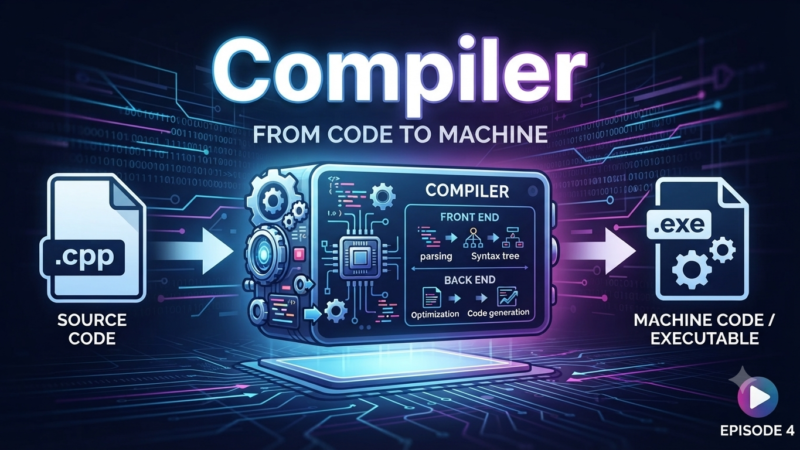
A computer initially perceives a program’s code as plain text. To make it work, it must be fed to a special tool— a compiler or interpreter for the target language. This tool converts the code into something the computer can understand. After that, it can be run.
What is program code for?
Computers don’t understand human languages. But they also don’t understand program code in modern programming languages: it needs to be compiled or interpreted to work. The question arises: why not write programs in human languages? But that won’t work—code is still necessary. Let’s try to explain why in simple terms.
Human languages are complex. It’s virtually impossible to create a compiler that would translate human natural languages into a form understandable by computers. In programming, there’s a field called NLP that specializes in recognizing them, but it’s extremely complex and can’t recognize everything. Therefore, human language is simply unsuitable as a programming language.
Code helps you issue commands faster and more concisely. Imagine you need to sort a large amount of data. Describing the task in plain text would be more difficult than writing one or two lines of code.
The code is clear and structured. Modern programming languages are high-level. This means their level of abstraction is higher, closer to human understanding than machine understanding. Therefore, code written in them must be compiled or interpreted. The original “machine language” consists of long machine codes of zeros and ones, and writing programs in them is practically impossible for a human. It would be completely incomprehensible. But the program code itself makes it clear what it does—its syntax is closer to human understanding.
Programming languages serve as a kind of compromise between machine codes, which are complex for humans, and human language, which is incomprehensible for computers.
What does the program code look like?
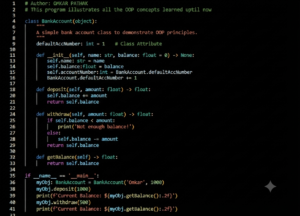
This is a set of lines in a programming language. Languages are usually close to English: words are borrowed from it to denote commands. Structurally, code consists of commands, relationships between them, various operators and punctuation marks, as well as variables and values. Large groups of commands that perform a specific action are collected into blocks called functions.
Most languages use a semicolon at the end of each line. This helps the compiler or interpreter understand that a command has ended. However, this isn’t always the case: for example, Python uses a line break instead of a semicolon.
In the code images you’ve probably seen online, it appears in different colors. This is because specialized programming tools highlight different elements of the syntax for clarity.
Understanding the terms: what types of code there are
This isn’t a classification—it’s simply a list of terms you often hear in the context of coding. They may sound similar, but they mean different things.
Source code is a version of software in its original form, as written by the developer (i.e., entered into the computer), represented as plain text (i.e., a sequence of alphanumeric characters that a human can read). The concept of source code can also have a broader meaning, encompassing machine code and symbols in graphical languages, but neither of these cases is inherently text.
Source code can be open or closed. Open source code can be viewed by anyone. Closed source code is either hidden from users or absent from the final software product altogether—executable code is used instead.
Executable code is code that a program can execute. It is sometimes contrasted with source code. Most often, it refers to code resulting from compilation. The compiler translates source code into machine code that the operating system can execute —the output is executable code.
Clean code is a different concept, more related to good developer etiquette. Clean code is defined as well-written, not overly verbose, clear, and concise. Such code is easy to read for other developers, not just the author.
What is the code written in?
Programming languages are designed so that code can be written in any editor, even Notepad. The computer will then interpret it as text, but to run it, you need to perform additional steps: save the file in the required format and send it to the compiler or interpreter. If the code is in JavaScript, the easiest way is to run it in a browser. And if the code is in the operating system’s native languages, it’s best to run it in the console.
Programmers most often write code in specialized programs: development environments ( IDEs ) and code editors. An IDE is a more powerful tool with many additional features. Code can be run directly from it with a single click. An editor is simpler, easier to understand, and less resource-intensive.
Dedicated coding tools offer more than just text editors. They highlight syntax and color-code the code to make it easier for developers to understand. They help you find bugs, debug programs, display data, and do many other things. They’re convenient and visual tools.
We recommend beginners start with code editors or IDEs. They make writing more convenient and less confusing.
What does the code consist of?
The set of rules by which code is written is called syntax. Syntax explains which commands can be used, what the code structure should be, how to correctly place links, pass arguments, and use various operators. It can be compared to the rules of the Russian language.
The syntax of a programming language says nothing about the meaning of a program. It only ensures its correctness.
Code consists of commands, the relationships between them, and other syntax elements. Here are some of them.
First, let’s agree on some general concepts.
- We’ll call commands direct instructions to the computer. For example, to print a word: print(“word”).
- Links are the various elements that connect commands to each other. These are most often punctuation marks and various operators.
Now let’s look at the components in more detail.
Variables. When a user manipulates values repeatedly, they often need to store them somewhere. For this purpose, programming languages use variables. A variable has a name, a type, and a value.
- The name indicates how to access the variable. For example, if we declared a = 5, then the variable is called a.
- A value is the data stored in a variable. For the variable a mentioned above, this value is the number 5.
- A data type indicates the type of information a variable stores: a number, a letter, a string, or something more complex. There are simple and composite data types. The former store primitive values like numbers and strings, while the latter store complex constructs consisting of multiple primitives or even functions.
Working with data types in different programming languages is a topic for a separate article. They can vary greatly: in some languages, the type must be explicitly specified, while in others, it’s not. Some languages allow you to compare or add data of different types, while others don’t. There are many variations, so it’s worthwhile to immediately understand how types are structured in your chosen language.
Constants. These are variables whose value cannot be changed. It is set once and for all. In some programming languages, such as functional languages, all variables are essentially constants.
Keywords. Keywords are special, reserved words used for technical purposes. For example, the values True and False. These words are often not commands: they tell the computer about a certain value or format. Reserved words cannot be used to name anything. For example, a program cannot have a variable named True.
Identifiers. In computer science, these are the names programmers give to entities in their code. For example, the name of a variable is its identifier. And if a user wants to create a function, they’ll give it a name. This name is also an identifier.
Values and literals. Literals are also called unnamed constants. They are values of some type that are used in code but aren’t assigned to a variable. They don’t change because they aren’t written anywhere—they’re not variables. The only way to change a literal is to rewrite the source code.
For example, when we write print(“word”), the string “word” is a literal. We don’t need to store it in a variable, but we can’t do without it either. It remains in the code as an unnamed constant.
Punctuation marks and symbols. Symbols are most often links, and sometimes operators. These are the “punctuation marks” of a programming language: periods, colons, commas, semicolons, and so on. They help structure a program. For example, parentheses () after a function enclose the data that needs to be passed to it when it’s run. The data itself is separated by commas to separate one from another.
Punctuation rules also vary by language. However, the most common symbols found in programming languages include parentheses, brackets, and braces, commas and semicolons, as well as periods and quotation marks. Other common symbols include the colon, the ^ sign, the question mark, the vertical bar or slash, the percentage sign, and many more.
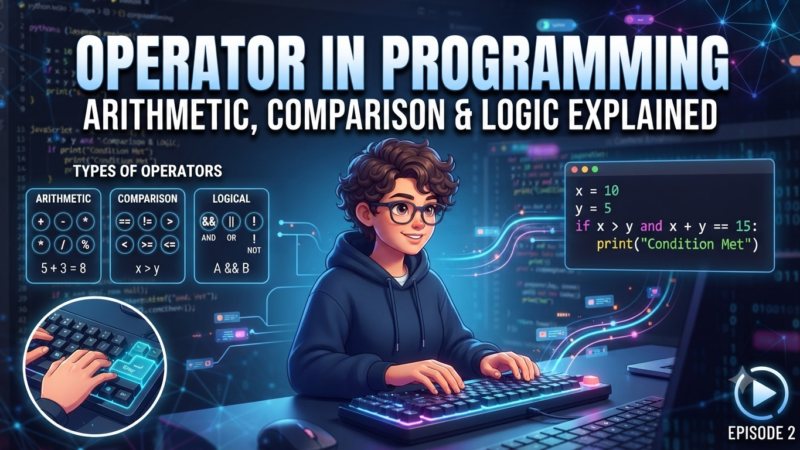
Operations, operators, and operands. Don’t be alarmed. Operations are specific actions performed on data: addition, subtraction, comparison, and so on. These aren’t always mathematical operations—they’re simply a good visual example.
Operations consist of operands and operators.
- An operand is a variable or literal, something we will work with.
- An operator is a symbol or word used to represent an action.
For example, in the operation, a + 2the variable a and the literal 2 will be operands, and the + sign will be the operator.
Functions. Sometimes you need to combine a set of commands into a single block so that it can be called as a single, larger command. This is possible. Such blocks are called functions in programming.
A function most often has a name (exceptions occur, but rarely) and a list of arguments—data passed to it when called. When the programmer calls a function, it performs the actions defined within it.
Built-in commands in programming languages are usually functions too. They’re simply built into the language. However, a programmer can also write their own. Furthermore, breaking code into functions is a good practice because it improves the readability and flexibility of a program.
Additional sets of functions for specific tasks are called libraries. They can be built-in, existing in the language, or user-defined. To use functions from a library, you need to include it in the program. If the library isn’t on your computer, you need to download it first.
Comments. Most languages allow you to write comments—text blocks that do nothing and are meant for the developer’s convenience. They are marked with special characters. The compiler or interpreter ignores comments and does nothing with them.
Comments have two main purposes:
- Document and explain. For example, a developer might leave a comment next to a complex function and explain what it does;
- Temporarily hide sections of code. For example, a person might turn a line of code into a comment to temporarily exclude it from program execution.
If you want to pursue programming professionally, enroll in our courses. We’ll be happy to help you gain a new profession.
Explore More IT Terms
#
A
- A Guide to SQL Query Formatting for Beginners
- A/B testing
- Abstract Data Type (ADT)
- AES Encryption Algorithm: How It Works and Where It's Used
- Agile
- Algorithm
- Algorithm Analysis
- Algorithm Complexity
- Algorithm complexity: deep parsing O(log n)
- Algorithm vs. Program
- Algorithms and Data Structures in C#
- An overview of the C # programming language
- An overview of the Python programming language
- Anaconda Python
- Android
- Android App Bundle
- Android SDK
- Angular
- Ansible
- Apache
- Apache Airflow
- Apache Kafka
- Apache Tomcat
- App Store
- AppCode
- Applications of microcontrollers: From simple circuits in electronics to complex systems
- Applications of the derivative
- Arduino: How to Program It: Basics for Beginners
- Array-based stack
- ArrayList
- ASCII
- ASP.NET
- Assembly Language Lessons
B
C
D
- Data Analytics: applications of data analysis in companies
- Data Engineer - Who is it, what does a data engineer do, and an overview of the profession
- Data modeling: what it is, types, and process steps.
- Data preprocessing: a complete guide for beginners and professionals.
- Data structure
- Data Structures and Algorithms (DSA)
- Data types vs. Data structures
- Database Tests with Answers
- Deep Learning
- Defining Aliases
- Defining Arrays
- Deque
- Developing a Website from Scratch
- Differential Equations
- Differentiation of functions
- Digital data: understand the importance of this asset for businesses.
- Double integrals
- Doubly linked lists
- DSA Tutorial
E
F
G
H
- Handling errors and exceptions
- Heads or Tails? How Probability Theory Is Used in IT
- History of the development of computer science
- Homogeneous equations
- Homogeneous vs. non-homogeneous structures
- How to effectively organize your workflow
- How to Learn Java: Tips for Beginner Developers
- How to Learn PHP: A Beginner's Guide
- How to Use S3 Storage in Kubernetes with CSI
- HTML
- HTML and CSS: Definition, Application, and Operating Principles
- HTML and CSS. Layout from Scratch: What to Learn, Where to Learn, and How Long Will It Take?
- HTML Frame Structure
- HTML Link Formatting
I
- if..else construction
- Infinite sequences and series
- Information properties
- Inheritance in Java: A Complete Guide to Principles and Implementation
- Inserting an Image
- Integration of functions
- Interactive Python Tutorial – Learn Programming from Scratch
- Interpreter
- Interview Problem: Finding a Deleted Element in O(N)
- Interview Scare: The FizzBuzz Challenge
- Introduction to C++
- Introduction to Machine Learning
- Introduction to Networking | Network Fundamentals Part 1
- Introduction to Number Systems (Binary, Octal, Hexadecimal) | Math for CS Foundations #1
- IT Specialist Resume (CV)
J
K
L
M
- Machine Learning
- Machine Learning Basic Tool: NumPy
- Machine Learning Basic Tool: Pandas
- Machine Learning Mathematics
- Mathematics for programmers: what is really needed?
- MD5 encryption algorithm: What is it and why is it needed?
- Microcontroller and Microprocessor - what's the difference?
- ML Engineer: Who They Are, What They Do, How Much They Earn, and How to Become a Neural Network Specialist
- Monte Carlo Simulation: How It Works and What It's For
O
P
- PHP lessons
- Private DNS server and its configuration
- Program code
- Programmer's Dictionary
- Programming
- Programming with pseudocode
- Python Code Formatting Guide: PEP8
- Python for data analysis: how to do it and main libraries
- Python Lessons
- Python Superstar: 5 Ways to Use the * Operator
- Python vs. Julia: Should You Replace Python with Julia?
R
S
- SFML Graphics Library Tutorials
- Sorting Algorithms in Programming: Types, Descriptions, and Comparisons
- SQL commands: see what they are, what the main ones are + examples
- SQL Interview Questions and Tasks
- SQL Lessons
- SQL Stored Procedures
- SQL Syntactic Sugar: The COALESCE Function
- Stack
- Start in analytics: Python or R
- Static vs. dynamic data structures
- Statistical analysis: importance for decision making.
- String formatting in Python
- Structure of computer science
- Swift Lessons
- switch/match construct
- Syntax
T
- Terms in programming
- Text and paragraph formatting tags
- The concept of information and its transmission
- The Future of Python: Key Trends and Insights from Global Researc
- The Infrastructure of Code: A Complete Guide to Repositories for Languages, Frameworks, and Compilers
- The pip package manager in Python
- The role of informatization in the development of society
- Transfers
- Tutorials / Articles
- TypeScript: What It Is and Why Developers Need It
W
- What are databases, and why do they need DBMS and SQL?
- What do Linux distributions consist of?
- What is .NET and what is it used for?
- What is a data structure?
- What is a GPU in a computer, in simple terms?
- What is a quantum computer: 100,500 problems in one second
- What Is an Algorithm?
- What is Arduino: How it Works and the Platform's Capabilities
- What is Big Data? Introduction, Types, Characteristics, and Examples
- What is FizzBuzz Challenge?
- What is Golang and what is it used for?
- What is Haskell and what is it used for?
- What is Kotlin and what is it used for?
- What is Linux? The History of Linux
- What is machine learning, and how does it work?
- What is Power BI: everything about the data analytics software
- What is recursion, recursive and iterative process in programming?
- What is the C++ programming language?
- What is the OSI Model: A Complete Explanation of the Seven Layers and Their Role in Networking
- What's the difference between x86 and ARM processors?
- Where to start learning the C programming language?
- Which Linux distribution should you choose? A Linux distribution overview