Programming
Programming is the creation of instructions for a computer, or programs. It typically involves writing code in a programming language. Developers use it to create websites, apps, and various digital services.
In a broader sense, programming is any creation of instructions for an executor. For example, a mother shows her child how to make a sandwich. Computer programming is similar, except the instructions are written as code in specialized languages. And the executor is some device.
When a person programs, they essentially translate tasks for a machine into a language it understands. Instructions written in this language can be executed and carried out—the computer follows them. This is how programs are created.
What is programming for?
All the websites, services, operating systems, and applications we use are created using programming. True, there’s also the zero-code approach, but we’ll talk about that later. What’s important now is that without programming, neither Windows, nor Google, nor this website would have existed.
The number of industries requiring programming is growing every year. For example, while businesses were previously reluctant to use the internet, now some companies operate exclusively online. For this, they need programmers. Here are some industry examples:
- trade – you need to program online stores, marketplaces, and online payments;
- advertising – programs manage the impressions and cost of advertisements;
- analytics and predictions – programs collect data, process it, and analyze it;
- business processes are automated using software;
- medicine – programs are written for medical equipment and accounting;
- Education – electronic diaries, online courses, and much more are created using programming.
In reality, there are many more examples, and almost no field can function without programming. Even a cash register won’t work without a program.
What do programmers do?
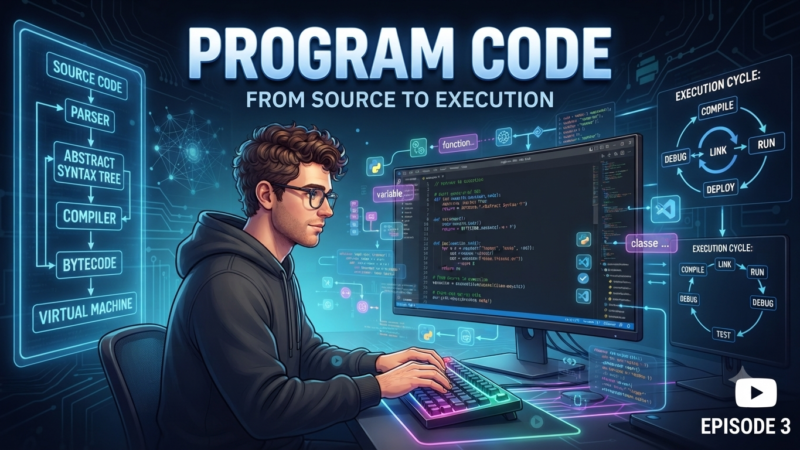
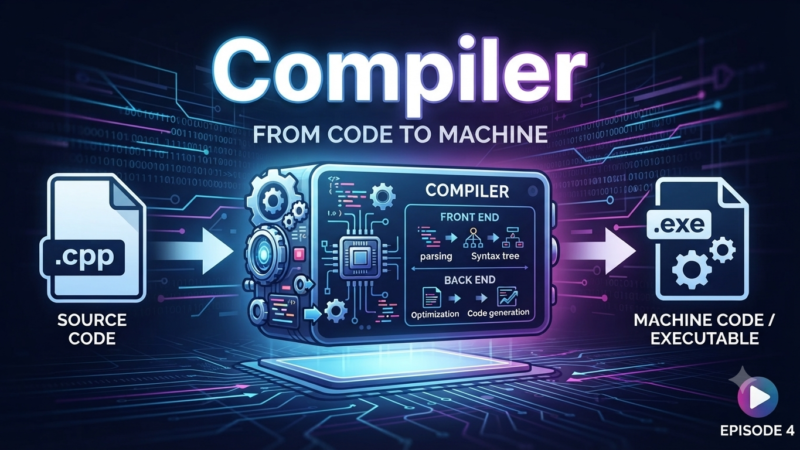
Simply put, programmers write code. Code is a set of control commands in a programming language. Special programs called compilers or interpreters translate these commands into machine code so that the computer can execute them. Machine code is incomprehensible to humans, but program code in a programming language can be read by anyone familiar with that language.
Commands can be complex and need to be written according to certain syntax rules so that the compiler or interpreter can understand them. Unlike natural human language, typos are critical—a computer will not understand something written with an error.
Programmers use code to give instructions to computer systems—they implement algorithms. An algorithm is a sequence of actions required to complete a task. There are well-known algorithms, each with its own name, and then there is the general concept of an algorithm—a set of instructions.
Ready-made programs operate according to the algorithms embedded in them by their developers. This is how the software accomplishes its tasks.
What do you need to start programming?
For beginner-level training, all you need is a computer (preferably with internet access), a compiler or interpreter for the chosen programming language installed on it, and some tutorials on hand. Some languages also require downloading an SDK (a set of developer tools). In theory, this is sufficient; you can start coding in Notepad and then compile it via the command line. In practice, it’s also advisable to install an IDE or code editor—they’re easier and more convenient to work with.
To study programming at an advanced level, you’ll need a version control system like Git installed. You’ll also need to install libraries and frameworks for your chosen field, such as web development or machine learning.
What types of programming languages are there?
There are many programming languages. There are no universal ones. Each is used for its own specific purpose. They also have different operating principles, principles, and programming styles.
By purpose. The most popular language in the world is JavaScript, which is used to create web interfaces. It is used to program the user-facing portion of a website. The language can also be used for server-side programming, and sometimes even for desktop or mobile apps.
The second most popular language is Python. It’s used in server-side web development, machine learning, analytics, and automation. The language is concise and clear, making it easier to tackle data-intensive tasks.
Also among the popular languages by purpose:
- PHP is the server-side of websites;
- Java – heavy-duty enterprise programs;
- C, C++, C# — system programs, operating systems, games;
- Kotlin and Swift are mobile development languages; Swift is also used to write programs for macOS;
- Ruby, Go — server part of websites, microservices, application programs.
Regarding translation features. Languages can be compiled or interpreted. In the first case, the compiler translates the entire program into machine code at once, while in the second, the interpreter executes it line by line.
Programs written in compiled languages run faster. However, each operating system requires its own compiler, meaning cross-platform compatibility is limited.
Interpreted languages allow for faster code debugging and easy cross-platform implementation, but programs run slower on average.
Typing. Programming languages work with data, and data has types: number, string, float, array. Data is stored in variables. An important feature of languages is how they define types:
- Languages with static typing do not change the type of an entity once it is created. In languages with dynamic typing, the type of the same variable can change.
- Strong typing means that types cannot be converted or coerced to each other—or they can, but only in very limited ways. Weak typing, on the other hand, allows for broad possibilities for conversion but reduces safety.
- Explicit typing means that variable types are clearly defined. With implicit typing, the compiler or interpreter guesses them automatically based on the data.
By ideology. Some languages are oriented toward a procedural programming style, others toward a functional one, and still others toward object-oriented programming. The syntax and program structure of each language make some styles easier to write in, while others are more difficult. There are general-purpose programming languages, but each still has its own values: for example, brevity, simplicity, and clarity. These factors also determine which language to work with; programmers often choose technologies that align with their values.
Basic concepts in programming
We won’t go into detail about programming in this article, but we’ll just briefly explain the basic concepts.
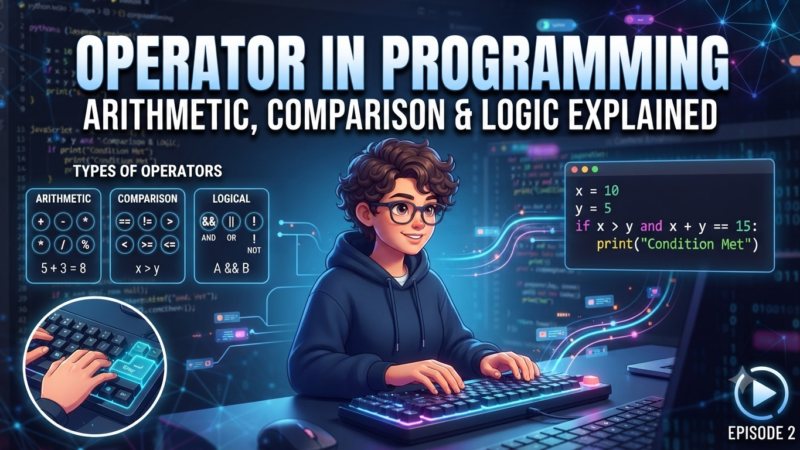
A variable is a special entity that stores data of a certain type. A variable gives this data a name and a location in memory. For example, in the expression “x = 10,” x is the variable and 10 is its value. Variables can range from simple integers to complex data structures. All programming is built on working with variables.
Instruction. An instruction is a shortened term for a command or set of commands in a programming language. It’s a collective term. It can include simple commands and operators like “do something,” as well as more complex control structures, such as a conditional statement (“do something if…”) or a loop. An instruction is the simplest unit of a programming language. Programs consist of a sequence of instructions.
Expression. The second type of primitive is an expression. This is something that needs to be calculated. An expression can contain instructions, and instructions can contain expressions. For example, the notation if (n == 10) is itself an instruction, and the == sign is an operator, which is also an instruction. However, n == 10 is an expression, not a computer command. The result is calculated, and instructions are executed based on that result.
Subroutine. Subroutines are used to isolate one code from another. This includes, for example, a loop body—a set of actions that must be executed cyclically. Or a function: a set of commands isolated from others. It can be accessed from anywhere in the program. Functions usually have names, like variables. Loop and conditional subroutines, however, don’t have names. They are executed only in conjunction with a control structure.
Object. In addition to simple variables, it’s sometimes necessary to store complex data, or even describe a single entity and its entire behavior. For this purpose, programming uses the concept of an object—a software structure with properties (data) and methods (functions, i.e., actions). Objects are the foundation of object-oriented programming, but they are also found in other coding styles.
What does commercial development look like?
People just beginning to learn programming sometimes struggle to relate their knowledge to real-world commercial development. Software development requires more than just knowing the syntax and basic capabilities of a language. It’s also important to be able to use a specific set of technologies, have skills in working with various libraries and frameworks, and understand how modern software is structured. There’s much more to it than just a programming language, but it’s entirely achievable.
In modern commercial development:
- actively use frameworks and software platforms to facilitate development;
- work in teams where each developer has their own tasks;
- debug, test, and refine code as the product develops;
- use version control systems;
- constantly learn something new and teach newcomers.
Therefore, it’s believed that becoming a developer without hands-on experience on real projects is difficult. You need to become familiar with the processes, workflow, and teamwork. So, modern courses offer internships or participation in open source projects to newcomers.
Is it possible to do without programming?
There’s a concept called zero code—creating apps without programming using specialized builders. Examples include building websites on Tilda and similar projects. Some believe that programmers will soon be obsolete. This isn’t true.
- Zero-coding services also need to be developed and maintained—that is, programmed. And converting them to zero-code on their own is practically impossible.
- Zero-coding isn’t universal, and you won’t be able to create anything complex or unique with it. You’ll still have to code and do a lot of other work.
- An app or website built using zero-code is tied to a specific service. This is inconvenient and makes developers dependent on a platform that’s difficult to migrate elsewhere.
Therefore, zero-code is a good tool for prototyping and simple tasks, but it won’t replace development. The same applies to artificial intelligence: it can write simple code, but it won’t solve a real problem. And AI is completely incapable of program optimization.
What makes programming attractive?
The programming profession is in demand and popular, attracting interest from even those who hadn’t previously considered working with computers. The reasons include high salaries, excellent working conditions, and an engaging, creative workflow. But that’s not the only appeal of the profession.
Programming is intellectual work: it challenges your thinking, teaching you to constantly learn new things and develop. It helps you think more structured and logically. And this approach can positively change not only your work but your life as well.
If you want to start programming, sign up for a course! We’ll help you master the language you’re interested in and find a job.
Explore More IT Terms
#
A
- A Guide to SQL Query Formatting for Beginners
- A/B testing
- Abstract Data Type (ADT)
- AES Encryption Algorithm: How It Works and Where It's Used
- Agile
- Algorithm
- Algorithm Analysis
- Algorithm Complexity
- Algorithm complexity: deep parsing O(log n)
- Algorithm vs. Program
- Algorithms and Data Structures in C#
- An overview of the C # programming language
- An overview of the Python programming language
- Anaconda Python
- Android
- Android App Bundle
- Android SDK
- Angular
- Ansible
- Apache
- Apache Airflow
- Apache Kafka
- Apache Tomcat
- App Store
- AppCode
- Applications of microcontrollers: From simple circuits in electronics to complex systems
- Applications of the derivative
- Arduino: How to Program It: Basics for Beginners
- Array-based stack
- ArrayList
- ASCII
- ASP.NET
- Assembly Language Lessons
B
C
D
- Data Analytics: applications of data analysis in companies
- Data Engineer - Who is it, what does a data engineer do, and an overview of the profession
- Data modeling: what it is, types, and process steps.
- Data preprocessing: a complete guide for beginners and professionals.
- Data structure
- Data Structures and Algorithms (DSA)
- Data types vs. Data structures
- Database Tests with Answers
- Deep Learning
- Defining Aliases
- Defining Arrays
- Deque
- Developing a Website from Scratch
- Differential Equations
- Differentiation of functions
- Digital data: understand the importance of this asset for businesses.
- Double integrals
- Doubly linked lists
- DSA Tutorial
E
F
G
H
- Handling errors and exceptions
- Heads or Tails? How Probability Theory Is Used in IT
- History of the development of computer science
- Homogeneous equations
- Homogeneous vs. non-homogeneous structures
- How to effectively organize your workflow
- How to Learn Java: Tips for Beginner Developers
- How to Learn PHP: A Beginner's Guide
- How to Use S3 Storage in Kubernetes with CSI
- HTML
- HTML and CSS: Definition, Application, and Operating Principles
- HTML and CSS. Layout from Scratch: What to Learn, Where to Learn, and How Long Will It Take?
- HTML Frame Structure
- HTML Link Formatting
I
- if..else construction
- Infinite sequences and series
- Information properties
- Inheritance in Java: A Complete Guide to Principles and Implementation
- Inserting an Image
- Integration of functions
- Interactive Python Tutorial – Learn Programming from Scratch
- Interpreter
- Interview Problem: Finding a Deleted Element in O(N)
- Interview Scare: The FizzBuzz Challenge
- Introduction to C++
- Introduction to Machine Learning
- Introduction to Networking | Network Fundamentals Part 1
- Introduction to Number Systems (Binary, Octal, Hexadecimal) | Math for CS Foundations #1
- IT Specialist Resume (CV)
J
K
L
M
- Machine Learning
- Machine Learning Basic Tool: NumPy
- Machine Learning Basic Tool: Pandas
- Machine Learning Mathematics
- Mathematics for programmers: what is really needed?
- MD5 encryption algorithm: What is it and why is it needed?
- Microcontroller and Microprocessor - what's the difference?
- ML Engineer: Who They Are, What They Do, How Much They Earn, and How to Become a Neural Network Specialist
- Monte Carlo Simulation: How It Works and What It's For
O
P
- PHP lessons
- Private DNS server and its configuration
- Program code
- Programmer's Dictionary
- Programming
- Programming with pseudocode
- Python Code Formatting Guide: PEP8
- Python for data analysis: how to do it and main libraries
- Python Lessons
- Python Superstar: 5 Ways to Use the * Operator
- Python vs. Julia: Should You Replace Python with Julia?
R
S
- SFML Graphics Library Tutorials
- Sorting Algorithms in Programming: Types, Descriptions, and Comparisons
- SQL commands: see what they are, what the main ones are + examples
- SQL Interview Questions and Tasks
- SQL Lessons
- SQL Stored Procedures
- SQL Syntactic Sugar: The COALESCE Function
- Stack
- Start in analytics: Python or R
- Static vs. dynamic data structures
- Statistical analysis: importance for decision making.
- String formatting in Python
- Structure of computer science
- Swift Lessons
- switch/match construct
- Syntax
T
- Terms in programming
- Text and paragraph formatting tags
- The concept of information and its transmission
- The Future of Python: Key Trends and Insights from Global Researc
- The Infrastructure of Code: A Complete Guide to Repositories for Languages, Frameworks, and Compilers
- The pip package manager in Python
- The role of informatization in the development of society
- Transfers
- Tutorials / Articles
- TypeScript: What It Is and Why Developers Need It
W
- What are databases, and why do they need DBMS and SQL?
- What do Linux distributions consist of?
- What is .NET and what is it used for?
- What is a data structure?
- What is a GPU in a computer, in simple terms?
- What is a quantum computer: 100,500 problems in one second
- What Is an Algorithm?
- What is Arduino: How it Works and the Platform's Capabilities
- What is Big Data? Introduction, Types, Characteristics, and Examples
- What is FizzBuzz Challenge?
- What is Golang and what is it used for?
- What is Haskell and what is it used for?
- What is Kotlin and what is it used for?
- What is Linux? The History of Linux
- What is machine learning, and how does it work?
- What is Power BI: everything about the data analytics software
- What is recursion, recursive and iterative process in programming?
- What is the C++ programming language?
- What is the OSI Model: A Complete Explanation of the Seven Layers and Their Role in Networking
- What's the difference between x86 and ARM processors?
- Where to start learning the C programming language?
- Which Linux distribution should you choose? A Linux distribution overview