RSA Encryption Algorithm: How It Protects Your Data When You Buy Online
- What is the RSA encryption algorithm? In simple terms
- How does the RSA algorithm work? No math, just logic.
- Where we meet RSA every day
- Why RSA Can Be Hacked—and How to Prevent It
- The Future of RSA: The Quantum Challenge
- RSA vs. ECC: Why Elliptic Curves Are Becoming More of a Choice
- How to check that RSA is working correctly on a website
- RSA is not about mathematics; it’s about freedom
- Briefly about the RSA algorithm
What is the RSA encryption algorithm? In simple terms
The RSA encryption algorithm is an asymmetric cryptosystem that allows two parties to exchange secret data without ever meeting or knowing each other. It protects your passwords, bank transfers, electronic signatures, and even your WhatsApp messages.
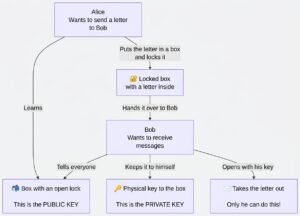
It’s like you wanted to send a letter to a friend but didn’t trust the post office.
You give them an open lock—one that can be closed but not opened. They put the letter in a box, lock it with your lock, and send it back. Now, even if the letter is intercepted, no one will be able to read it. Because only you can open it—you have the private key.
This is asymmetric encryption—the keys are different. Unlike symmetric encryption (where one key is used for both encryption and decryption), here the public key can be shared with everyone, while the private key is kept secret.
The algorithm is named after the three mathematicians—Rivest, Shamir, and Adleman—who introduced it in 1977. Since then, it has become the basis for HTTPS, SSL, PGP, SSH, and thousands of other systems you use every day.
How does the RSA algorithm work? No math, just logic.
Yes, RSA is built on complex number theory. But you don’t need to understand modular arithmetic to understand how it works.
Here’s a simple diagram.
- First, two keys are generated.
- Two large prime numbers are chosen, say p and q.
- In practice, these are numbers with 600+ digits.
- They are multiplied: n = p × q. This number becomes the basis of both keys.
- Based on this, two more numbers are calculated: e and d.
A public key is a pair (e, n). It can be shown to everyone.
The private key is a pair (d, n). It is kept secret.
When you submit data—for example, a card number—the system:
- Converts it to a number;
- Raises it to the power e modulo n;
- The result is an encrypted code.
The server takes this code, raises it to the power d modulo n, and gets the original number.
Why does this work?
Because it’s mathematically easy to multiply two numbers together, but it’s impossible to quickly factor the result back into its factors if they’re large enough. It’s like finding that 17 × 11 = 187—easy. Now try guessing which two prime numbers yielded 187—harder. And what if the number is 2048 bits long? Then even a supercomputer would need thousands of years.
Where we meet RSA every day
Do you think RSA is just something for programmers? No. It works behind the scenes—and you encounter it dozens of times a day.
Every time you visit a website with https://, your browser and server use RSA. The server sends the public key via an SSL certificate. The browser encrypts a temporary session key and sends it. After this, all traffic is encrypted quickly, but the key for it was transmitted via RSA.
Without RSA, HTTPS wouldn’t exist. You wouldn’t be able to securely log into a bank, buy tickets, or even access your email.
When you download a Windows or Telegram update, and the system says, “Signature valid,” it’s RSA. The developer signed the file with their private key. Your computer verified the signature with their public key and confirmed that the file hasn’t been tampered with.
Signing contracts through government services? Transfers to Sber or Tinkoff? Cryptocurrency wallets? All of this is RSA.
Important: RSA doesn’t encrypt the entire file. It only transmits the key. AES does the main encryption—it’s faster. RSA is the key to the door. After that, the fast lane begins.
Why RSA Can Be Hacked—and How to Prevent It
RSA is secure, but only if used correctly. Three main flaws make it vulnerable:
- Short keys.
A 512-bit key is like a child’s toy lock. It was cracked back in 1999. A 1024-bit key is considered insecure. The minimum standard today is 2048 bits. For financial systems and government contracts, 3072 or 4096 bits are recommended. If you’re a user, make sure the websites where you enter data use 2048+ bits. If you’re a developer, never use keys shorter than 2048 bits.
- A weak random number generator.
RSA requires truly random prime numbers. If the generator is predictable, an attacker can guess p and q. In 2008, a bug in Debian OpenSSL resulted in hundreds of thousands of SSL certificates being generated with identical numbers. They were easily cracked. The solution is to use trusted libraries and high-entropy systems, such as /dev/urandom on Linux. - No padding.
If you encrypt a “bare” message, you can guess the patterns. Two identical card numbers will yield the same cipher. The solution is OAEP. This is a scheme that adds randomness. Modern libraries do this automatically—just leave it enabled.
The Future of RSA: The Quantum Challenge
Yes, RSA isn’t perfect. The main threat is quantum computers. Shor’s algorithm, running on a quantum computer, can factorize large numbers in hours instead of thousands of years. This means RSA-2048 will become vulnerable.
Such computers don’t exist yet. But the “build now, decrypt later” attack already exists. Hackers can intercept your encrypted data today and decrypt it in 10 years, when quantum computers are available.
What do professionals do?
NIST has already standardized the first post-quantum algorithms: CRYSTALS-Kyber and Dilithium. Companies are switching to hybrid schemes: RSA + the new algorithm. Banks and government agencies are already testing the transition.
But RSA isn’t going away tomorrow. It’s installed in millions of devices, from smartphones to banking terminals. It works in legacy systems that haven’t been updated in decades. RSA remains the most secure key exchange method for classic computers.
RSA isn’t obsolete. It’s just no longer the only option. It remains secure for most tasks. For long-term projects, it’s worth preparing for the transition.
RSA vs. ECC: Why Elliptic Curves Are Becoming More of a Choice
We mentioned that RSA is slow. That’s why more and more systems are switching to ECC—elliptic curve cryptography.
ECC provides the same security as RSA-2048, but with a key 10 times shorter.
256 bits versus 2048. This is important for mobile devices, IoT sensors, and blockchain. However, ECC is less common. If you’re not a developer, this isn’t your problem. Your browser and bank will choose the best option.
How to check that RSA is working correctly on a website
Just open any website with https://—for example, your bank or store. Look for the lock icon in the address bar. If it says “2048 bits” or higher, everything is fine. If it says “1024 bits,” the site uses an outdated standard. Such sites may be less secure, and it’s best not to enter sensitive data there.
You might see information like “Certificate is valid” or “Encryption: 2048-bit.” If it says “2048-bit” or higher, everything is fine. If it says “1024-bit,” the site is outdated. Such sites can be dangerous.
For those who want to check the reliability of their resource, SSL Labs is a free service that will tell you how secure your site is in just a few seconds.
RSA is not about mathematics; it’s about freedom
The RSA encryption algorithm isn’t just a formula. It’s the result of the efforts of three mathematicians—Rivest, Shamir, and Adleman—who wanted you to be able to live in the digital world without fearing for your data.
But while it works, you can:
– pay for purchases online;
– write confidential letters;
– trust digital signatures.
If you’re not a developer, you don’t need to know how it works. But you should know: without the right RSA, your security is an illusion. Check your certificates. Don’t ignore browser warnings. Keep up with updates. Because security isn’t about technology. It’s about making informed choices.
Briefly about the RSA algorithm
The RSA encryption algorithm is an asymmetric system where data is encrypted with a public key and decrypted with a private key.
It works behind the scenes in HTTPS, digital signatures, and banking.
It’s secure when used with a 2048-4096-bit key and proper padding (OAEP).
Its main threat is quantum computers, but they haven’t been created yet.
RSA isn’t the only option right now, but it’s still one of the most reliable.
To protect yourself, make sure that the sites where you enter data use 2048-bit keys.
RSA isn’t about math. It’s about your ability to live securely in the digital world.
Explore More IT Terms
#
A
- A Guide to SQL Query Formatting
- A/B testing
- AES Encryption Algorithm: How It Works and Where It's Used
- Agile
- Algorithm
- Algorithm complexity in 5 minutes
- Algorithms and Data Structures in C#
- An overview of the C # programming language
- An overview of the Python programming language
- Anaconda Python
- Android
- Android App Bundle
- Android SDK
- Angular
- Ansible
- Apache
- Apache Airflow
- Apache Kafka
- Apache Tomcat
- App Store
- AppCode
- Applications of microcontrollers: From simple circuits in electronics to complex systems
- Applications of the derivative
- Arduino: How to Program It: Basics for Beginners
- Array-based stack
- ArrayList
- ASCII
- ASP.NET
- Assembly Language Lessons
B
C
D
- Data Analytics: applications of data analysis in companies
- Data Engineer - Who is it, what does a data engineer do, and an overview of the profession
- Data modeling: what it is, types, and process steps.
- Data preprocessing: a complete guide for beginners and professionals.
- Data structure
- Database Tests with Answers
- Deep Learning
- Defining Aliases
- Defining Arrays
- Deque
- Developing a Website from Scratch
- Differential Equations
- Differentiation of functions
- Digital data: understand the importance of this asset for businesses.
- Double integrals
- Doubly linked lists
E
F
H
- Handling errors and exceptions
- Heads or Tails? How Probability Theory Is Used in IT
- History of the development of computer science
- How to effectively organize your workflow
- How to Learn Java: Tips for Beginner Developers
- How to Learn PHP: A Beginner's Guide
- How to Use S3 Storage in Kubernetes with CSI
- HTML
- HTML and CSS: Definition, Application, and Operating Principles
- HTML and CSS. Layout from Scratch: What to Learn, Where to Learn, and How Long Will It Take?
- HTML Frame Structure
- HTML Link Formatting
I
- if..else construction
- Infinite sequences and series
- Information properties
- Inheritance in Java: A Complete Guide to Principles and Implementation
- Inserting an Image
- Integration of functions
- Interactive Python Tutorial – Learn Programming from Scratch
- Interpreter
- Interview Problem: Finding a Deleted Element in O(N)
- Interview Scare: The FizzBuzz Challenge
- Introduction to C++
- Introduction to Machine Learning
- Introduction to Networking | Network Fundamentals Part 1
- Introduction to Number Systems (Binary, Octal, Hexadecimal) | Math for CS Foundations #1
- IT Specialist Resume (CV)
J
K
M
- Machine Learning
- Machine Learning Basic Tool: NumPy
- Machine Learning Basic Tool: Pandas
- Machine Learning Mathematics
- Mathematics for programmers: what is really needed?
- MD5 encryption algorithm: What is it and why is it needed?
- Microcontroller and Microprocessor - what's the difference?
- ML Engineer: Who They Are, What They Do, How Much They Earn, and How to Become a Neural Network Specialist
- Monte Carlo Simulation: How It Works and What It's For
O
P
- PHP lessons
- Private DNS server and its configuration
- Program code
- Programmer's Dictionary
- Programming
- Programming with pseudocode
- Python Code Formatting Guide: PEP8
- Python for data analysis: how to do it and main libraries
- Python Lessons
- Python Superstar: 5 Ways to Use the * Operator
- Python vs. Julia: Should You Replace Python with Julia?
R
S
- SFML Graphics Library Tutorials
- Sorting Algorithms in Programming: Types, Descriptions, and Comparisons
- SQL commands: see what they are, what the main ones are + examples
- SQL Interview Questions and Tasks
- SQL Lessons
- SQL Stored Procedures
- SQL Syntactic Sugar: The COALESCE Function
- Stack
- Start in analytics: Python or R
- Statistical analysis: importance for decision making.
- String formatting in Python
- Structure of computer science
- Swift Lessons
- switch/match construct
- Syntax
T
- Terms in programming
- Text and paragraph formatting tags
- The concept of information and its transmission
- The Future of Python: Key Trends and Insights from Global Researc
- The Infrastructure of Code: A Complete Guide to Repositories for Languages, Frameworks, and Compilers
- The pip package manager in Python
- The role of informatization in the development of society
- Transfers
- Tutorials / Articles
- TypeScript: What It Is and Why Developers Need It
W
- What are databases, and why do they need DBMS and SQL?
- What do Linux distributions consist of?
- What is .NET and what is it used for?
- What is a GPU in a computer, in simple terms?
- What is a quantum computer: 100,500 problems in one second
- What is Arduino: How it Works and the Platform's Capabilities
- What is Big Data? Introduction, Types, Characteristics, and Examples
- What is Golang and what is it used for?
- What is Haskell and what is it used for?
- What is Kotlin and what is it used for?
- What is Linux? The History of Linux
- What is machine learning, and how does it work?
- What is Power BI: everything about the data analytics software
- What is the C++ programming language?
- What is the OSI Model: A Complete Explanation of the Seven Layers and Their Role in Networking
- What's the difference between x86 and ARM processors?
- Where to start learning the C programming language?
- Which Linux distribution should you choose? A Linux distribution overview