Applications of microcontrollers: From simple circuits in electronics to complex systems
- Simple circuits
- Advantages of microcontrollers in simple circuits
- Popular circuit design platforms: Arduino and Raspberry Pi
- Complex control systems
- Features of programming and designing complex systems
- Choosing a microcontroller for a project
- Selecting a microcontroller type
- Equipment for working with microcontrollers
A microcontroller (MC) is a miniature computer on a single integrated circuit, designed to control specific tasks in electronic systems.
In 1971, the processor, memory, and peripherals were successfully combined into a single package. Since then, the development of microcontrollers and microprocessors has proceeded in parallel. The era of computer automation in control systems was dawning. The demand for miniature devices interacting with the environment was growing rapidly.
Gordon Moore, co-founder of the American electronics manufacturer Intel, formulated Moore’s Law, which defines the trend in the development of microprocessor technology. According to this law, the number of transistors in an integrated circuit doubles every two years, leading to a sharp increase in computing power and a decrease in cost.
The technological advancement and relatively low production costs have led to a growing diversity of microcontrollers in terms of computing power and affordability. Therefore, they are used in both simple circuits, such as blinking LEDs, and complex control systems, including industrial automation, robotics, and smart home equipment.
This article examines current trends in microcontroller use, including AVR, ARM, and PIC, as well as the popular Arduino and Raspberry Pi platforms based on them. It highlights their advantages and disadvantages, helping both beginners and professionals adapt to the rapidly changing world of microelectronics.
Simple circuits
To better understand what a microcontroller is and its strengths and weaknesses, let’s start with the simple.
Examples of diagrams
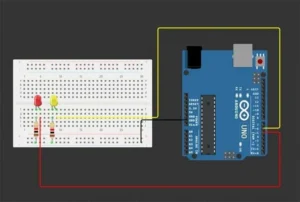
LED flasher
An example of the simplest circuit is an LED flasher, which consists of:
- MC;
- stabilizer microcircuits (optional if the required voltage is supplied) LED;
- Resistor (to limit the current through the LED).
Operating principle
The MC turns the LED on and off at a frequency specified by the program embedded in it.
Reading data from a sensor (more complex example)
This circuit is more engaging for beginners. It will help them build useful devices for the home, thereby increasing their motivation to learn electronics.
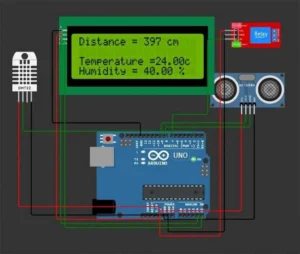
For example, it is possible to make devices for measuring the temperature and humidity of the environment.
The scheme includes:
- MC;
- temperature sensor;
- humidity sensor;
- two resistors (to pull up signals in the sensor circuit);
- indicator.
Operating principle
The MC reads data from sensors at specified time intervals, processes it, and sends it to the indicator.
The prototype can be supplemented with indicators, such as atmospheric pressure, illumination, sound level, and so on. This requires the appropriate sensors and a simple program modification. It’s also possible, for example, to connect an audible or visual alarm for excessive temperature, but only through a relay to ensure sufficient power. This can be accomplished with virtually no expense, simply by modifying the program. Using simple microcontrollers, dozens of device modifications can be implemented without resorting to complex hardware redesign.
Advantages of microcontrollers in simple circuits
- The control algorithms are stored in memory as a program that can be adjusted during debugging without changing the circuit’s fundamentals. For example, the LED blinking time intervals in the circuit shown above can be easily changed.
- Design simplification. Fewer discrete components required result in more compact circuits.
- Time savings. Less time is spent on assembling and configuring the circuit.
- Debugging and diagnostics. It’s easier to identify and fix errors in code and hardware using debugging tools.
These characteristics make the MC a good choice for radio amateurs and students who want to create projects.
Popular circuit design platforms: Arduino and Raspberry Pi
This flexibility and versatility of microcontrollers have led to the emergence of modular designs that simplify the development and debugging of circuit prototypes. Among these, the Arduino and Raspberry Pi platforms stand out.
Arduino
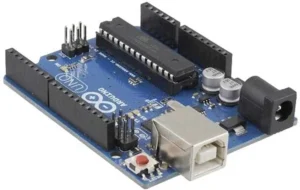
Arduino is a versatile platform suitable for projects that integrate sensors with actuators. Its features include:
- ease of use and accessibility of a huge library, technical support;
- ease of programming thanks to an understandable language based on C/C++;
- variety of boards in terms of power and functionality;
- The availability of additional expansion boards—shields—designed with a special form factor makes it easy to assemble electronic designs with the required functionality.
Many Arduino simulator programs have also been developed for developing and initially debugging simple bare-metal circuits on a computer or tablet. These include UnoArduSim, as well as cloud-based simulators like Tinkercad and Arduino Create.
Application area:
- Educational and developmental projects.
- Creating models “on the fly” to solve modular problems is often encountered in professional environments.
- Home automation devices.
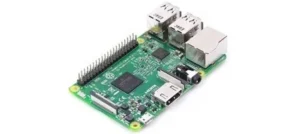
Raspberry Pi
Raspberry Pi is a mini-computer that can solve complex problems. Its features include:
- Thanks to the Linux-based operating system and computing power, multitasking operations are performed;
- With his participation, network applications are created;
- Support for Python and other programming languages ensures adaptation to complex projects.
Application area:
- Complex projects requiring network solutions (e.g., remote control).
- Processing large amounts of data, such as image analysis.
- Multilingual programming.
Comparison of Arduino and Raspberry Pi platforms
- Entry barrier. Arduino is easier for beginners.
- Application: Arduino is better suited for simple projects, while Raspberry Pi is better at multitasking.
- Computing power. Raspberry Pi is ahead in performance.
- Cost. Arduino is often cheaper.
- Power consumption. Arduino is the leader in portable devices that require energy consumption. Raspberry Pi is even more sensitive to power quality.
The choice between Arduino and Raspberry Pi is determined by the scale of the project. Both platforms allow for the creation of various circuits, but require different levels of developer experience. To solve combined problems, projects are created using both platforms simultaneously, leveraging the strengths of both. For example, in robotics, the Arduino handles peripheral communications, while the Raspberry Pi serves as the computing center. If you’re just starting, it’s recommended to start with a simpler platform, such as Arduino.
Complex control systems
The advantages of microcontrollers in simple circuits have been appreciated.
Let us now consider their advantages in complex systems.
Examples of complex control systems
Automation in a smart home
The idea of home automation was conceived by Nikola Tesla in the late 19th century. But it remained just an idea—the technology to implement it was lacking. Attempts at practical implementation were made by the American Emil Mathias in the mid-20th century. But back then, it was too complex and impractical, so it never gained widespread acceptance. Today, the “smart home” is no longer a rarity. We can thank the microcontroller for this—the heart and brain of electronic devices, without which they would not function. Modern microcontrollers make it possible to build flexible and adaptive solutions by analyzing input data from various sensors.
A “smart home” is a microcontroller with sensors and actuators connected to it. Its embedded software can turn on lights based on a signal from an acoustic sensor, shut off a water tap based on a signal from a leak detector, alert a resident to the smell of gas in the apartment via SMS, and perform other actions within the smart home’s capabilities. Thanks to the microcontroller’s ability to process and store data, more precise customization of system operation scenarios is possible.
Robotics
Today, robotics isn’t just about iron androids planned for the exploration of other planets. It’s come to homes in the form of vacuum cleaners, window and floor washers, educational and entertainment robots, and, finally, robot toys. And microcontrollers have played a significant, if not the primary, role in this. In all these robots, microcontrollers control actuators based on sensor signals. Microcontrollers are used to quickly process information from sensors, motors, gyroscopes, and other actuators. Multiple independent input/output ports allow microcontrollers to simultaneously control different modules.
Application in medicine
Yes, both the blue-eyed robot caregiver Garmi from the Munich Institute of Robotics and Machine Intelligence for caring for the elderly and sick, and the brunette Nadine, who smiles sweetly at her patients at the Institute of Media Innovation at Nanyang Technological University in Singapore, are packed with various microcontrollers. The American company Perceptive is creating and is already successfully testing a dental robot… The microcontrollers in such devices ensure precise coordination of movements and analysis of received sensory data. However, medicine needs not only sensational inventions but also primitive devices to assist nurses, lab technicians, and massage therapists. And this miracle of electronic technology—His Majesty the microcontroller—is everywhere.
Application in nuclear power plants
Nuclear power plants (NPPs) are leaders in terms of energy efficiency and the environmental friendliness of the electricity they generate. However, they are also complex and unsafe facilities. To avoid paying a high price for cheap energy, human error in plant operation must be eliminated as much as possible. To this end, NPPs have implemented specialized automated process control systems (APCS), which also rely on microcontrollers. Complex control systems built on microcontrollers ensure high reliability and minimal operator intervention.
Application on unmanned aerial vehicles (UAVs)
The use of unmanned aerial vehicles for scientific research, surveying, and military purposes is now on the rise. Avionics—a complex of onboard electronic devices that includes control units, including flight and navigation controls—represent the core of flying drones. And microcontrollers again! Microcontrollers ensure continuous communication between navigation sensors and flight control systems.
Application in the automotive industry
A modern car won’t move without electronics. Microcontrollers regulate fuel and ignition timing in the engine management system. They monitor ABS and ESP sensor signals to prevent accidents. They display key vehicle parameters and hazard warning lights on the driver’s monitor. Furthermore, microcontrollers analyze data from cameras and radars to quickly respond to changing road conditions.
Finally, microcontrollers play a key role in the control systems of self-driving cars. They process signals from camera, lidar, and radar sensors, allowing the car to determine its location and surroundings. They control driving modes, provide automated braking and maneuvering, and interact with other road users. Modern automotive electronics utilize multiple microcontrollers operating in parallel across different modules.
Features of programming and designing complex systems
Complex systems are subject to stringent reliability requirements, including durability, uptime, resistance to external factors, and maintainability. Therefore, when designing complex systems, specialized circuit design techniques and careful selection of components are required. Programming such devices requires precision and an understanding of the logic of data exchange between components. In particular, microcontrollers must be selected not only based on computing power, but also on acceptable ranges of temperatures, vibrations, shock, and ionizing radiation, as well as other parameters based on specific operating conditions. Furthermore, reliability is affected by the quality of the tools and software used during development and manufacturing. For example, a poor-quality programmer can cause a program to be loaded into memory with errors, leading to unpredictable consequences. If a project uses more than one circuit, the interaction between the microcontrollers of different components must be carefully considered.
Choosing a microcontroller for a project
Since the microcontroller is the most important component of any modern electronic device, circuit design begins with its selection. The effectiveness of the design ultimately depends on how accurately the microcontroller is selected.
Factors influencing the choice of a microcontroller
Performance
Basic performance parameters:
- clock frequency (MHz or GHz);
- number of processor cores;
- multithreading support.
Storage device (SD)
Basic types:
- Random Access Memory (RAM). Used for temporary data storage and program execution.
- Read-only memory (ROM). Stores software permanently, including firmware.
- Flash. It has the properties of RAM and ROM, i.e., it allows data to be written and erased.
Periphery
The MC’s peripherals are the interfaces for communicating with external devices. The main ones are:
- UART, I2C, SPI for interaction with other devices;
- GPIO for controlling external components;
- ADC/DAC for working with analog signals.
Selecting a microcontroller type
Consumer demand, technological advances, and manufacturer competition have flooded the market with a wide variety of microcontrollers, varying in bit depth and architecture. Navigating this flood of options will help developers improve design efficiency.
Bit depth
The processor’s bit depth determines the internal memory capacity and performance limits. Depending on the type, serial microcontrollers have bit depths of 4, 8, 16, 32, and 64.
Architecture
The architecture of the microcontroller is determined by the command system and the method of organizing the memory
There are two types of instruction set architecture: RISC and CISC. Learn more about them:
- RISC (Reduced Instruction Set Computer) is an architecture that uses a reduced instruction set. This enables high speed operation with low power consumption. It is suitable for tasks with stringent performance and power consumption requirements. It is built into popular AVR, ARM, and PIC microcontrollers.
- CISC (Complex Instruction Set Computer) is a type of architecture with a large, specialized, and complex instruction set. This type of microcontroller is suitable for complex operations, but this has a negative impact on performance. Microcontrollers with CISC architecture are produced by Zilog, Intel, Motololla, and Siemens.
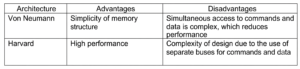
Program and data codes are stored in the memory. Memory is divided into Von Neumann and Harvard types.
Von Neumann architecture. Instructions and data are not separated in memory. This simplifies the design but can create performance bottlenecks when accessing them simultaneously.
- Advantages: Simplicity of structure
- Disadvantages: Limited performance when working with large amounts of data.
Harvard architecture. Commands and data are stored in separate areas. This improves performance through parallel information exchange.
- Advantages: High-speed data access, efficient operation.
- Disadvantages: Complex architecture; requires more components.
Comparison of architectures
AVR microcontrollers
The acronym AVR stands for Advanced Virtual RISC. Its history began in 1996 at Atmel, later acquired by Microchip.
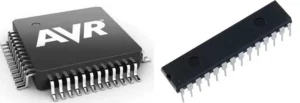
Currently, three subfamilies are popular:
tinyAVR (ATtinyxxx), megaAVR (ATmegaxxx) and XMEGA AVR (ATxmegaxxx)
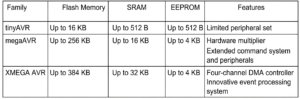
TinyAVR is used for simple applications
The MegaAVR’s popularity stems from its multitude of built-in peripherals. It’s suitable for complex projects and solutions.
XmegaAVR is more suitable for complex tasks that require large program memory and high processing speed. It is most commonly found in commercial solutions.
ARM microcontroller
ARM is an acronym for Advanced RISC Machines.
ARM does not manufacture chips, but it designs microprocessors and licenses its technology to third parties for chip production.
For example, STMicroelectronics produces the STM32 family of 32-bit microcontrollers based on 32-bit ARM cores. These include the Cortex-M33, Cortex-M7F, Cortex-M4F, Cortex-M3, Cortex-M0+, and Cortex-M0.
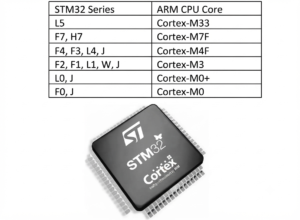
These MCs have impressive parameters even for a wide range of applications:
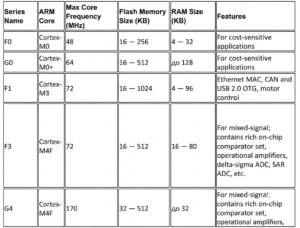
A wide range of products and free software (STM32CubeIDE) have made these microcontrollers popular among both amateurs and professionals.
PIC microcontroller
8, 16,, and 32-bit PIC (peripheral interface controller) microcontrollers from Microchip Technology Inc. consist of 4 large families:
- PIC10 (10FXXX).
- PIC12 (PIC12FXXX).
- PIC16 (16FXXX).
- PIC 17/18(18FXXX).
Specifications:
- RISC is a standard instruction set architecture.
- Harvard ZU architecture.
- Clock frequency: up to 64 MHz.
- Memory: up to 128 KB Flash, up to 4 KB RAM.
- Peripherals: UART, I2C, SPI, ADC.
These microcontrollers are distinguished by good continuity across different families. They offer software compatibility (shared development tools: the free MPLAB IDE, shared libraries, and common stacks for the most popular data transfer protocols), pin compatibility, peripheral compatibility, and supply voltage compatibility.
Key Differences Between AVR, ARM, and PIC Microcontrollers
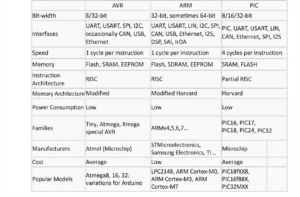
Equipment for working with microcontrollers
Microcontroller programming involves loading a digital code into the memory. A special electronic device called a programmer is used for this purpose. Programmers are categorized by purpose into hobbyist and professional, universal and specialized. Before purchasing a programmer, it’s important to ensure it supports the desired microcontroller type.
Universal programmers are characterized by a wide range of programmable element types. Therefore, they are more in demand in design bureaus and laboratories. They are also popular among radio amateurs.
Universal programmer RT809F
This is an effective, reliable and relatively inexpensive universal programmer from the Chinese company Ifix.
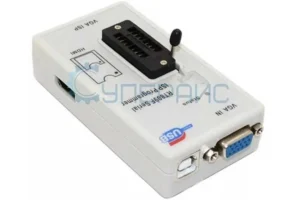
Advantages:
- It is not demanding on computer power; a Pentium IV with Windows XP OS is sufficient.
- The software is easily installed using the utility from the included installation package.
- The built-in generator will help repair TVs and monitors with HDMI and VGA signals.
- Performs a Pin test on every operation with the programmable chip to detect poor contacts with the pins.
RT809F Specifications
| Microcontroller support | AVR, ATMEGA, Attiny, PIC, AT90, AT89S |
| Memory support | EEPROM, Flash, 24, 25, 26, 93, 95 |
| OS compatibility | Windows 2000/XP/2003/2008/Vista/7 |
| Exit | VGA, HDMI |
| Entrance | VGA |
| Interfaces | ICSP, I2C, UART, JTAG |
| Special software features | Smart Identify SmartID, Auto ISP |
| Operating voltage | 5 V |
| Panel | ZIF16-pin with zero gain and locking handle |
| LED indication | nutrition |
| General characteristics | |
| Power supply | USB 5V |
| Dimensions | 103 x 50 x 27 mm |
| Weight | 100 g |
| Equipment | programmer RT809F – 1 pc USB cable – 1 pc VGA cable – 1 pc SOP adapter – 1 pc |
| Compatibility | A set of adapters for the programmer (SOP8/16-DIP8) Adapters for programming chips in SOP8/16/20/28 packages (5 pcs.) EDID cable for programming LED matrices SPI adapter 3V – 1.8V A set of adapters for programming chips (20 pcs.) PLCC socket adapters for chips (5 in 1 set) A set of adapters for chips in PLCC packages (6 in 1) Adapters for programming chips with PLCC IC extractor (18 in 1 set) SSOP8/TSSOP8-DIP8 socket adapter |
Xhorse VVDI PROG Automotive Microchip Programmer
In a modern car, electronics have certain specific features, to which manufacturers of electronic components adapt, and subsequently, manufacturers of the corresponding equipment.
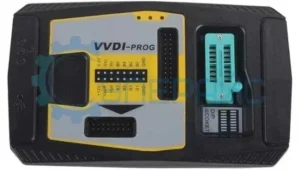
The Xhorse VVDI PROG automotive chip programmer from Xhorse, a recognized leader in automotive electronics development, is designed specifically for working with memory chips, processors in engine control units (ECUs), immobilizers, instrument clusters, and write-protected transponder chips.
Advantages:
- Technical support from the manufacturer.
- VVDI Prog software supports Russian localization and has detailed connection instructions.
- Built-in software that allows you to update the VVDIProg firmware in a timely manner.
- Built-in self-test function.
Functional:
- Supports R&W chips and most EEPROM and other chips.
- Support chip data checking and empty function checking.
- Support data file comparison function.
- Support reading and writing BMW N20, N55 ECU (directly show ISN).
- Stable reading and writing of MC9S12XE series chips.
- (5M48H/1N35H/2M53J/3M25J, etc.).
- Support for the updated PCF79XX remote control, currently supporting the BMW E/F series.
- Has an extensive database of connection diagrams.
The purpose of this article was to highlight the place of electronics in the world and its development prospects. To create an understanding that electronics is not the exclusive domain of scientists and engineers.
Amateur radio is growing in popularity. Microcontrollers are becoming more accessible and easier to learn, opening up new opportunities for experimentation and innovation. Educational institutions are increasingly integrating modern technologies into their curricula, teaching students the basics of design and programming.
For those just starting with microcontrollers, the popular Arduino and Raspberry Pi platforms are a good place to start. They offer tremendous opportunities for both hobbyist and serious projects, boast user-friendly interfaces, and extensive communities where advice and support are always available. And, after all, electronics are fun!
Explore More IT Terms
#
- Using an integrating factor
- Equations in total differentials
- Bernoulli's equation
- Linear differential equations of the first order
- 10 Mixed C++ Challenges to Test Your Skills
- 11 Tricky Non-Technical Questions to Ask in a Recruiting Interview
- 50 Terms Every Programmer Should Know
- 52 Java Thread Interview Questions
- 7 Levels of Using the Zip Function in Python
- 7 Python Code Bugs You Need to Fix
- 70+ Free Resources for Learning Programming
A
- A Comprehensive Guide to HTML and CSS
- A Comprehensive Guide to MODX CMS
- A computer science question tests your ability to work with IP addresses and network masks
- A Guide to SQL Query Formatting for Beginners
- A/B testing
- Abstract Data Type (ADT)
- AES Encryption Algorithm: How It Works and Where It's Used
- Agile
- Algorithm
- Algorithm Analysis
- Algorithm Complexity-Key Points
- Algorithm complexity: deep parsing O(log n)
- Algorithm vs. Program
- Algorithms and Data Structures in C#
- An overview of the C # programming language
- An overview of the Python programming language
- Anaconda Python
- Analysis of graphs and adjacency matrices question
- Android
- Android App Bundle
- Android SDK
- Angular
- Ansible
- Apache
- Apache Airflow
- Apache Kafka
- Apache Tomcat
- App Store
- AppCode
- Applications of microcontrollers: From simple circuits in electronics to complex systems
- Applications of the derivative
- Arduino: How to Program It: Basics for Beginners
- Array-based stack
- ArrayList
- ASCII
- ASP.NET
- Assembly Language Lessons
B
C
- C++ Lessons
- Cache
- Calculating Memory Capacity
- Character sets and encodings
- Characteristics of a good Algorithm
- Circular singly linked list
- Coding Tests with Answers
- Combinational Circuits Solved Questions
- Compiler
- Complexity of algorithms-Tutorial
- Computer Science Fundamentals Test with Answers (47 questions)
- Computer science tests with answers (More than 100 Questions)
- Constants
- Creating a Table in HTML
- Creating Forms in HTML
- Creating Lists
- Cybernetics and informatics
- Cycles
D
- Data Analytics: applications of data analysis in companies
- Data Engineer - Who is it, what does a data engineer do, and an overview of the profession
- Data modeling: what it is, types, and process steps.
- Data preprocessing: a complete guide for beginners and professionals.
- Data structure
- Data Structures and Algorithms (DSA)
- Data types vs. Data structures
- Database Tests with Answers
- Deep Learning
- Defining Aliases
- Defining Arrays
- Deque
- Detailed articles and tutorials on PHP
- Developing a Website from Scratch
- Differential Equations
- Differentiation of functions
- Digital data: understand the importance of this asset for businesses.
- Double integrals
- Doubly linked lists
- DSA Tutorial
E
F
G
H
- Handling errors and exceptions
- Heads or Tails? How Probability Theory Is Used in IT
- History of the development of computer science
- Homogeneous equations
- Homogeneous vs. non-homogeneous structures
- How to effectively organize your workflow
- How to Learn Java: Tips for Beginner Developers
- How to Learn PHP: A Beginner's Guide
- How to Use S3 Storage in Kubernetes with CSI
- HTML
- HTML and CSS: Definition, Application, and Operating Principles
- HTML and CSS. Layout from Scratch: What to Learn, Where to Learn, and How Long Will It Take?
- HTML Frame Structure
- HTML Link Formatting
- HTML Quizzes with Answers
I
- if..else construction
- Infinite sequences and series
- Information properties
- Inheritance in Java: A Complete Guide to Principles and Implementation
- Inserting an Image
- Integration of functions
- Interactive Python Tutorial – Learn Programming from Scratch
- Interpreter
- Interview Problem: Finding a Deleted Element in O(N)
- Interview Scare: The FizzBuzz Challenge
- Introduction to C++
- Introduction to Machine Learning
- Introduction to Networking | Network Fundamentals Part 1
- Introduction to Number Systems (Binary, Octal, Hexadecimal) | Math for CS Foundations #1
- IT Specialist Resume (CV)
J
K
L
M
- Machine Learning
- Machine Learning Basic Tool: NumPy
- Machine Learning Basic Tool: Pandas
- Machine Learning Mathematics
- Mathematics for programmers: what is really needed?
- MD5 encryption algorithm: What is it and why is it needed?
- Microcontroller and Microprocessor - what's the difference?
- ML Engineer: Who They Are, What They Do, How Much They Earn, and How to Become a Neural Network Specialist
- Monte Carlo Simulation: How It Works and What It's For
O
P
- PHP lessons
- Private DNS server and its configuration
- Program code
- Programmer's Dictionary
- Programming
- Programming with pseudocode
- Python Code Formatting Guide: PEP8
- Python for data analysis: how to do it and main libraries
- Python Lessons
- Python Superstar: 5 Ways to Use the * Operator
- Python vs. Julia: Should You Replace Python with Julia?
R
S
- SFML Graphics Library Tutorials
- Sorting Algorithms in Programming: Types, Descriptions, and Comparisons
- SQL commands: see what they are, what the main ones are + examples
- SQL Interview Questions and Tasks
- SQL Lessons
- SQL Stored Procedures
- SQL Syntactic Sugar: The COALESCE Function
- Stack
- Start in analytics: Python or R
- Static vs. dynamic data structures
- Statistical analysis: importance for decision making.
- String formatting in Python
- Structure of computer science
- Swift Lessons
- switch/match construct
- Syntax
T
- Terms in programming
- Text and paragraph formatting tags
- The Complete Guide to Bootstrap
- The Complete Guide to JavaScript
- The concept of information and its transmission
- The Future of Python: Key Trends and Insights from Global Researc
- The Infrastructure of Code: A Complete Guide to Repositories for Languages, Frameworks, and Compilers
- The pip package manager in Python
- The role of informatization in the development of society
- Transfers
- Tricky Java Questions Often Asked in Interviews
- Tutorials / Articles
- TypeScript: What It Is and Why Developers Need It
W
- What are databases, and why do they need DBMS and SQL?
- What do Linux distributions consist of?
- What is .NET and what is it used for?
- What is a data structure?
- What is a GPU in a computer, in simple terms?
- What is a quantum computer: 100,500 problems in one second
- What Is an Algorithm?
- What is Arduino: How it Works and the Platform's Capabilities
- What is Big Data? Introduction, Types, Characteristics, and Examples
- What is FizzBuzz Challenge?
- What is Golang and what is it used for?
- What is Haskell and what is it used for?
- What is Kotlin and what is it used for?
- What is Linux? The History of Linux
- What is machine learning, and how does it work?
- What is Power BI: everything about the data analytics software
- What is recursion, recursive and iterative process in programming?
- What is the C++ programming language?
- What is the OSI Model: A Complete Explanation of the Seven Layers and Their Role in Networking
- What's the difference between x86 and ARM processors?
- Where to start learning the C programming language?
- Which Linux distribution should you choose? A Linux distribution overview