The Future of Python: Key Trends and Insights from Global Researc
The world of programming is constantly evolving, and few topics reflect this as well as the future of Python. Simple, powerful, and versatile, it has become central to fields ranging from data science to web development.
The latest global survey conducted by JetBrains and the Python Software Foundation provides an updated picture of how the Python community is using the language.
The results show that Python remains strong, but also reveal interesting changes in the profile of developers and the most used tools.
Python remains one of the most widely used programming languages in the world.
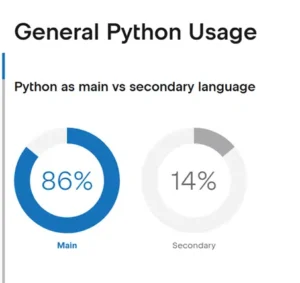
According to the research, 86% of developers use Python as their primary language.
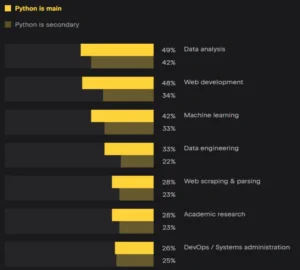
And the areas of greatest importance are:
- Data analysis and data science – the main driver of Python’s popularity;
- Web development, which is gaining increasing momentum with modern frameworks.
- Automation, where Python establishes itself as a simple and efficient tool.
Let’s understand each of these areas better:
1. Data analysis and data science.
Undoubtedly, the main driver of Python’s popularity is that the language has become practically synonymous with data analysis thanks to its combination of simplicity and power.
Many well-known Python libraries are primarily used in the field of data, such as Pandas, NumPy, Matplotlib, and Scikit-learn. They allow you to manipulate, visualize, and model data.
Another important point is the integration with machine learning and artificial intelligence tools. This has transformed Python into an almost essential tool for data scientists and analysts seeking to generate insights and make data-driven decisions.
2. Web Development
Another area that is expanding very rapidly is web development. Modern frameworks used for web development, such as Django and Flask, have boosted the use of Python in creating websites, APIs, and complex applications quickly and securely.
Previously, creating web pages was almost exclusively done using languages like JavaScript and PHP. Today, website and app development relies heavily on highly efficient Python solutions that cater to everyone from startups to large platforms like Amazon, Spotify, and Netflix. This versatility leads more and more developers to choose Python as the foundation for their web projects.
3. Automation and Scripting
Finally, another great strength of Python is automation. Thanks to its simple syntax and the vast number of available libraries, it is widely used to create scripts that automate repetitive tasks, integrate systems, and optimize workflows.
From basic computer operations to complex server processes, Python offers great efficiency (and ease of maintenance), making it an indispensable tool for both technical professionals and corporate teams.
Many new professionals are entering the field.
One of the most interesting findings of the research is the strong growth of new programmers in the Python community. According to the data:
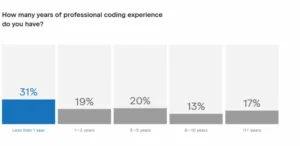
- 50% of professionals started programming in Python less than 2 years ago ;
- and 21% learned it less than a year ago.
These numbers reveal a constant renewal. Python continues to attract beginners from different areas, from professionals migrating to the field of technology to students taking their first steps in the world of programming.
This move reinforces Python’s role as one of the main gateways to a career in technology.
The reasons for this may be the gentle learning curve, the clarity of the syntax, and the immense amount of resources available. For example, tutorials, online communities, and courses make the first contact with Python programming more accessible than ever.
Key uses of Python in 2025
As we have seen, the research highlights three major growing trends in the use of Python:
1. Data Analysis and Science
Python remains the first choice in data science, with libraries such as Pandas, NumPy, and Spark.
Pandas and NumPy are widely used for data manipulation and analysis, while PySpark is preferred for scenarios requiring distributed processing, i.e., using data from multiple sources and capable of processing data from various machines or servers.
In addition to these, we can also mention tools such as Matplotlib, Seaborn, and Plotly, which remain essential for visualizations, an important part of data analysis.
In the data field, it’s safe to say that Python has established itself as the language that combines statistical analysis and automation, while also integrating with unbeatable platforms on the market, such as Power BI. All of this makes the language increasingly important for data teams.
2. Web Development
The trio FastAPI, Django, and Flask share the spotlight. The rise of FastAPI, in particular, shows how Python is increasingly present in modern API projects and web applications.
The highlight is FastAPI, which has revolutionized the development of modern, high-performance APIs and can be integrated with OpenAPI.
Django has been established as a Python web development tool for some time now and continues to be a benchmark for creating complete, secure, and efficient applications.
Equally important, Flask offers much of what Django offers, but as a lighter and more flexible option, suitable for smaller projects or simpler APIs.
3. Machine Learning and Artificial Intelligence
Frameworks like Scikit-learn, TensorFlow, and PyTorch remain at the top, but Hugging Face is gaining momentum in the generative AI ecosystem.
Scikit-learn, Tensorflow, and PyTorch have long been preferred for projects involving AI and machine learning. They remain at the top due to their flexibility and suitability for different stages (from algorithm modeling to working with complex neural networks).
Hugging Face is a highlight, bringing new libraries like LanChain and Transforms, which bring Python closer to language models and generative AI. This makes the language usable for applications in chatbots, text analysis, computer vision, etc.
Most popular databases and integrations
When it comes to databases, the community’s favorites are PostgreSQL and SQLite. These options offer advantages such as reliability, flexibility, and ease of integration.
• PostgreSQL – An ideal choice for medium and large-scale projects. It offers support for advanced features such as custom data types, complex queries, and extensions. These characteristics make it indispensable for enterprise applications and high-performance systems.
• SQLite – On the other hand, SQLite is attractive due to its simplicity and lightweight nature. Being a database that runs locally, without the need for a server, it’s perfect for smaller applications, prototypes, and individual projects. Its ease of configuration allows for quick testing of ideas and maintaining an agile development workflow.
When it comes to integrating Python with databases, the most frequently mentioned tools are SQLAlchemy and Django ORM, which lead in popularity and reliability.
- SQLAlchemy – Valued for its flexibility, as it allows developers to work with different databases without having to rewrite their queries.
- Django ORM – It is integrated into the Django framework and simplifies data management, accelerating the development of web applications while maintaining consistency and productivity.
Together, these technologies demonstrate how the Python ecosystem remains evolving and adaptable, catering to everything from simple projects to complex enterprise architectures. The focus of the tools receiving attention and development is on efficiency, clarity, and good development practices.
Preferred tools and systems
- Operating systems: Windows (58%) and Linux (59%) are practically tied, with each dominating in different developer profiles.
- Code editors: PyCharm and VS Code remain firmly established as the most popular development environments.
- AI tools: ChatGPT is the most widely used, but other options, such as Gemini, Cursor, and integrated copilots, are starting to gain ground.
Conclusion
Python will remain one of the most important languages in the world in 2025. Its use in data, AI, and web development continues to grow, while the community is renewed with thousands of new programmers every year.
For businesses, the message is clear: investing in Python means investing in the future. And for those starting in programming, learning Python opens doors to some of the most promising areas of the market.
FAQ – Frequently Asked Questions about Python in 2025
1. Is Python still worth learning in 2025?
Yes. Python remains one of the most widely used languages in the world, especially in areas such as data analysis, artificial intelligence, and web development. Furthermore, it continues to be a great choice for beginners.
2. What is the main area of application for Python today?
Data science leads the way in the use of Python, followed closely by machine learning and web development.
3. Which Python frameworks are trending in 2025?
For web applications: FastAPI, Django, and Flask ;
For data applications: Pandas, NumPy, and Spark ;
For AI applications: Scikit-learn, TensorFlow, PyTorch, and Hugging Face.
4. Is Python better on Windows or Linux?
It depends on the developer’s profile. Research shows a balance: Windows is preferred by 58% and Linux by 59% of developers (many use both).
5. Is Python only suitable for beginners?
No. Although it’s a favorite language for beginners, Python is also widely used in complex big data, automation, AI, and enterprise applications.
6. Is Python growing or losing ground?
It’s growing. The number of new developers learning Python is high (21% started less than a year ago), and the demand for data and AI specialists increases every day.
Explore More IT Terms
#
- Using an integrating factor
- Equations in total differentials
- Bernoulli's equation
- Linear differential equations of the first order
- 10 Mixed C++ Challenges to Test Your Skills
- 11 Tricky Non-Technical Questions to Ask in a Recruiting Interview
- 50 Terms Every Programmer Should Know
- 52 Java Thread Interview Questions
- 7 Levels of Using the Zip Function in Python
- 7 Python Code Bugs You Need to Fix
- 70+ Free Resources for Learning Programming
A
- A Comprehensive Guide to HTML and CSS
- A Comprehensive Guide to MODX CMS
- A computer science question tests your ability to work with IP addresses and network masks
- A Guide to SQL Query Formatting for Beginners
- A/B testing
- Abstract Data Type (ADT)
- AES Encryption Algorithm: How It Works and Where It's Used
- Agile
- Algorithm
- Algorithm Analysis
- Algorithm Complexity-Key Points
- Algorithm complexity: deep parsing O(log n)
- Algorithm vs. Program
- Algorithms and Data Structures in C#
- An overview of the C # programming language
- An overview of the Python programming language
- Anaconda Python
- Analysis of graphs and adjacency matrices question
- Android
- Android App Bundle
- Android SDK
- Angular
- Ansible
- Apache
- Apache Airflow
- Apache Kafka
- Apache Tomcat
- App Store
- AppCode
- Applications of microcontrollers: From simple circuits in electronics to complex systems
- Applications of the derivative
- Arduino: How to Program It: Basics for Beginners
- Array-based stack
- ArrayList
- ASCII
- ASP.NET
- Assembly Language Lessons
B
C
- C++ Lessons
- Cache
- Calculating Memory Capacity
- Character sets and encodings
- Characteristics of a good Algorithm
- Circular singly linked list
- Coding Tests with Answers
- Combinational Circuits Solved Questions
- Compiler
- Complexity of algorithms-Tutorial
- Computer Science Fundamentals Test with Answers (47 questions)
- Computer science tests with answers (More than 100 Questions)
- Constants
- Creating a Table in HTML
- Creating Forms in HTML
- Creating Lists
- Cybernetics and informatics
- Cycles
D
- Data Analytics: applications of data analysis in companies
- Data Engineer - Who is it, what does a data engineer do, and an overview of the profession
- Data modeling: what it is, types, and process steps.
- Data preprocessing: a complete guide for beginners and professionals.
- Data structure
- Data Structures and Algorithms (DSA)
- Data types vs. Data structures
- Database Tests with Answers
- Deep Learning
- Defining Aliases
- Defining Arrays
- Deque
- Detailed articles and tutorials on PHP
- Developing a Website from Scratch
- Differential Equations
- Differentiation of functions
- Digital data: understand the importance of this asset for businesses.
- Double integrals
- Doubly linked lists
- DSA Tutorial
E
F
G
H
- Handling errors and exceptions
- Heads or Tails? How Probability Theory Is Used in IT
- History of the development of computer science
- Homogeneous equations
- Homogeneous vs. non-homogeneous structures
- How to convert numbers between binary, octal, and hexadecimal number systems
- How to effectively organize your workflow
- How to Learn Java: Tips for Beginner Developers
- How to Learn PHP: A Beginner's Guide
- How to Use S3 Storage in Kubernetes with CSI
- HTML
- HTML and CSS: Definition, Application, and Operating Principles
- HTML and CSS. Layout from Scratch: What to Learn, Where to Learn, and How Long Will It Take?
- HTML Frame Structure
- HTML Link Formatting
- HTML Quizzes with Answers
I
- if..else construction
- Infinite sequences and series
- Information properties
- Inheritance in Java: A Complete Guide to Principles and Implementation
- Inserting an Image
- Integration of functions
- Interactive Python Tutorial – Learn Programming from Scratch
- Interpreter
- Interview Problem: Finding a Deleted Element in O(N)
- Interview Scare: The FizzBuzz Challenge
- Introduction to C++
- Introduction to Machine Learning
- Introduction to Machine Learning with Python
- Introduction to Networking | Network Fundamentals Part 1
- Introduction to Number Systems (Binary, Octal, Hexadecimal) | Math for CS Foundations #1
- IT Specialist Resume (CV)
J
K
L
M
- Machine Learning
- Machine Learning Basic Tool: NumPy
- Machine Learning Basic Tool: Pandas
- Machine Learning Basics
- Machine Learning Mathematics
- Machine Learning with Python
- Mathematics for programmers: what is really needed?
- MD5 encryption algorithm: What is it and why is it needed?
- Microcontroller and Microprocessor - what's the difference?
- ML Engineer: Who They Are, What They Do, How Much They Earn, and How to Become a Neural Network Specialist
- Monte Carlo Simulation: How It Works and What It's For
O
P
- PHP lessons
- Private DNS server and its configuration
- Program code
- Programmer's Dictionary
- Programming
- Programming with pseudocode
- Python Code Formatting Guide: PEP8
- Python for data analysis: how to do it and main libraries
- Python Lessons
- Python Superstar: 5 Ways to Use the * Operator
- Python vs. Julia: Should You Replace Python with Julia?
Q
R
S
- Setting up model parameters
- SFML Graphics Library Tutorials
- Sorting Algorithms in Programming: Types, Descriptions, and Comparisons
- SQL commands: see what they are, what the main ones are + examples
- SQL Interview Questions and Tasks
- SQL Lessons
- SQL Stored Procedures
- SQL Syntactic Sugar: The COALESCE Function
- Stack
- Start in analytics: Python or R
- Static vs. dynamic data structures
- Statistical analysis: importance for decision making.
- String formatting in Python
- Structure of computer science
- Supervised learning
- Swift Lessons
- switch/match construct
- Syntax
T
- Terms in programming
- Text and paragraph formatting tags
- The Complete Guide to Bootstrap
- The Complete Guide to JavaScript
- The concept of information and its transmission
- The Future of Python: Key Trends and Insights from Global Researc
- The Infrastructure of Code: A Complete Guide to Repositories for Languages, Frameworks, and Compilers
- The pip package manager in Python
- The role of informatization in the development of society
- Transfers
- Tricky Java Questions Often Asked in Interviews
- Tutorials / Articles
- TypeScript: What It Is and Why Developers Need It
W
- What are databases, and why do they need DBMS and SQL?
- What do Linux distributions consist of?
- What is .NET and what is it used for?
- What is a data structure?
- What is a GPU in a computer, in simple terms?
- What is a quantum computer: 100,500 problems in one second
- What Is an Algorithm?
- What is Arduino: How it Works and the Platform's Capabilities
- What is Big Data? Introduction, Types, Characteristics, and Examples
- What is FizzBuzz Challenge?
- What is Golang and what is it used for?
- What is Haskell and what is it used for?
- What is Kotlin and what is it used for?
- What is Linux? The History of Linux
- What is machine learning, and how does it work?
- What is Power BI: everything about the data analytics software
- What is recursion, recursive and iterative process in programming?
- What is the C++ programming language?
- What is the OSI Model: A Complete Explanation of the Seven Layers and Their Role in Networking
- What's the difference between x86 and ARM processors?
- Where to start learning the C programming language?
- Which Linux distribution should you choose? A Linux distribution overview