History of the development of computer science
The history of computer science as a science began in the second half of the 20th century. This was associated with the advent and spread of computers and the beginning of the computer revolution. The advent of computers in the 1940s and 1950s created the necessary hardware support for computer science, creating a favorable environment for its development as a science.
However, despite its short history, computer science has a long prehistory, rooted in the specifics of information accumulation and processing across various stages of human development. Thus, the entire history of computer science can be divided into two major stages: prehistory and history itself.
Prehistory of computer science
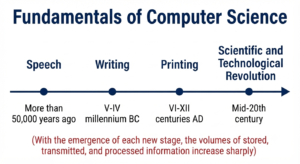
The prehistory of computer science begins with the emergence of society. This prehistory is divided into several stages. Each stage is characterized by a dramatic increase in the capabilities of storing, transmitting, and processing information compared to the previous stage.
The first stage is the acquisition of developed oral speech by humans. Among ancient peoples, articulate speech and the language they spoke began to serve as a means of storing and transmitting information.
The second stage saw the emergence of writing. Compared to the previous stage, the ability to store information increased dramatically. Humans acquired a kind of artificial external memory. The establishment of postal services made it possible to use writing as a means of transmitting information, not just storing it.
The emergence of writing was a necessary condition for the development of science. The concept of “natural number” is also likely associated with this stage. All people who possessed writing possessed the concept of number and used some form of number system.
The third stage was printing. It could be called the first information technology. Information reproduction was now streamlined. Compared to the previous stage, this stage not so much increased the ability to store information (although there was a benefit here: a written source is often a single copy, while a printed book is a whole run of copies, and therefore, the risk of information loss during storage is low) as it increased the accessibility of information to everyone, as well as the accuracy of its reproduction—that is, its reliability.
The fourth and final stage in the prehistory of computer science is associated with advances in the exact sciences (primarily mathematics and physics) and the nascent scientific and technological revolution. This stage is characterized by the emergence of powerful communication tools such as radio, telephone, and telegraph, and later, television. New ways of obtaining and storing information emerged, such as photography and film. Importantly, these included the development of methods for recording information on magnetic media (magnetic tapes and disks).
Various programmable mechanical mechanisms were also invented in the 17th-19th centuries. That is, the idea that the same device could be configured to operate with different algorithms and produce different results emerged long before the advent of computers.
History of computer science
The development of the first computers is commonly associated with the beginning of computer science. There are several reasons for this connection.
Firstly, the term “computer science” itself appeared thanks to the development of computing technology, and at first, computer science was understood as the science of automated computing, since the first computers were mostly used to perform numerical calculations.
Secondly, the emergence of computer science as a separate science was facilitated by such an important feature of modern computing technology as the unified representation of processed and stored information. All information, regardless of its type, is stored and processed on computers in binary form.
It so happened that the computer combined the storage and processing of numerical, textual (symbolic), and audiovisual (sound, image) information in a single system. This versatility played a pivotal role in the emergence and development of this new science.
Today, informatics and computer science are complex scientific and technical disciplines. They encompass a number of areas, such as information theory, cybernetics, programming, modeling, hardware, and much more.
Concept of the information society
The history of civilization has seen several information revolutions—transformations of social relations due to fundamental changes in information processing. The consequence of such transformations was the acquisition of a new quality by human society.
The first revolution was associated with the invention of writing, which led to a gigantic qualitative and quantitative leap. It became possible to transmit knowledge from generation to generation.
The second (mid-16th century) was caused by the invention of printing, which radically changed industrial society, culture, and the organization of activities.
The third (late 19th century) was caused by the invention of electricity, which gave rise to the telegraph, telephone, and radio, allowing for the rapid transmission and accumulation of information in any volume.
The fourth (1970s) is associated with the invention of microprocessor technology and the emergence of the personal computer. Computers, computer networks, and data transmission systems (information communications) are created using microprocessors and integrated circuits. This period is characterized by three fundamental innovations:
transition from mechanical and electrical means of information conversion to electronic ones;
miniaturization of all units, devices, instruments, machines;
Creation of software-controlled devices and processes.
To create a more complete picture of this period, it is useful to familiarize yourself with the information below on the change in generations of electronic computers (ECM) and compare this information with the stages in the field of information processing and transmission.
Information on the change in computer generations: 1st generation (early 1950s). The electronic components were vacuum tubes. These computers were characterized by large dimensions, high power consumption, low performance, low reliability, and code-based programming.
2nd generation (since the late 1950s). The electronic base is made up of semiconductor components. All technical characteristics have been improved compared to the previous generation of computers. Algorithmic languages are used for programming.
3rd generation (early 1960s). The electronic components were integrated circuits and multilayer printed circuit boards. Computer size was dramatically reduced, reliability increased, and performance increased. Access from remote terminals was possible.
4th generation (since the mid-1970s). The basic components are microprocessors and large-scale integrated circuits. Technical characteristics have improved. Mass production of personal computers. Development directions: powerful multiprocessor computing systems with high performance, creation of low-cost microcomputers.
5th generation (since the mid-1980s). The development of intelligent computers began, though it has not yet been successful. Computer networks were introduced into all areas, and their interconnection, distributed data processing, and computer information technologies were widely used.
The latest information revolution is bringing to the fore a new sector— the information industry —related to the production of technical means, methods, and technologies for generating new knowledge. All forms of information technology, especially telecommunications, are becoming crucial components of the information industry. Modern information technology relies on advances in computer technology and communications.
Information technology (IT) is a process that uses a set of means and methods for collecting, processing,g and transmitting data (primary information) to obtain new quality information about the state of an object, process, or phenomenon.
Telecommunications is the remote transmission of data based on computer networks and modern technical means of communication.
The increasing complexity of industrial production, social, economic, and political life, and the changing dynamics of processes in all spheres of human activity have led, on the one hand, to an increase in the need for knowledge, and on the other, to the creation of new means and methods for satisfying these needs.
The rapid development of computer technology and information technology has served as an impetus for the development of a society built on the use of various information, and known as the information society.
Japanese scientists believe that in an information society, computerization will give people access to reliable sources of information, free them from routine work, and ensure a high level of automation of information processing in production and social spheres. The driving force behind social development should be the production of information, not material products. Material products will become more information-intensive, which means an increased share of innovation, design, and marketing in their value.
In the information society, not only production but also the entire way of life and value system will change, and the importance of cultural leisure will increase relative to material values. Compared to an industrial society, where everything is focused on the production and consumption of goods, in the information society, intelligence and knowledge are produced and consumed, leading to an increase in the share of mental labor. People will be required to be creative, and the demand for knowledge will increase.
The material and technological basis of the information society will be various types of systems based on computer technology and computer networks, information technology, and telecommunications.
An information society is a society in which the majority of workers are engaged in the production, storage, processing, and sale of information, especially its highest form – knowledge.
In the actual practice of scientific and technological development in advanced countries at the end of the 20th century, the picture of the information society created by theorists is gradually taking shape. It is predicted that the entire world will be transformed into a single computerized and information-based community of people living in electronic apartments and cottages. Every home will be equipped with a wide range of electronic devices and gadgets. Human activity will be focused primarily on information processing, while material and energy production will be entrusted to machines.
Some factual materials have already been published, indicating that this is not a utopia, but an inevitable reality of the near future.
Example.
The landscape of the American workforce has transformed significantly since the late 20th century, evolving from a traditional office-centric model to a more flexible, decentralized system. While earlier data tracked a steady rise in self-employment—growing from 5.7 million in 1980 to 20.7 million by 1995—the modern era shows an even more dramatic expansion of independent work. Today, over 70 million Americans participate in some form of gig or freelance work, accounting for approximately 36% of the total U.S. workforce.
Remote work has similarly solidified its place as a cornerstone of the post-pandemic economy. As of early 2024, the Bureau of Labor Statistics reported that 35.5 million people in the U.S. teleworked or worked from home for pay, representing nearly 23% of the active workforce. This shift has fundamentally changed business formation as well, with self-employment and non-employer firms now comprising 81% of all small businesses in the United States.
With the transition to an information society, a new information-processing industry is emerging based on computer and telecommunications technologies.
Some scientists identify the characteristic features of the information society:
The problem of the information crisis has been solved, i.e., the contradiction between the information avalanche and the information famine has been resolved;
priority of information over other resources is ensured;
The main form of development will be the information economy;
The foundation of society will be based on automated generation, storage, processing, and use of knowledge with the help of the latest information technology and equipment;
Information technology will acquire a global character, covering all spheres of human social activity;
The information unity of the entire human civilization is being formed;
With the help of information technology, free access for every person to the information resources of the entire civilization has been realized;
Humanistic principles of social management and environmental impact have been implemented.
In addition to positive aspects, dangerous trends are also predicted:
The increasing influence of mass media on society;
Information technology can destroy the privacy of individuals and organizations;
There is a problem of selecting high-quality and reliable information;
Many people will have difficulty adapting to the information society environment. There is a danger of a gap between the “information elite” (people developing information technologies) and consumers.
Countries with developed information industries, including the United States, Japan, England, Germany, and Western European countries, are closest to the information society. In these countries, investment and support for innovation in the information industry, computer systems, and telecommunications have long been a focus of government policy.
References
Bureau of Labor Statistics. (2026). Industry and occupational employment projections overview and highlights, 2024–34. https://www.bls.gov/opub/mlr/2026/article/industry-and-occupational-employment-projections-overview.htm
Lynch, L. (n.d.). The Gig Economy Safety Net Gap: Gen Z and Worker Protections. YIP Institute Economic Policy.
Okoye, O. A. (2026). Remote Work and the Changing Geography of Technology‐Based Economic Development in the United States. Preprints.org.
U.S. Census Bureau. (2018). 2018 Report on Nonemployer Firms: Findings from the 2017 Small Business Credit Survey. https://www.fedsmallbusiness.org/reports/survey/2018/2018-report-on-nonemployer-firms
Explore More IT Terms
#
- Using an integrating factor
- Equations in total differentials
- Bernoulli's equation
- Linear differential equations of the first order
- 10 Mixed C++ Challenges to Test Your Skills
- 11 Tricky Non-Technical Questions to Ask in a Recruiting Interview
- 50 Terms Every Programmer Should Know
- 52 Java Thread Interview Questions
- 7 Levels of Using the Zip Function in Python
- 7 Python Code Bugs You Need to Fix
- 70+ Free Resources for Learning Programming
A
- A Comprehensive Guide to HTML and CSS
- A Comprehensive Guide to MODX CMS
- A computer science question tests your ability to work with IP addresses and network masks
- A Guide to SQL Query Formatting for Beginners
- A/B testing
- Abstract Data Type (ADT)
- AES Encryption Algorithm: How It Works and Where It's Used
- Agile
- Algorithm
- Algorithm Analysis
- Algorithm Complexity-Key Points
- Algorithm complexity: deep parsing O(log n)
- Algorithm vs. Program
- Algorithms and Data Structures in C#
- An overview of the C # programming language
- An overview of the Python programming language
- Anaconda Python
- Analysis of graphs and adjacency matrices question
- Android
- Android App Bundle
- Android SDK
- Angular
- Ansible
- Apache
- Apache Airflow
- Apache Kafka
- Apache Tomcat
- App Store
- AppCode
- Applications of microcontrollers: From simple circuits in electronics to complex systems
- Applications of the derivative
- Arduino: How to Program It: Basics for Beginners
- Array-based stack
- ArrayList
- ASCII
- ASP.NET
- Assembly Language Lessons
B
C
- C++ Lessons
- Cache
- Calculating Memory Capacity
- Character sets and encodings
- Characteristics of a good Algorithm
- Circular singly linked list
- Coding Tests with Answers
- Combinational Circuits Solved Questions
- Compiler
- Complexity of algorithms-Tutorial
- Computer Science Fundamentals Test with Answers (47 questions)
- Computer science tests with answers (More than 100 Questions)
- Constants
- Creating a Table in HTML
- Creating Forms in HTML
- Creating Lists
- Cybernetics and informatics
- Cycles
D
- Data Analytics: applications of data analysis in companies
- Data Engineer - Who is it, what does a data engineer do, and an overview of the profession
- Data modeling: what it is, types, and process steps.
- Data preprocessing: a complete guide for beginners and professionals.
- Data structure
- Data Structures and Algorithms (DSA)
- Data types vs. Data structures
- Database Tests with Answers
- Deep Learning
- Defining Aliases
- Defining Arrays
- Deque
- Detailed articles and tutorials on PHP
- Developing a Website from Scratch
- Differential Equations
- Differentiation of functions
- Digital data: understand the importance of this asset for businesses.
- Double integrals
- Doubly linked lists
- DSA Tutorial
E
F
G
H
- Handling errors and exceptions
- Heads or Tails? How Probability Theory Is Used in IT
- History of the development of computer science
- Homogeneous equations
- Homogeneous vs. non-homogeneous structures
- How to effectively organize your workflow
- How to Learn Java: Tips for Beginner Developers
- How to Learn PHP: A Beginner's Guide
- How to Use S3 Storage in Kubernetes with CSI
- HTML
- HTML and CSS: Definition, Application, and Operating Principles
- HTML and CSS. Layout from Scratch: What to Learn, Where to Learn, and How Long Will It Take?
- HTML Frame Structure
- HTML Link Formatting
- HTML Quizzes with Answers
I
- if..else construction
- Infinite sequences and series
- Information properties
- Inheritance in Java: A Complete Guide to Principles and Implementation
- Inserting an Image
- Integration of functions
- Interactive Python Tutorial – Learn Programming from Scratch
- Interpreter
- Interview Problem: Finding a Deleted Element in O(N)
- Interview Scare: The FizzBuzz Challenge
- Introduction to C++
- Introduction to Machine Learning
- Introduction to Networking | Network Fundamentals Part 1
- Introduction to Number Systems (Binary, Octal, Hexadecimal) | Math for CS Foundations #1
- IT Specialist Resume (CV)
J
K
L
M
- Machine Learning
- Machine Learning Basic Tool: NumPy
- Machine Learning Basic Tool: Pandas
- Machine Learning Mathematics
- Mathematics for programmers: what is really needed?
- MD5 encryption algorithm: What is it and why is it needed?
- Microcontroller and Microprocessor - what's the difference?
- ML Engineer: Who They Are, What They Do, How Much They Earn, and How to Become a Neural Network Specialist
- Monte Carlo Simulation: How It Works and What It's For
O
P
- PHP lessons
- Private DNS server and its configuration
- Program code
- Programmer's Dictionary
- Programming
- Programming with pseudocode
- Python Code Formatting Guide: PEP8
- Python for data analysis: how to do it and main libraries
- Python Lessons
- Python Superstar: 5 Ways to Use the * Operator
- Python vs. Julia: Should You Replace Python with Julia?
R
S
- SFML Graphics Library Tutorials
- Sorting Algorithms in Programming: Types, Descriptions, and Comparisons
- SQL commands: see what they are, what the main ones are + examples
- SQL Interview Questions and Tasks
- SQL Lessons
- SQL Stored Procedures
- SQL Syntactic Sugar: The COALESCE Function
- Stack
- Start in analytics: Python or R
- Static vs. dynamic data structures
- Statistical analysis: importance for decision making.
- String formatting in Python
- Structure of computer science
- Swift Lessons
- switch/match construct
- Syntax
T
- Terms in programming
- Text and paragraph formatting tags
- The Complete Guide to Bootstrap
- The Complete Guide to JavaScript
- The concept of information and its transmission
- The Future of Python: Key Trends and Insights from Global Researc
- The Infrastructure of Code: A Complete Guide to Repositories for Languages, Frameworks, and Compilers
- The pip package manager in Python
- The role of informatization in the development of society
- Transfers
- Tricky Java Questions Often Asked in Interviews
- Tutorials / Articles
- TypeScript: What It Is and Why Developers Need It
W
- What are databases, and why do they need DBMS and SQL?
- What do Linux distributions consist of?
- What is .NET and what is it used for?
- What is a data structure?
- What is a GPU in a computer, in simple terms?
- What is a quantum computer: 100,500 problems in one second
- What Is an Algorithm?
- What is Arduino: How it Works and the Platform's Capabilities
- What is Big Data? Introduction, Types, Characteristics, and Examples
- What is FizzBuzz Challenge?
- What is Golang and what is it used for?
- What is Haskell and what is it used for?
- What is Kotlin and what is it used for?
- What is Linux? The History of Linux
- What is machine learning, and how does it work?
- What is Power BI: everything about the data analytics software
- What is recursion, recursive and iterative process in programming?
- What is the C++ programming language?
- What is the OSI Model: A Complete Explanation of the Seven Layers and Their Role in Networking
- What's the difference between x86 and ARM processors?
- Where to start learning the C programming language?
- Which Linux distribution should you choose? A Linux distribution overview