Data Engineer – Who is it, what does a data engineer do, and an overview of the profession
- Who is this?
- What does a data engineer do?
- Differences from a Data Scientist
- Where is a data engineer needed?
- How much is this in demand?
- 1. Data as a Core Corporate Asset
- 2. Infrastructure Modernization and Tech Migration
- 3. A Widening Talent Shortage
- 4. Rapid Technological Evolution
- How much does a data engineer earn?
- Junior (Entry-Level)
- Mid-Level (2–3 Years of Experience)
- Senior
- Key Factors Influencing Your Offer
- What a Data Engineer Should Know and Be Able to Do
- Where do data engineers come from?
- Pros and cons
- How to become a data engineer and where to study
- How to get started
- Let’s sum it up
- Question and Answer:
Imagine a huge warehouse where tons of goods—boxes, crates, bags—are delivered every day. All of this needs to be sorted, checked for defects, and neatly stacked on shelves so that the right product can quickly reach the customer. The world of data works much the same way. Only instead of boxes, there are numbers, text, user clicks, transactions, and messages. And the hero of this article is responsible for bringing order to this world. In this article, we explain what a data engineer is and what they need to know and be able to do when processing data.
Who is this?
In today’s world, we’re surrounded by a huge flow of information: online purchases, video views, social media messages, data from sensors in smart homes, and even cars. All of this represents terabytes of data, which by itself means little until it’s prepared for analysis. It’s like scattered puzzle pieces. Someone is needed to help assemble them into a coherent picture so businesses can make the right decisions, create new products, and improve services.
A data engineer is an IT specialist who designs, builds, and maintains systems for collecting, storing, and processing large volumes of information. Their job is to ensure that information from various sources is delivered to key employees in a convenient and structured format.
What does a data engineer do?
Let’s say you have a food delivery app. Customers place orders, couriers deliver them, and restaurants prepare them. All these actions leave a digital trail: what was ordered, when, where there were delays, and how much the delivery cost. Statistics come from multiple sources and in different forms. It needs to be prepared so that managers can understand in which areas couriers are frequently late or which dishes have become popular this week.
The hero of our article is engaged in the following:
- Collects information from various sources, including websites, apps, databases, sensors in production, or terminals in stores.
- Cleans data. For example, if the database indicates that a person was born in 1799 and also has a phone number of “123,” the engineer will not allow such “dirty” data.
- Stores information so it can be quickly accessed. It’s like a warehouse where items aren’t piled up in one place, but organized so the right drawer can be found in seconds.
- It transmits the results to analysts and data scientists, who use them to create reports, forecasts, or train neural networks.
Data engineering is about creating an infrastructure that transforms disparate streams of diverse facts into a robust system for analysis. If you want to work with information at a deep level and create a true foundation for decisions, data engineering can be an excellent choice.
Differences from a Data Scientist
These two professions are often confused, as both work with metrics. However, these specialists have different roles, tools, and goals. The former is responsible for structure and reliability, while the latter is responsible for analysis and meaning. While the former builds the foundations, the latter rides them and opens new horizons. We’ve compiled a comparison chart to clearly explain the differences.
| Data Engineer | Data Scientist | |
| What does it do? | Prepares data for use: collects, cleans, stores | Analyzes data, makes forecasts |
| Tools | SQL, Python, Spark, Airflow, databases | Python, machine learning, statistics, algorithms |
| The purpose of the work | Accessible and high-quality information for further analysis | Informed decisions based on quality information |
| Who does it help? | For analysts, data scientists, and the BI team | Business, marketing, product |
| Nature of work | Technical, engineering, infrastructure | Analytical, research, creative |
Where is a data engineer needed?
Telecom, banks, retail
Every call, payment, or purchase leaves a digital trace. And there are millions of such traces. All of this needs to be collected, filtered, and passed on. For example, to understand customer behavior and improve services.
Online services and advertising
Here, it’s crucial to understand user behavior: what they search for, what they click on, where they get lost. Technical processes need to be streamlined so marketers can launch accurate and timely campaigns.
Logistics and transport
Optimal routes, on-time delivery, and avoiding traffic jams—all of this requires taking into account a huge number of parameters in real time. And here, a specialist ensures that all necessary signals are processed without delay.
Gaming industry
When millions of people play, you need to understand how they behave and where glitches occur. Engineers help build the infrastructure that monitors player activity and responds to it.
Government agencies and smart cities
Traffic management, security, and emergency forecasting—all of this relies on digital information, which must be managed effectively. And here again, data engineers play a key role.
Medicine and pharmaceuticals
Modern clinics and laboratories interact with a huge number of images, indicators, and test results. A specialist helps doctors quickly find what they need and make accurate decisions.
Agro-industry
Machinery in the fields, weather sensors, satellite imagery—all of this allows farmers to increase yields. This requires an expert to transform this information into useful recommendations.
Any company that wants to grow and develop in the market needs such specialists.
Sometimes, in small teams, one person combines both engineering and analytical tasks. But as the business grows, these roles become clearly separated—the engineer becomes the one who provides others with a solid foundation of knowledge.
How much is this in demand?
Today, Database and Data Engineers are among the most highly sought-after and well-compensated IT professionals in the United States. Demand for these specialists is projected to climb steadily over the coming years, fueled by exponential data growth and the widespread corporate shift toward data-driven decision-making. Here is why their expertise is so critical.
1. Data as a Core Corporate Asset
Companies increasingly recognize that information is far more than just numbers on a spreadsheet—it is a vital business asset. Extracting actionable value from this data requires robust, efficient systems for collection, storage, and processing. Engineers build this essential foundation, enabling accurate business intelligence and strategic decision-making.
2. Infrastructure Modernization and Tech Migration
As organizations transition away from legacy on-premise systems and navigate the complexities of multi-cloud environments (such as AWS, Azure, and Google Cloud) or open-source alternatives, infrastructure must often be re-engineered from the ground up. This massive wave of modernization creates a continuous need for skilled professionals to manage the transition.
3. A Widening Talent Shortage
The demand for qualified professionals consistently outpaces the available talent supply. This shortage is particularly acute in major tech hubs and metropolitan areas—such as Silicon Valley, New York, Seattle, and Austin. While job openings are abundant, finding highly qualified specialists remains a significant challenge for employers.
4. Rapid Technological Evolution
Continuous advancements in technology are reshaping the profession. The rapid rise of real-time data streaming, AI-driven data pipelines, automated cleansing, and advanced cloud architectures requires a new breed of engineer. Organizations need specialists who do more than just write basic code; they need architects capable of designing smart, adaptable, and scalable data ecosystems.
How much does a data engineer earn?
Even if you are just starting, the earning potential in data engineering is significantly higher than in many other IT professions.
Junior (Entry-Level)
Newcomers to the field (with up to a year of experience) can typically expect a starting salary of $70,000 to $90,000 in smaller regional markets, while starting offers in major metropolitan areas routinely exceed $100,000. The average entry-level salary ranges from $80,000 to $105,000, with highly competitive starting offers reaching up to $120,000. This provides an exceptionally strong foundation for career entry and future advancement.
Mid-Level (2–3 Years of Experience)
Mid-level specialists typically command base salaries between $115,000 and $150,000. At top-tier tech companies and major enterprises, mid-career compensation often climbs to $160,000 to $180,000.
Senior
Engineers with extensive experience and deep technical expertise generally start around $150,000. In large enterprises, base income averages $170,000 to $200,000, while elite specialists at major tech firms can see total compensation packages reaching $250,000 to $350,000+ when accounting for equity and bonuses.
Key Factors Influencing Your Offer
The final compensation figure is directly shaped by several critical factors:
Location: Salaries in major tech hubs like San Francisco, New York, Seattle, and Austin are substantially higher than in smaller regional markets or rural areas.
Experience: The maturity of your career and your proven track record with complex data pipelines directly correlate with your market value to employers.
In-Demand Expertise: Specializing in cutting-edge cloud infrastructure (AWS, Azure, GCP), real-time streaming architectures, and advanced AI-driven integration tools heavily skews salary offers in your favor.
The Employer: Major technology giants and leading financial institutions (e.g., FAANG companies, top-tier fintech firms) consistently pay well above standard market rates to secure premium talent.
What a Data Engineer Should Know and Be Able to Do
Programming and automation
The most popular language is Python, but Java and Scala are also frequently used, and Go or automation scripts (bash, PowerShell) may be useful for some projects. Automating routine tasks is an important part of the job.
SQL
A solid command of the Structured Query Language is essential. You need to be able to work with relational databases (such as PostgreSQL or MySQL) and more specialized ones, like ClickHouse. A good engineer knows when it’s best to use each database and how to optimize it all.
ETL and orchestrators
One of the key tasks is building ETL processes: extracting information, transforming it, and loading it into the processing center. Airflow, NiFi, Talend, and other orchestrators are often used for this. It’s like setting up logistics—except for information flows, not goods.
Architecture and Big Data
It’s important to understand how a data warehouse or data lake works and how large distributed systems like Hadoop, Spark, or Kafka operate. It’s also important to be able to build and maintain pipelines—information processing flows that operate automatically and reliably.
Clouds and infrastructure
Modern projects most often live in the cloud—AWS, Google Cloud, or Azure. It’s important to understand how to set up cloud infrastructure and how it differs from on-premises servers. It’s crucial to be able to choose the right platform for your project’s needs.
Optimization and security
A good specialist not only builds systems but also ensures they operate quickly, reliably, and securely. They must be able to monitor performance, identify bottlenecks, and protect information from leaks and unauthorized access.
Theory is also important.
Although a data engineer is primarily a practitioner, basic knowledge of algorithms, data structures, and mathematics (linear algebra, probability) is essential. This is necessary to understand how to optimize systems and collaborate with ML teams.
A valuable specialist knows how to process large data flows, writes code, understands storage systems and clouds, configures pipelines, and monitors speed and security. And most importantly, they can turn a technical challenge into tangible business benefits.
Where do data engineers come from?
- From analytics outside of IT. People working with spreadsheets and reports often want to automate routine tasks and improve their data management, so they move into data engineering to master programming and building data processing systems.
- From analytics to IT. Professionals already familiar with basic Python programming and data science experience are looking to develop in a more technical direction, mastering ETL processes, database management, and Big Data technologies.
- From programming and development. Data engineers are often developers and programmers who want to shift their focus to working with data, building infrastructure, and automating processes. The reverse transition is also possible—from data engineers to data scientists or DevOps engineers, depending on interests and career goals.
- After graduating from a technical university. Faculties of IT, applied mathematics, and computer science. But theory isn’t enough—you need to improve your practical skills.
- Through courses and self-study. Online programs, pet projects, internships—anything where you can build real pipelines and practice.
People rarely enter this profession from scratch. These are often professionals transitioning from analytics and development who want to deepen their technical skills and tackle more complex and large-scale projects.
Pros and cons
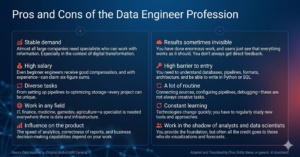
This profession is suitable for those who enjoy order, technical challenges, and IT infrastructure, and want to be part of systemic change. However, regular training and a willingness to handle a variety of routine tasks are required.
How to become a data engineer and where to study
The “Data Engineer from Scratch” course from 365education is a great starting point. If you’re already working with data or just want to get into this field, this is the course for you. This course will be especially useful for:
- data analysts who want to gain a deeper understanding of the infrastructure;
- data engineers who want to systematize knowledge;
- BI developers who need to understand where their data comes from;
- Backend developers interested in moving into data engineering.
The program offers maximum practical training: you’ll build your own project, replicating a real ETL process for a major platform. Airflow, Spark, S3, and Greenplum—everything is covered, just like in production. The project is allotted two weeks: no other disciplines will distract you during this time. It’s all about working with infrastructure and real-world scenarios.
How to get started
Remember!
- You don’t have to be a mathematical genius. The key is logic, accuracy, and an interest in data.
- You can transfer from another field. The main thing is the desire to learn.
- It’s okay if you don’t know all the tools right away. You’ll grow as you go. The key is to get started.
Let’s sum it up
We’ve explained in simple terms who a data engineer is and what they do, how this profession differs from a data science engineer, and why database engineering is needed. It’s one of the most promising roles in IT: high salaries, stable demand, and work that impacts businesses in various fields—from medicine to game development.
Question and Answer:
What types of data does a data engineer process, and how do they ensure its quality?
The specialist works with information in various formats—from Excel spreadsheets and website logs to social media messages and camera footage. Sometimes the data is “dirty”—containing errors, duplicates, empty fields, or odd formats. For example, the “Age” field might say “200 years old,” or the address might be a jumble of random letters. The engineer identifies errors, removes duplicates, checks for compliance with rules, and automates the entire data collection process.
The career path in this field is quite flexible. You can grow vertically, becoming a team lead or department manager. You can delve into data architecture, cloud technologies, DevOps, or move into machine learning. It’s also possible to transition into analytics or data science. Experienced professionals can work as consultants or launch their own projects.
What challenges and difficulties do data engineers most often face in their work?
Data often arrives with errors and duplicates—it needs to be cleaned and verified. Tasks are often poorly defined, and there’s a lack of documentation, management support, or resources for infrastructure development. This requires combining technical skills with the ability to collaborate with the business and the team.
Explore More IT Terms
#
- Using an integrating factor
- Equations in total differentials
- Bernoulli's equation
- Linear differential equations of the first order
- 10 Mixed C++ Challenges to Test Your Skills
- 11 Tricky Non-Technical Questions to Ask in a Recruiting Interview
- 50 Terms Every Programmer Should Know
- 52 Java Thread Interview Questions
- 7 Levels of Using the Zip Function in Python
- 7 Python Code Bugs You Need to Fix
- 70+ Free Resources for Learning Programming
A
- A Comprehensive Guide to HTML and CSS
- A Comprehensive Guide to MODX CMS
- A computer science question tests your ability to work with IP addresses and network masks
- A Guide to SQL Query Formatting for Beginners
- A/B testing
- Abstract Data Type (ADT)
- AES Encryption Algorithm: How It Works and Where It's Used
- Agile
- Algorithm
- Algorithm Analysis
- Algorithm Complexity-Key Points
- Algorithm complexity: deep parsing O(log n)
- Algorithm vs. Program
- Algorithms and Data Structures in C#
- An overview of the C # programming language
- An overview of the Python programming language
- Anaconda Python
- Analysis of graphs and adjacency matrices question
- Android
- Android App Bundle
- Android SDK
- Angular
- Ansible
- Apache
- Apache Airflow
- Apache Kafka
- Apache Tomcat
- App Store
- AppCode
- Applications of microcontrollers: From simple circuits in electronics to complex systems
- Applications of the derivative
- Arduino: How to Program It: Basics for Beginners
- Array-based stack
- ArrayList
- ASCII
- ASP.NET
- Assembly Language Lessons
B
C
- C++ Lessons
- Cache
- Calculating Memory Capacity
- Character sets and encodings
- Characteristics of a good Algorithm
- Circular singly linked list
- Coding Tests with Answers
- Combinational Circuits Solved Questions
- Compiler
- Complexity of algorithms-Tutorial
- Computer Science Fundamentals Test with Answers (47 questions)
- Computer science tests with answers (More than 100 Questions)
- Constants
- Creating a Table in HTML
- Creating Forms in HTML
- Creating Lists
- Cybernetics and informatics
- Cycles
D
- Data Analytics: applications of data analysis in companies
- Data Engineer - Who is it, what does a data engineer do, and an overview of the profession
- Data modeling: what it is, types, and process steps.
- Data preprocessing: a complete guide for beginners and professionals.
- Data structure
- Data Structures and Algorithms (DSA)
- Data types vs. Data structures
- Database Tests with Answers
- Deep Learning
- Defining Aliases
- Defining Arrays
- Deque
- Detailed articles and tutorials on PHP
- Developing a Website from Scratch
- Differential Equations
- Differentiation of functions
- Digital data: understand the importance of this asset for businesses.
- Double integrals
- Doubly linked lists
- DSA Tutorial
E
F
G
H
- Handling errors and exceptions
- Heads or Tails? How Probability Theory Is Used in IT
- History of the development of computer science
- Homogeneous equations
- Homogeneous vs. non-homogeneous structures
- How to convert numbers between binary, octal, and hexadecimal number systems
- How to effectively organize your workflow
- How to Learn Java: Tips for Beginner Developers
- How to Learn PHP: A Beginner's Guide
- How to Use S3 Storage in Kubernetes with CSI
- HTML
- HTML and CSS: Definition, Application, and Operating Principles
- HTML and CSS. Layout from Scratch: What to Learn, Where to Learn, and How Long Will It Take?
- HTML Frame Structure
- HTML Link Formatting
- HTML Quizzes with Answers
I
- if..else construction
- Infinite sequences and series
- Information properties
- Inheritance in Java: A Complete Guide to Principles and Implementation
- Inserting an Image
- Integration of functions
- Interactive Python Tutorial – Learn Programming from Scratch
- Interpreter
- Interview Problem: Finding a Deleted Element in O(N)
- Interview Scare: The FizzBuzz Challenge
- Introduction to C++
- Introduction to Machine Learning
- Introduction to Machine Learning with Python
- Introduction to Networking | Network Fundamentals Part 1
- Introduction to Number Systems (Binary, Octal, Hexadecimal) | Math for CS Foundations #1
- IT Specialist Resume (CV)
J
K
L
M
- Machine Learning
- Machine Learning Basic Tool: NumPy
- Machine Learning Basic Tool: Pandas
- Machine Learning Basics
- Machine Learning Mathematics
- Machine Learning with Python
- Mathematics for programmers: what is really needed?
- MD5 encryption algorithm: What is it and why is it needed?
- Microcontroller and Microprocessor - what's the difference?
- ML Engineer: Who They Are, What They Do, How Much They Earn, and How to Become a Neural Network Specialist
- Monte Carlo Simulation: How It Works and What It's For
O
P
- PHP lessons
- Private DNS server and its configuration
- Program code
- Programmer's Dictionary
- Programming
- Programming with pseudocode
- Python Code Formatting Guide: PEP8
- Python for data analysis: how to do it and main libraries
- Python Lessons
- Python Superstar: 5 Ways to Use the * Operator
- Python vs. Julia: Should You Replace Python with Julia?
Q
R
S
- Setting up model parameters
- SFML Graphics Library Tutorials
- Sorting Algorithms in Programming: Types, Descriptions, and Comparisons
- SQL commands: see what they are, what the main ones are + examples
- SQL Interview Questions and Tasks
- SQL Lessons
- SQL Stored Procedures
- SQL Syntactic Sugar: The COALESCE Function
- Stack
- Start in analytics: Python or R
- Static vs. dynamic data structures
- Statistical analysis: importance for decision making.
- String formatting in Python
- Structure of computer science
- Supervised learning
- Swift Lessons
- switch/match construct
- Syntax
T
- Terms in programming
- Text and paragraph formatting tags
- The Complete Guide to Bootstrap
- The Complete Guide to JavaScript
- The concept of information and its transmission
- The Future of Python: Key Trends and Insights from Global Researc
- The Infrastructure of Code: A Complete Guide to Repositories for Languages, Frameworks, and Compilers
- The pip package manager in Python
- The role of informatization in the development of society
- Transfers
- Tricky Java Questions Often Asked in Interviews
- Tutorials / Articles
- TypeScript: What It Is and Why Developers Need It
W
- What are databases, and why do they need DBMS and SQL?
- What do Linux distributions consist of?
- What is .NET and what is it used for?
- What is a data structure?
- What is a GPU in a computer, in simple terms?
- What is a quantum computer: 100,500 problems in one second
- What Is an Algorithm?
- What is Arduino: How it Works and the Platform's Capabilities
- What is Big Data? Introduction, Types, Characteristics, and Examples
- What is FizzBuzz Challenge?
- What is Golang and what is it used for?
- What is Haskell and what is it used for?
- What is Kotlin and what is it used for?
- What is Linux? The History of Linux
- What is machine learning, and how does it work?
- What is Power BI: everything about the data analytics software
- What is recursion, recursive and iterative process in programming?
- What is the C++ programming language?
- What is the OSI Model: A Complete Explanation of the Seven Layers and Their Role in Networking
- What's the difference between x86 and ARM processors?
- Where to start learning the C programming language?
- Which Linux distribution should you choose? A Linux distribution overview