
Agile
Agile is a group of methodologies for flexible project management within a development team. This approach breaks the workflow into short timeframes, also known as sprints (from the English word ” sprint ” meaning “short-distance running”) or iterations. During each sprint, the development team creates a portion of the product that can be tested and evaluated. This approach allows for significant changes to be made to the project, even while development is in full swing.
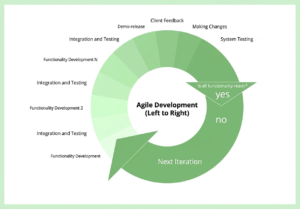
For example, the team has already designed the interface for a new online cinema, which includes a player, a preloaded movie catalog, selections based on user viewing history, and even facial recognition technology. When a new iteration begins, it becomes clear that users are missing the ability to recognize soundtracks directly within the player, as they don’t want to open Shazam while watching a movie. The team begins developing and implementing this feature in the next phase of development.
Agile’s principles are the complete opposite of another development approach—Waterfall. It structures product development according to a different logic:
- preparation of complete technical specifications;
- design;
- development;
- testing;
- final result.
Development processes in this methodology cannot be rolled back; the team returns to previous stages only if something is malfunctioning and not working according to the specifications. Because of this, problems with the product (app, website, software) are discovered relatively late—only during the testing phase—and the resulting product may completely fail to meet the client’s expectations or not function as intended.
Types of Agile Methodologies
Agile is a general term for several methodologies united by the idea of flexible work. This group includes various methods, such as:
- Scrum. This methodology works in iterations. All tasks necessary for completing a product are compiled into a special list—the backlog—and the customer plays a key role in determining the product’s type and functionality.
- Kanban. It emphasizes visualizing tasks on boards and streamlining workflows. Kanban teams strive to reduce project time and improve efficiency.
- Extreme Programming is based on practices such as pair programming, test-driven development, and continuous integration, which is the constant addition of new elements to the main project.
Agile principles
The Agile approach to development is based on several principles:
- People and interactions are more important than processes and tools. Therefore, the methodology is suitable for both small startups and large corporations. It doesn’t matter where communication and tasks are taking place—in a Telegram chat or a task manager—the key is that all participants understand the project’s goals and are aware of what’s happening at the current stage.
- A working product is more important than comprehensive documentation. This principle allows Agile development to begin faster—from the very first stages, instead of creating extensive technical specifications, prototypes are created and tested to validate hypotheses.
- Collaboration with the client is more important than negotiating contract terms. Agile development requires active client participation, so it’s not suitable for clients who aren’t prepared to delve into the work, dedicate sufficient time to the project, and experiment.
- Being open to change is more important than sticking to the original plan. This principle is the foundation of agile development. It’s impossible to plan everything perfectly in advance, and some brilliant ideas come as you work on a product. Agile allows you to focus on the tasks that matter most now and avoid wasting resources on thinking two or three steps ahead.
How an Agile team works
- product owner;
- project managers;
- UX designers;
- technical writers;
- developers (the type of developer depends on the project profile);
- testers.
Moreover, even a person in the product owner position is not formally a manager; they simply take responsibility for formulating product requirements: they convey to the rest of the team a vision of what the product should look like and what functionality it should have.
Cross-discipline collaboration is essential in Agile teams. Experts need more than just their own expertise; productive collaboration requires an understanding of how their colleagues work together. When designers understand how to calculate the developers’ workload, and developers understand the purpose of certain elements in a mockup without explanation, the team works more effectively.
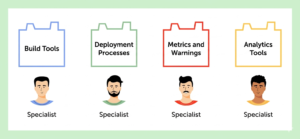
For example, at Netflix, work is organized using the Agile methodology. The streaming service’s vast workforce is divided into multiple teams, and each employee has their own area of responsibility, ensuring the quality of their work. Each team focuses on solving problems in its own subject area, but collaboration is encouraged when additional tools shared by multiple development teams are needed.
How to implement an Agile approach
When transitioning to a new model, companies may make mistakes:
- fail to provide training to employees;
- fail to take into account the specifics of development;
- fail to take into account the financial aspect of the company’s restructuring;
- Use only some of the methods that will not work on their own.
To implement Agile, you can gradually test the methodology on small groups. First, launch a first wave of Agile teams, and evaluate their performance based on financial metrics, efficiency, and reorganization investment. If all indicators show positive dynamics, the experiment can continue.
It’s important to remember that the reorganization will affect several parties, so training and preparation will need to be carried out not only with the team but also with clients. Some clients may not be ready for the level of involvement required by Agile.
Briefly about the main thing
- Agile is a group of methodologies for flexible project management in a development team.
- With this approach, the work process is broken down into small time periods, also called sprints or iterations.
- Scrum is a methodology in which all tasks necessary to complete a product are formed into a special list – a backlog.
- Kanban is a methodology that emphasizes visualizing tasks on boards and optimizing the workflow.
- Extreme Programming is based on practices such as pair programming, test-driven development, and continuous integration.
- The Agile approach to development is based on the principle that “People and interactions are more important than processes and tools.”
- Cross-discipline is important in Agile teams.
- To implement Agile, you can gradually test the methodology on small groups.
Explore More IT Terms
#
A
- A Guide to SQL Query Formatting
- A/B testing
- Agile
- Algorithm
- Algorithm complexity in 5 minutes
- Algorithms and Data Structures in C#
- An overview of the C # programming language
- An overview of the Python programming language
- Anaconda Python
- Android
- Android App Bundle
- Android SDK
- Angular
- Ansible
- Apache
- Apache Airflow
- Apache Kafka
- Apache Tomcat
- App Store
- AppCode
- Applications of microcontrollers: From simple circuits in electronics to complex systems
- Applications of the derivative
- Arduino: How to Program It: Basics for Beginners
- Array-based stack
- ArrayList
- ASCII
- ASP.NET
- Assembly Language Lessons
B
C
D
- Data Analytics: applications of data analysis in companies
- Data Engineer - Who is it, what does a data engineer do, and an overview of the profession
- Data modeling: what it is, types, and process steps.
- Data preprocessing: a complete guide for beginners and professionals.
- Data structure
- Database Tests with Answers
- Deep Learning
- Defining Aliases
- Defining Arrays
- Deque
- Developing a Website from Scratch
- Differential Equations
- Differentiation of functions
- Digital data: understand the importance of this asset for businesses.
- Double integrals
- Doubly linked lists
E
F
H
- Handling errors and exceptions
- Heads or Tails? How Probability Theory Is Used in IT
- History of the development of computer science
- How to effectively organize your workflow
- How to Learn Java: Tips for Beginner Developers
- How to Learn PHP: A Beginner's Guide
- How to Use S3 Storage in Kubernetes with CSI
- HTML
- HTML and CSS: Definition, Application, and Operating Principles
- HTML and CSS. Layout from Scratch: What to Learn, Where to Learn, and How Long Will It Take?
- HTML Frame Structure
- HTML Link Formatting
I
- if..else construction
- Infinite sequences and series
- Information properties
- Inheritance in Java: A Complete Guide to Principles and Implementation
- Inserting an Image
- Integration of functions
- Interactive Python Tutorial – Learn Programming from Scratch
- Interpreter
- Interview Problem: Finding a Deleted Element in O(N)
- Interview Scare: The FizzBuzz Challenge
- Introduction to C++
- Introduction to Machine Learning
- IT Specialist Resume (CV)
J
K
M
- Machine Learning
- Machine Learning Basic Tool: NumPy
- Machine Learning Basic Tool: Pandas
- Machine Learning Mathematics
- Mathematics for programmers: what is really needed?
- Microcontroller and Microprocessor - what's the difference?
- ML Engineer: Who They Are, What They Do, How Much They Earn, and How to Become a Neural Network Specialist
- Monte Carlo Simulation: How It Works and What It's For
O
P
- PHP lessons
- Private DNS server and its configuration
- Program code
- Programmer's Dictionary
- Programming
- Programming with pseudocode
- Python Code Formatting Guide: PEP8
- Python for data analysis: how to do it and main libraries
- Python Lessons
- Python Superstar: 5 Ways to Use the * Operator
- Python vs. Julia: Should You Replace Python with Julia?
R
S
- SFML Graphics Library Tutorials
- Sorting Algorithms in Programming: Types, Descriptions, and Comparisons
- SQL commands: see what they are, what the main ones are + examples
- SQL Interview Questions and Tasks
- SQL Lessons
- SQL Stored Procedures
- SQL Syntactic Sugar: The COALESCE Function
- Stack
- Start in analytics: Python or R
- Statistical analysis: importance for decision making.
- String formatting in Python
- Structure of computer science
- Swift Lessons
- switch/match construct
- Syntax
T
- Terms in programming
- Text and paragraph formatting tags
- The concept of information and its transmission
- The Future of Python: Key Trends and Insights from Global Researc
- The Infrastructure of Code: A Complete Guide to Repositories for Languages, Frameworks, and Compilers
- The pip package manager in Python
- The role of informatization in the development of society
- Transfers
- Tutorials / Articles
- TypeScript: What It Is and Why Developers Need It
W
- What are databases, and why do they need DBMS and SQL?
- What do Linux distributions consist of?
- What is .NET and what is it used for?
- What is a GPU in a computer, in simple terms?
- What is Arduino: How it Works and the Platform's Capabilities
- What is Big Data? Introduction, Types, Characteristics, and Examples
- What is Golang and what is it used for?
- What is Haskell and what is it used for?
- What is Kotlin and what is it used for?
- What is Linux? The History of Linux
- What is machine learning, and how does it work?
- What is Power BI: everything about the data analytics software
- What is the C++ programming language?
- What is the OSI Model: A Complete Explanation of the Seven Layers and Their Role in Networking
- What's the difference between x86 and ARM processors?
- Where to start learning the C programming language?
- Which Linux distribution should you choose? A Linux distribution overview