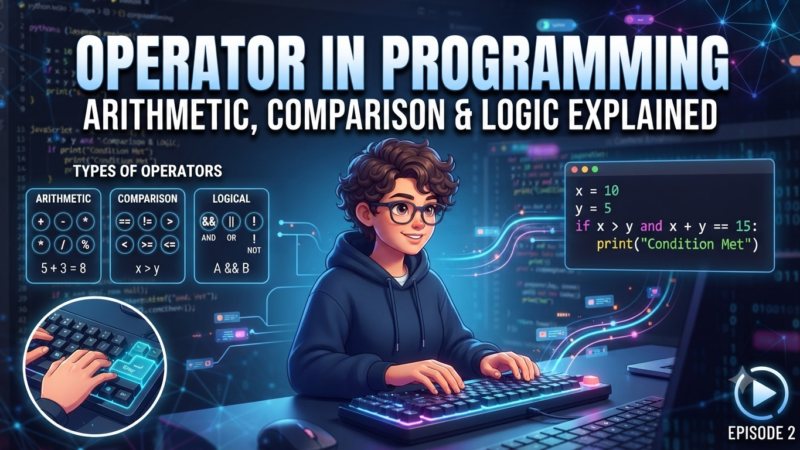
if..else construction
The if...else Construction is a fundamental control flow statement in programming. It allows your code to make decisions by executing specific blocks of code only when certain conditions are met.
At its simplest, it evaluates a condition as either True or False.
Basic Structure
The syntax varies slightly by language, but the logic remains the same:
if: Executes the code block if the condition is True.else: Provides an alternative path if theifcondition is False.
Conceptual Example (Pseudocode)
if (it is raining) {
    take an umbrella
} else {
    wear sunglasses
}
Expanding the Logic
When you have more than two possibilities, you use else if (or elif in languages like Python) to test multiple conditions in sequence.
| Statement | Purpose |
if | The initial condition to check. |
else if | Additional conditions to check if the previous ones were False. |
else | The “catch-all” block if no previous conditions were True. |
Implementation in Python
score = 85

if score >= 90:
    print("Grade: A")
elif score >= 80:
    print("Grade: B")
elif score >= 70:
    print("Grade: C")
else:
    print("Grade: F")
Best Practices
Order Matters: Conditions are evaluated from top to bottom. Once one condition is met, the program executes that block and skips the rest of the chain. Always place your most specific conditions at the top.
Keep it Readable: If you find yourself nesting
ifstatements too deeply (e.g., anifinside anifinside anif), consider using aswitchormatchstatement, or breaking your logic into smaller functions.Boolean Logic: You can combine multiple conditions using logical operators:
and: Both conditions must be True.or: At least one condition must be True.not: Reverses the boolean value.
Here are the following examples in the if..else construction for different programming languages
C
C++
Common Lisp
Dart
F#
Go
Java
JavaScript
Python
Rust
int n = 21;

if (n > 22)
{
    printf("n > 22 \n");
}
else if (n < 22)
{
    printf("n < 22 \n");
}
else
{
    printf("n == 22 \n");
}
C++
#include <iostream>

int main()
{
    int n {21};
    if (n > 22)
    {
        std::cout << "n > 22" << std::endl;
    }
    else if (n < 22)
    {
        std::cout << "n < 22" << std::endl;
    }
    else
    {
        std::cout << "n == 22" << std::endl;
    }

    // if-else with variable initialization
    int a {5};
    int b {3};
    if(int c {a - b}; a > b)
    {
        std::cout << "a + b = " << c << std::endl;
    }
    else
    {
        std::cout << "a - b = " << c << std::endl;
    }
}
C#
C#
int n = 21;

if(n > 22)
{
    Console.WriteLine("n > 22");
}
else if (n < 22)
{
    Console.WriteLine("n < 22");
}
else
{
    Console.WriteLine("n = 22");
}
Common Lisp
Lisp
(let ((n 21))
    (if (> n 22)
        (format t "n > 22")
        (if (< n 22)
            (format t "n < 22")
            (format t "n = 22"))))
If the if block must have several expressions, which are formatted using the progn operator:
Lisp
(let ((n 21))
    (if (< n 22)
        (progn
            (format t "n < 22~%")
            (format t "n != 22~%"))))
To test the truth of a condition, you can also use the when macro, which is similar to if..then:
Lisp
(let ((n 21))
    (when (< n 22)
        (format t "n < 22~%")
        (format t "n != 22~%")))
The unless macro is equivalent to an else expression and tests the opposite condition:
Lisp
(let ((n 22))
    (when (< n 22)
        (format t "n < 22~%")
        (format t "n != 22~%"))
    (unless (< n 22)
        (format t "n >= 22~%")))
Dart
Dart
void main() {
    int n = 21;
    if(n > 22){
        print("n > 22");
    }
    else if(n < 22){
        print("n < 22");
    }
    else{
        print("n = 22");
    }
}
F#
F#
let n = 21

if n > 22 then
    printfn "n > 22"
elif n < 22 then
    printfn "n < 22"
else
    printfn "n = 22"
Getting the result from if..then
F#
let a = 21
let b = 22
let res = if(a > b) then 1 elif(a < b) then -1 else 0
printfn "%d" res
Go
Go
package main
import "fmt"

func main() {
    n := 21

    if n > 22 {
        fmt.Println("n > 22")
    } else if n < 22{
        fmt.Println("n < 22")
    } else{
        fmt.Println("n == 22")
    }
}
Java
Java
class Program {
    public static void main(String[] args) {
        int n = 21;

        if(n > 22)
        {
            System.out.println("n > 22");
        }
        else if (n < 22)
        {
            System.out.println("n < 22");
        }
        else
        {
            System.out.println("n = 22");
        }
    }
}
JavaScript
JavaScript
let n = 21;

if(n > 22) {
    console.log("n > 22");
}
else if (n < 22){
    console.log("n < 22");
}
else{
    console.log("n == 22");
}
Kotlin
Kotlin
fun main() {
    val n = 21
    if(n > 22) {
        println("n > 22")
    }
    else if(n < 22){
        println("n < 22")
    }
    else{
        println("n = 22")
    }
}
Getting the result from if..else
Kotlin
fun main() {
    val a = 21
    val b = 22
    val res = if(a > b) 1 else if(a < b) -1 else 0
    println(res) // -1
}
Python
Python
n = 21
if n > 22:
    print("n > 22")
elif n < 22:
    print("n < 22")
else:
    print("n = 22")
Getting the result from if..else
Python
a = 21
b = 22
res = 1 if(a > b) else -1
print(res)
Rust
Rust
fn main(){
    let n = 21;
    if n > 22 {
        println!("n > 22")
    }
    else if n < 22 {
        println!("n < 22")
    }
    else{
        println!("n = 22")
    }
}
Getting the result from if..else
Rust
fn main(){
    let a = 21;
    let b = 22;
    let res = if a > b {1} else {-1};
    println!("{}", res);
}


NextExplore More IT Terms
#
- Using an integrating factor
- Equations in total differentials
- Bernoulli's equation
- Linear differential equations of the first order
- 10 Mixed C++ Challenges to Test Your Skills
- 50 Terms Every Programmer Should Know
- 7 Levels of Using the Zip Function in Python
- 7 Python Code Bugs You Need to Fix
- 70+ Free Resources for Learning Programming
A
- A Guide to SQL Query Formatting for Beginners
- A/B testing
- Abstract Data Type (ADT)
- AES Encryption Algorithm: How It Works and Where It's Used
- Agile
- Algorithm
- Algorithm Analysis
- Algorithm Complexity-Key Points
- Algorithm complexity: deep parsing O(log n)
- Algorithm vs. Program
- Algorithms and Data Structures in C#
- An overview of the C # programming language
- An overview of the Python programming language
- Anaconda Python
- Android
- Android App Bundle
- Android SDK
- Angular
- Ansible
- Apache
- Apache Airflow
- Apache Kafka
- Apache Tomcat
- App Store
- AppCode
- Applications of microcontrollers: From simple circuits in electronics to complex systems
- Applications of the derivative
- Arduino: How to Program It: Basics for Beginners
- Array-based stack
- ArrayList
- ASCII
- ASP.NET
- Assembly Language Lessons
B
C
D
- Data Analytics: applications of data analysis in companies
- Data Engineer - Who is it, what does a data engineer do, and an overview of the profession
- Data modeling: what it is, types, and process steps.
- Data preprocessing: a complete guide for beginners and professionals.
- Data structure
- Data Structures and Algorithms (DSA)
- Data types vs. Data structures
- Database Tests with Answers
- Deep Learning
- Defining Aliases
- Defining Arrays
- Deque
- Developing a Website from Scratch
- Differential Equations
- Differentiation of functions
- Digital data: understand the importance of this asset for businesses.
- Double integrals
- Doubly linked lists
- DSA Tutorial
E
F
G
H
- Handling errors and exceptions
- Heads or Tails? How Probability Theory Is Used in IT
- History of the development of computer science
- Homogeneous equations
- Homogeneous vs. non-homogeneous structures
- How to effectively organize your workflow
- How to Learn Java: Tips for Beginner Developers
- How to Learn PHP: A Beginner's Guide
- How to Use S3 Storage in Kubernetes with CSI
- HTML
- HTML and CSS: Definition, Application, and Operating Principles
- HTML and CSS. Layout from Scratch: What to Learn, Where to Learn, and How Long Will It Take?
- HTML Frame Structure
- HTML Link Formatting
I
- if..else construction
- Infinite sequences and series
- Information properties
- Inheritance in Java: A Complete Guide to Principles and Implementation
- Inserting an Image
- Integration of functions
- Interactive Python Tutorial – Learn Programming from Scratch
- Interpreter
- Interview Problem: Finding a Deleted Element in O(N)
- Interview Scare: The FizzBuzz Challenge
- Introduction to C++
- Introduction to Machine Learning
- Introduction to Networking | Network Fundamentals Part 1
- Introduction to Number Systems (Binary, Octal, Hexadecimal) | Math for CS Foundations #1
- IT Specialist Resume (CV)
J
K
L
M
- Machine Learning
- Machine Learning Basic Tool: NumPy
- Machine Learning Basic Tool: Pandas
- Machine Learning Mathematics
- Mathematics for programmers: what is really needed?
- MD5 encryption algorithm: What is it and why is it needed?
- Microcontroller and Microprocessor - what's the difference?
- ML Engineer: Who They Are, What They Do, How Much They Earn, and How to Become a Neural Network Specialist
- Monte Carlo Simulation: How It Works and What It's For
O
P
- PHP lessons
- Private DNS server and its configuration
- Program code
- Programmer's Dictionary
- Programming
- Programming with pseudocode
- Python Code Formatting Guide: PEP8
- Python for data analysis: how to do it and main libraries
- Python Lessons
- Python Superstar: 5 Ways to Use the * Operator
- Python vs. Julia: Should You Replace Python with Julia?
R
S
- SFML Graphics Library Tutorials
- Sorting Algorithms in Programming: Types, Descriptions, and Comparisons
- SQL commands: see what they are, what the main ones are + examples
- SQL Interview Questions and Tasks
- SQL Lessons
- SQL Stored Procedures
- SQL Syntactic Sugar: The COALESCE Function
- Stack
- Start in analytics: Python or R
- Static vs. dynamic data structures
- Statistical analysis: importance for decision making.
- String formatting in Python
- Structure of computer science
- Swift Lessons
- switch/match construct
- Syntax
T
- Terms in programming
- Text and paragraph formatting tags
- The concept of information and its transmission
- The Future of Python: Key Trends and Insights from Global Researc
- The Infrastructure of Code: A Complete Guide to Repositories for Languages, Frameworks, and Compilers
- The pip package manager in Python
- The role of informatization in the development of society
- Transfers
- Tutorials / Articles
- TypeScript: What It Is and Why Developers Need It
W
- What are databases, and why do they need DBMS and SQL?
- What do Linux distributions consist of?
- What is .NET and what is it used for?
- What is a data structure?
- What is a GPU in a computer, in simple terms?
- What is a quantum computer: 100,500 problems in one second
- What Is an Algorithm?
- What is Arduino: How it Works and the Platform's Capabilities
- What is Big Data? Introduction, Types, Characteristics, and Examples
- What is FizzBuzz Challenge?
- What is Golang and what is it used for?
- What is Haskell and what is it used for?
- What is Kotlin and what is it used for?
- What is Linux? The History of Linux
- What is machine learning, and how does it work?
- What is Power BI: everything about the data analytics software
- What is recursion, recursive and iterative process in programming?
- What is the C++ programming language?
- What is the OSI Model: A Complete Explanation of the Seven Layers and Their Role in Networking
- What's the difference between x86 and ARM processors?
- Where to start learning the C programming language?
- Which Linux distribution should you choose? A Linux distribution overview